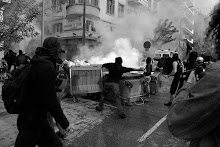
from Italian review “Insurrezione” – novembre 1977,
translated from 'Parafulmine e controfigure', ed. Anarchismo
If we undoubtedly claim the wealth of violent and armed expressions of the movement (generalised theft and expropriation as critique of waged work, radicalisation of clashes in the streets, sabotage, etc.), we are convinced, on the other hand, that the field of violence cannot in itself constitute a qualifying moment, a moment, in other words, that characterises the new revolutionaries as such. «The impatience to use weapons at all costs today in reality is delaying the moment in which the proletariat as a whole will have recourse to arms, because it anticipates repression. Those who congratulate themselves in the stupid use of arms are not the revolutionary movement, but the rearguard of its theoretical and strategic conscience». (Manifesto handed out in Bologna 23 settembre 1977, signed: Ass. For the Epidemic of Contagious Rage).
In our opinion, it is precisely social decomposition to push towards totalizing choices – armed struggle as a specialistic and separate dimension – which, by reducing the complexity of the clash to a feud between gangs, remains in a field that capital can always manage for its own benefit. If, concerning the BR [Brigate Rossi] for example, we cannot prevent ourselves from feeling a feeling of sympathy for the measure in which they sometimes manage to ridiculise and beat the State in its own field, we don’t forget that their neostalinist program is full of militaristic ideology and has nothing to do with the project of the proletarian revolution.
And on the basis of the failure of the movement of ‘68 it is possible to understand the present wave of terrorism. When, at the beginning of the 70s, the perspective of a total revolution seemed to be moving away, a few groups considered it possible to destroy the State in a military clash. The incapacity to understand how no armed volontarism or other can take the place of the pace of the real movement, led to to a curious ideology that puts together elements of a naive rebellious tendency and ultrabolshevist traits, in a horrible pot-pourri. In the beginning, the armed groups at least obtained the aim of showing up the vulnerability of the State, all the same the rapid rationalisation of the police apparatus immediately rendered the repression more effective and, soon, their practice trasformed itself into a personal war, autonomised by a real struggle. Moreover, the typical slogan “strike the heart of the State”, hides the real objective, capital, which the State is only the phenominal manifestation of. Actually, the armed groups have become an obstacle to the development of the movement that they (BR) criticise as spontaneist and adventurist (!). These criticisms recall the lamentations of the official left, which these people only constitute the radical wing of. Independently of intentions and the revolutionary ardour of single individuals, we grasp in this kind of armed struggle the seeds of recuperation. Not only and not so much in the sense of the police-like cannibalisation, but in the reduction, the repetition, absolutely functional to power, of the revolution to a simple military question. To that we are opposing real war, war that crosses the whole social totality and does not let itself simply be reduced to the armed clash. It is true that the groups of the autonomia do not identify with the BR, but it is just as true that their acritical pushing towards the militarisation of the movement presents the same problems.
The State is clearly trying to push a large number of people into clandestinity.That reaches the objective of reducing the movement to its military dimensions, where power can still win, at least in this phase. Groups such as the Brigate Rosse believe they have found confirmation of their strategy. And it is significant that the recent period characterised by growing confusion and a kind of return to traditional militarism has been marked by the most stupid terrorism (Casalegno and Acca Laurentia).
It is obvious that the clandestine groups are now playing on the ambiguity between crises and revolution; between neostalinist management and radical transformation in the communist.
Showing posts with label Italy. Show all posts
Showing posts with label Italy. Show all posts
Friday, 7 May 2010

Thursday, 6 May 2010
Some notes about the movement in Italy
In spite of their common boundaries, European countries are traditionally separate from each other and this separation and reciprocal lack of knowledge also applies to the revolutionary movement in struggle against individual States. The names that come to mind when one thinks of the Italy of years gone by tend to go no further than Lotta Continua, Prima Linea and the Red Brigades and, today, Autonomia and the Cobas.
In order to grasp what is happening now concerning a part of the Italian anarchist movement it is necessary to take a brief glimpse of the struggle in that country from the early seventies up until the present time.
Following the great insurrectional explosions of ’68, the next intensification of social struggle was to culminate in 1977 in the so-called ‘lead years’ folkloristically symbolised by the media through the P38. The Metropolitan Indians, mass demos and clashes with police, attacks on trade unionists, the looting of supermarkets, the spread of small acts of sabotage on various structures of exploitation were the order of the day. Hard demonstrations in the streets, tear gas and police bullets to disperse them. Comrades killed. Fights to the death between fascist youth and young communists.
Various extraparliamentarian organisations emerged during that period: Lotta continua, Potere Operaio, Potere Rosso in the communist milieu, and at a certain point clandestinity became the next step for many young comrades and was extended considerably as a result of intensive recruiting from within the organisations themselves. Not only the Red Brigades with their columns in many parts of the country, but numerous other communist tendencies went underground in the conviction that the time was ripe to attack the heart of the State, to overthrow a corrupt political and economic system and set themselves up in its place.
Such a discourse was naturally far from the intentions of the anarchists who, although present in the social struggles, attacks, sabotage, debate and various other initiatives, maintained a critique of the armed party in word and deed. Within the anarchist movement itself a heated debate was also taking place. This was centred around a critique of the ‘organisation of synthesis’ such as anarcho-syndicalism and the anarchist federation, and incorporated further debate concerning the use of revolutionary violence, i.e. the need to attack power in all its forms but using methods that were idoneous to the aims of anarchists, that is the destruction of power in all its forms through mass self-managed rebellion and insurrection leading to a social revolution that started deep within each individual, finally to become protagonists of their own life.
An attempt was made to form a libertarian clandestine structure, Azione Rivoluzionaria, and the latter carried out a considerable number of attacks (see Insurrection no 1). This also led to fierce debate within the anarchist movement: is it possible for such a structure to evolve the way anarchists want, or does it not simply turn out to be an ideological mystification of the usual closed specialist structure, albeit anti-stalinist in outlook?
Many meetings took place but the voice of anarchist critique often fell on deaf ears. Debates also proceeded on the pages of some of the publications of the time. The anarchist review Anarchismo in particular carried a progressively articulate methodolical critique and, drawing inspiration from the wide range of anonymous acts of sabotage all over the country, small actions which required not hierarchical specialisation but individual decision far from the heavy vindicative atmosphere of the stalinist ideology aimed at striking the heart of the State. In fact the social and economic set up was eveolving in such a way that now more than ever before was spreading over the whole country and no longer confined to the big industrial cities as it had been in the fifties and sixties. The question of number ‘let’s get a big organisation together then we’ll see’ came to be seen in another light, that of politics, far from the reality of revolutionary effectiveness.
Naturally this development was taking place parallel to developments in science and technology, now definitively being applied to all spheres of life.
Now we also saw a wide refusal of militarism, in particular military service at individual level. The anarchists were clear on this point. Against war, against militarism (no matter what colour) but not against arms in themselves which, although not of central importance in the way that they are for the armed parties (the armed wing of the proletariat), they are nevertheless also necessary for the attack on the exploiting enemy. Actions in this field go from total objection against military service, to desertion, to bomb attacks on army barracks, the desacration of military iconography, etc.
The years passed. The armed attack on the State in terms of centrality had come to an end and many of the 5,000 arrested in the early eighties began negotiating with the State in order to get out of a prospect of decades of prison meted out in multiple life sentences. Tactics went from outright delation (and it is here that the strategy of the pentiti, the ‘repentant terrorist’, took root. Captured militants underwent levels of torture which until then only proletarians had been submitted to as the norm and that, or fear of a prospect of long imprisonment (also a consequence of recruiting as opposed to mature choice in the class war), led to this breaking up of a situation which, had it remained solid, would have forced the State to find a solution itself, for its own reasons and because of relations with neighbouring States which were moving closer together in economic collaboration through a sanitisation of struggles of the past. 5,000 would have been too great a number to hide under the carpet. Instead, special prisons were built and special emergency laws were decreed. The prison reality gradually devolved from rebellion, mass escape attempts and rioting to the insertion in re-educative programmes of repentant ex-militants who had signed their definitice renunciation of armed struggle.
In order to grasp what is happening now concerning a part of the Italian anarchist movement it is necessary to take a brief glimpse of the struggle in that country from the early seventies up until the present time.
Following the great insurrectional explosions of ’68, the next intensification of social struggle was to culminate in 1977 in the so-called ‘lead years’ folkloristically symbolised by the media through the P38. The Metropolitan Indians, mass demos and clashes with police, attacks on trade unionists, the looting of supermarkets, the spread of small acts of sabotage on various structures of exploitation were the order of the day. Hard demonstrations in the streets, tear gas and police bullets to disperse them. Comrades killed. Fights to the death between fascist youth and young communists.
Various extraparliamentarian organisations emerged during that period: Lotta continua, Potere Operaio, Potere Rosso in the communist milieu, and at a certain point clandestinity became the next step for many young comrades and was extended considerably as a result of intensive recruiting from within the organisations themselves. Not only the Red Brigades with their columns in many parts of the country, but numerous other communist tendencies went underground in the conviction that the time was ripe to attack the heart of the State, to overthrow a corrupt political and economic system and set themselves up in its place.
Such a discourse was naturally far from the intentions of the anarchists who, although present in the social struggles, attacks, sabotage, debate and various other initiatives, maintained a critique of the armed party in word and deed. Within the anarchist movement itself a heated debate was also taking place. This was centred around a critique of the ‘organisation of synthesis’ such as anarcho-syndicalism and the anarchist federation, and incorporated further debate concerning the use of revolutionary violence, i.e. the need to attack power in all its forms but using methods that were idoneous to the aims of anarchists, that is the destruction of power in all its forms through mass self-managed rebellion and insurrection leading to a social revolution that started deep within each individual, finally to become protagonists of their own life.
An attempt was made to form a libertarian clandestine structure, Azione Rivoluzionaria, and the latter carried out a considerable number of attacks (see Insurrection no 1). This also led to fierce debate within the anarchist movement: is it possible for such a structure to evolve the way anarchists want, or does it not simply turn out to be an ideological mystification of the usual closed specialist structure, albeit anti-stalinist in outlook?
Many meetings took place but the voice of anarchist critique often fell on deaf ears. Debates also proceeded on the pages of some of the publications of the time. The anarchist review Anarchismo in particular carried a progressively articulate methodolical critique and, drawing inspiration from the wide range of anonymous acts of sabotage all over the country, small actions which required not hierarchical specialisation but individual decision far from the heavy vindicative atmosphere of the stalinist ideology aimed at striking the heart of the State. In fact the social and economic set up was eveolving in such a way that now more than ever before was spreading over the whole country and no longer confined to the big industrial cities as it had been in the fifties and sixties. The question of number ‘let’s get a big organisation together then we’ll see’ came to be seen in another light, that of politics, far from the reality of revolutionary effectiveness.
Naturally this development was taking place parallel to developments in science and technology, now definitively being applied to all spheres of life.
Now we also saw a wide refusal of militarism, in particular military service at individual level. The anarchists were clear on this point. Against war, against militarism (no matter what colour) but not against arms in themselves which, although not of central importance in the way that they are for the armed parties (the armed wing of the proletariat), they are nevertheless also necessary for the attack on the exploiting enemy. Actions in this field go from total objection against military service, to desertion, to bomb attacks on army barracks, the desacration of military iconography, etc.
The years passed. The armed attack on the State in terms of centrality had come to an end and many of the 5,000 arrested in the early eighties began negotiating with the State in order to get out of a prospect of decades of prison meted out in multiple life sentences. Tactics went from outright delation (and it is here that the strategy of the pentiti, the ‘repentant terrorist’, took root. Captured militants underwent levels of torture which until then only proletarians had been submitted to as the norm and that, or fear of a prospect of long imprisonment (also a consequence of recruiting as opposed to mature choice in the class war), led to this breaking up of a situation which, had it remained solid, would have forced the State to find a solution itself, for its own reasons and because of relations with neighbouring States which were moving closer together in economic collaboration through a sanitisation of struggles of the past. 5,000 would have been too great a number to hide under the carpet. Instead, special prisons were built and special emergency laws were decreed. The prison reality gradually devolved from rebellion, mass escape attempts and rioting to the insertion in re-educative programmes of repentant ex-militants who had signed their definitice renunciation of armed struggle.
Some actions against Benetton in Italy '98-2004
BENETTON, THE UNITED COLOURS OF EXPLOITATION
Behind a false appearance of multiethnic solidarity, Benetton, the biggest landowner of Argentina, takes water, land and freedom away from the native Mapuche people. In 19991 the big Venetian company bought 900,000 hectares of territory in Patagonia, Mapuche’s land, which the Argentine government sold for next to nothing. The Mapuche people were confined in a strip of land called ‘reserve of the Benetton company’ where they live in conditions of poverty and overcrowding. Most of them are compelled to work for the company in order to survive and get very low wages. Benetton exploit the Mapuches land for grazing about a million sheep, which produce tons and tons of wool for their company. Any attempt to revolt against the Benetton invasion has always been violently suppressed by the Argentinian police which works in accordance with Mr Benetton. In recent times a Mapuche family who had taken back their piece of land in Chubut (Patagonia, Argentina) were evicted by 12 policemen and had their poor house completely destroyed. Curinanco family was told by the police commisioner Perez that no one can contrast Benetton because they have more money than anyone. Other Mapuche communities, namely the ones living in Vuelta del Rio and Corcovado, are about to be thrown off their land as Benetton has taken possession of it. The struggle of the Mapuche people against the colonists of their land started a long time ago, when the Argentinian State gave its first concessions (oil, minerals and forest) to various companies inside the Mapuche territory. In the 90s, the Mapuche tried to take a great deal of estate back, but each time they were evicted. The didn;’t stop the many actions carried by the Mapuche against any company involved in the realisation of devastating plans such as the building of dams or the destruction of forests. In November 1998, for example, the Mapuche of Cuyinco attacked some vans of the big forest company Bosque Arauco, which was engaged in destroying the forest. They also attacked a group of journalists who were filming the actions and fought against the company’s security service. In January 1999, Mapuche organised a big demonstration against the building of Ralco hydro electric dam and were violently attacked by the army. In March 1999, the Mapuche rebelled against the creation of a tourist area in Lleu Lleu river region and set fire to a building. Five of them were arrested and 2 started a hunger strike in prison. In April 1999 the Mapuche set fire to a digger of the woodcutting company Miminco in Traiguen and in June they destroyed a bulldozer and a few vans of the same company in Bio Bio.
ACTIONS AGAINST THE BENETTON
May 1998 – Athens (Greece) A Benetton shop is destroyed by fire.
10 March 1999 – Trieste, Italy. The clothes of the Benetton shop in piazza della Borsa are dirtied with a stinking liquid. 15,000 euroes’ damage. A few days later the window of via Imbriani Benetton shop is dirtied with red paint.
October 1999 – Xixon (Spain) The local Benetton factory is attacked in solidarity with a few anarchists imprisoned for an attempted robbery.
March 2000 – Pisa, Italy. A Benetton shop is attacked and five windows are broken.
2001
19 January – La Spezia, Italy. Some eggs full of tar are thrown against the windows of a Benetton shop.
26 March – Florence, Italy. The windows of 3 Benetton shops are broken. The action is claimed by this communique:
Strike the capital and its tentacles every day. Behind Benetton’s joyful appearance some awful hides itself: child labour, prisoner’s work, Mapuche’s land stolen. Marici weu: we’ll win 10 times!
29 March – Milan, Italy. The windows of 3 Benetton shops are broken with steel balls. This is the communique that claimed the action: Benetton exploits prisnoers’ work. Benetton also took Mapuche’s land in Patagonia away from its inhabitants. Strike Benetton, the multinationals and the State. Marici weu!’
4 April – Rome, Italy. The windows of 2 Benetton shops are destroyed with hammer blows. The claim: We are with all the people who fight and rebel, we are with the Mapuche people, the struggle against Benetton is also ours.’
18 July – Ponzano, Veneto, Italy. A postal packet explodes inside Benetton head offices.
2002
8 February – Prato, Italy – 5 windows of a Benetton shop are broken. That night a telecom call centre (in which Benetton is a major investor) is set on fire. The claim: Fire to Telecom for the Argentine rebels.
19 December – Trento, Italy – A few balls full of paint are thrown into 2 shops. The damage is 15,000 euros. Two comrades are accused.
19 December – Lecce, Italy. Police attack a demonstration against Benetton. One cop is injured.
2003
A great many actions against Benetton, including demonstrations and distribution of leaflets, are carried all over Italy.
2004
5-11 January A new campaign against Benetton is organised in Italy.
Behind a false appearance of multiethnic solidarity, Benetton, the biggest landowner of Argentina, takes water, land and freedom away from the native Mapuche people. In 19991 the big Venetian company bought 900,000 hectares of territory in Patagonia, Mapuche’s land, which the Argentine government sold for next to nothing. The Mapuche people were confined in a strip of land called ‘reserve of the Benetton company’ where they live in conditions of poverty and overcrowding. Most of them are compelled to work for the company in order to survive and get very low wages. Benetton exploit the Mapuches land for grazing about a million sheep, which produce tons and tons of wool for their company. Any attempt to revolt against the Benetton invasion has always been violently suppressed by the Argentinian police which works in accordance with Mr Benetton. In recent times a Mapuche family who had taken back their piece of land in Chubut (Patagonia, Argentina) were evicted by 12 policemen and had their poor house completely destroyed. Curinanco family was told by the police commisioner Perez that no one can contrast Benetton because they have more money than anyone. Other Mapuche communities, namely the ones living in Vuelta del Rio and Corcovado, are about to be thrown off their land as Benetton has taken possession of it. The struggle of the Mapuche people against the colonists of their land started a long time ago, when the Argentinian State gave its first concessions (oil, minerals and forest) to various companies inside the Mapuche territory. In the 90s, the Mapuche tried to take a great deal of estate back, but each time they were evicted. The didn;’t stop the many actions carried by the Mapuche against any company involved in the realisation of devastating plans such as the building of dams or the destruction of forests. In November 1998, for example, the Mapuche of Cuyinco attacked some vans of the big forest company Bosque Arauco, which was engaged in destroying the forest. They also attacked a group of journalists who were filming the actions and fought against the company’s security service. In January 1999, Mapuche organised a big demonstration against the building of Ralco hydro electric dam and were violently attacked by the army. In March 1999, the Mapuche rebelled against the creation of a tourist area in Lleu Lleu river region and set fire to a building. Five of them were arrested and 2 started a hunger strike in prison. In April 1999 the Mapuche set fire to a digger of the woodcutting company Miminco in Traiguen and in June they destroyed a bulldozer and a few vans of the same company in Bio Bio.
ACTIONS AGAINST THE BENETTON
May 1998 – Athens (Greece) A Benetton shop is destroyed by fire.
10 March 1999 – Trieste, Italy. The clothes of the Benetton shop in piazza della Borsa are dirtied with a stinking liquid. 15,000 euroes’ damage. A few days later the window of via Imbriani Benetton shop is dirtied with red paint.
October 1999 – Xixon (Spain) The local Benetton factory is attacked in solidarity with a few anarchists imprisoned for an attempted robbery.
March 2000 – Pisa, Italy. A Benetton shop is attacked and five windows are broken.
2001
19 January – La Spezia, Italy. Some eggs full of tar are thrown against the windows of a Benetton shop.
26 March – Florence, Italy. The windows of 3 Benetton shops are broken. The action is claimed by this communique:
Strike the capital and its tentacles every day. Behind Benetton’s joyful appearance some awful hides itself: child labour, prisoner’s work, Mapuche’s land stolen. Marici weu: we’ll win 10 times!
29 March – Milan, Italy. The windows of 3 Benetton shops are broken with steel balls. This is the communique that claimed the action: Benetton exploits prisnoers’ work. Benetton also took Mapuche’s land in Patagonia away from its inhabitants. Strike Benetton, the multinationals and the State. Marici weu!’
4 April – Rome, Italy. The windows of 2 Benetton shops are destroyed with hammer blows. The claim: We are with all the people who fight and rebel, we are with the Mapuche people, the struggle against Benetton is also ours.’
18 July – Ponzano, Veneto, Italy. A postal packet explodes inside Benetton head offices.
2002
8 February – Prato, Italy – 5 windows of a Benetton shop are broken. That night a telecom call centre (in which Benetton is a major investor) is set on fire. The claim: Fire to Telecom for the Argentine rebels.
19 December – Trento, Italy – A few balls full of paint are thrown into 2 shops. The damage is 15,000 euros. Two comrades are accused.
19 December – Lecce, Italy. Police attack a demonstration against Benetton. One cop is injured.
2003
A great many actions against Benetton, including demonstrations and distribution of leaflets, are carried all over Italy.
2004
5-11 January A new campaign against Benetton is organised in Italy.
Leaflet against the Olympics 2006
Distributed this evening during the opening ceremony of ‘Atrium’ the celebretive structure of the next winter Olympic Games in Turin 2006.
ATRIUM – THE EMPTYNESS BEYOND EXPLOITATION When the emperors must get their subjects to swallow something disastrous, they organise majestic games. That is what is happening now: our governors, right and left together (divided only by the division of the funding), are trying to pass off the Olympics of 2006 (like the High Speed train and the metro) as a beautiful and good occasion for us subjects. It’s not like that, of course, and so they are trying to blind us with lights and ribbons, dwarfs and ballet dancers, splendid constructions behind which there is nothing but speculation. Devastation, cement, expropriation, waste, social control. Panem et circenses. Two weeks of olympic games cannot justify the ruin that is happening both in the valleys (where at the next flood there will cry scandal for the latest concreting that facilitates ‘natural tragedies’)and here in the city. They have built this Atrium, millionaire eyesore right in the city centre. A punch in the eye in an historic centre already devoid of all inhabitants without high incomes but full of banks, cameras, barracks and offices. The last two editions of the winter Olympics were nothing but occasions for doping,gigantic combines and corruption, culminating in mass arrests. Our candidature is, thanks to the intervention of the Agnelli family,good for leaving the city in tatters after taking millions from the State. Build pharaonic works everywhere to blind people, which like all the imperial works that we pay for will end up badly: see Italy ’61, Experimenta, the Alpine stadium of Italy ’90, the Valsusa motorway.
ATRIUM – THE EMPTYNESS BEYOND EXPLOITATION When the emperors must get their subjects to swallow something disastrous, they organise majestic games. That is what is happening now: our governors, right and left together (divided only by the division of the funding), are trying to pass off the Olympics of 2006 (like the High Speed train and the metro) as a beautiful and good occasion for us subjects. It’s not like that, of course, and so they are trying to blind us with lights and ribbons, dwarfs and ballet dancers, splendid constructions behind which there is nothing but speculation. Devastation, cement, expropriation, waste, social control. Panem et circenses. Two weeks of olympic games cannot justify the ruin that is happening both in the valleys (where at the next flood there will cry scandal for the latest concreting that facilitates ‘natural tragedies’)and here in the city. They have built this Atrium, millionaire eyesore right in the city centre. A punch in the eye in an historic centre already devoid of all inhabitants without high incomes but full of banks, cameras, barracks and offices. The last two editions of the winter Olympics were nothing but occasions for doping,gigantic combines and corruption, culminating in mass arrests. Our candidature is, thanks to the intervention of the Agnelli family,good for leaving the city in tatters after taking millions from the State. Build pharaonic works everywhere to blind people, which like all the imperial works that we pay for will end up badly: see Italy ’61, Experimenta, the Alpine stadium of Italy ’90, the Valsusa motorway.
Wednesday, 5 May 2010
OLYMPIC DEVASTATION
Olympics games, the most popular sport event in the world, are actually an occasion for exploitation and environmental disasters. Even the most enthusiastic fans can't deny this reality. Intended as symbol of peace between the various countries, the Olympics are far from being the triumph of genuine sporting spirit. In fact, they are an offence to those who still believe in the possibility of a world united by a sporting brotherhood as they represent the other face of war and slavery characterising the present times.
In 2004 the Olympics were hosted in Athens, Greece, where, as always occurs when their time approaches, a huge deployment of cops and soldiers patrolling the town put on a show of war scenery. Thousands of cameras were installed to spy on every corner of the Greek capital, whereas a great number of immigrant workers died while working under brutal conditions of exploitation in order to build the structures needed for the games. This has obviously nothing to do with peace and brotherhood.
The authority justified the militarization of the territory with the necessity of defending the country from the menace of terrorist attacks, but what they really feared was the so called `internal' enemy, that is to say anarchists and the many people who, well aware of what the Olympics really are, opposed the celebration of the event boasted by the media and carried out a series of attacks against the Olympic circus. Not by chance, the majority of people rebelled against the installation of cameras and, once the Olympics were over, destroyed all of them. The government has been so far unable to replace any camera in the city.
As everybody knows, London -will host the games in 2012 and it is not so difficult to imagine how control, exploitation, and devastation will reach proportions never seen before.
What is happening in North Italy these days, where the winter games are taking place, can give an idea of this. Thousands of police and soldiers are patrolling the streets and Nato surveillance crafts are flying over the town of Turin. Billions of euros have been spent to build gigantic infrastructures that will have a devastating impact on the environment. And, again, immigrants working without safety measures have been exploited in the name of the `sport brotherhood' in exchange for starvation wages.
But this time, even following the high speed rail link project that the Italian government plans to realise against the will of the local population, things are getting a different perspective. Since the Olympic flame arrived in Italy from Athens in December 2005, it has become the target of protest by angry people who have attempted to block its path, sometimes successfully, as it happened in Trento, Cremona, and Genoa. The attacks on the flame, which ended up in it being extinguished on a couple of occasions, have been carried out mostly by anarchists, but the popular protest against the Olympics is largely widespread. Not only do many people oppose the commercialisation of the games (the entrance fee to attend the event is 800 euros) and the presence of sponsors such as Coca-Cola and other multinationals, but the people of Val di Susa, one of the most beautiful and unspoiled parts of Italy, fear that police and soldiers who have come to protect the Olympics will stay on after the games are over in order to halt the opposition against the high speed rail link project.
As some comrades from Rovereto have pointed out, the winter Olympics games in are not just mere spectacle, they are obviously a police experiment involving the deployment of more than 10,000 policemen and the introduction of further security measures by home secretary Pisanu. Anarchists in Italy refuse the distinction between bad sponsors one the one hand (Coca-Cola and Finmeccanica first of all, the latter being one of the biggest producers of war weapons in the world) and good Olympic spirit on the other. They claim, and we are with them, that the Olympics must be opposed as a whole because what makes them possible are evictions, repression, environmental devastation, unacceptable waste of the so-called public resources, exploitation of `illegal' workers, militarization of Turin and its valleys, etc.
The conclusion to be drawn, as suggested by Brixton anarchists when the flame passed through London to celebrate the elected capital of the next Olympics, is just one: EXTINGUISH THE OLYMPIC FLAME OF DEATH, FIRE THE FLAMES OF REVOLT!
In 2004 the Olympics were hosted in Athens, Greece, where, as always occurs when their time approaches, a huge deployment of cops and soldiers patrolling the town put on a show of war scenery. Thousands of cameras were installed to spy on every corner of the Greek capital, whereas a great number of immigrant workers died while working under brutal conditions of exploitation in order to build the structures needed for the games. This has obviously nothing to do with peace and brotherhood.
The authority justified the militarization of the territory with the necessity of defending the country from the menace of terrorist attacks, but what they really feared was the so called `internal' enemy, that is to say anarchists and the many people who, well aware of what the Olympics really are, opposed the celebration of the event boasted by the media and carried out a series of attacks against the Olympic circus. Not by chance, the majority of people rebelled against the installation of cameras and, once the Olympics were over, destroyed all of them. The government has been so far unable to replace any camera in the city.
As everybody knows, London -will host the games in 2012 and it is not so difficult to imagine how control, exploitation, and devastation will reach proportions never seen before.
What is happening in North Italy these days, where the winter games are taking place, can give an idea of this. Thousands of police and soldiers are patrolling the streets and Nato surveillance crafts are flying over the town of Turin. Billions of euros have been spent to build gigantic infrastructures that will have a devastating impact on the environment. And, again, immigrants working without safety measures have been exploited in the name of the `sport brotherhood' in exchange for starvation wages.
But this time, even following the high speed rail link project that the Italian government plans to realise against the will of the local population, things are getting a different perspective. Since the Olympic flame arrived in Italy from Athens in December 2005, it has become the target of protest by angry people who have attempted to block its path, sometimes successfully, as it happened in Trento, Cremona, and Genoa. The attacks on the flame, which ended up in it being extinguished on a couple of occasions, have been carried out mostly by anarchists, but the popular protest against the Olympics is largely widespread. Not only do many people oppose the commercialisation of the games (the entrance fee to attend the event is 800 euros) and the presence of sponsors such as Coca-Cola and other multinationals, but the people of Val di Susa, one of the most beautiful and unspoiled parts of Italy, fear that police and soldiers who have come to protect the Olympics will stay on after the games are over in order to halt the opposition against the high speed rail link project.
As some comrades from Rovereto have pointed out, the winter Olympics games in are not just mere spectacle, they are obviously a police experiment involving the deployment of more than 10,000 policemen and the introduction of further security measures by home secretary Pisanu. Anarchists in Italy refuse the distinction between bad sponsors one the one hand (Coca-Cola and Finmeccanica first of all, the latter being one of the biggest producers of war weapons in the world) and good Olympic spirit on the other. They claim, and we are with them, that the Olympics must be opposed as a whole because what makes them possible are evictions, repression, environmental devastation, unacceptable waste of the so-called public resources, exploitation of `illegal' workers, militarization of Turin and its valleys, etc.
The conclusion to be drawn, as suggested by Brixton anarchists when the flame passed through London to celebrate the elected capital of the next Olympics, is just one: EXTINGUISH THE OLYMPIC FLAME OF DEATH, FIRE THE FLAMES OF REVOLT!
Subscribe to:
Posts (Atom)