Showing posts with label anarchists. Show all posts

Friday, 18 March 2011

Freedom

by Albert Libertad

Many think that it is a simple dispute over words that makes some declare themselves libertarians and others anarchist. I have an entirely different opinion.

I am an anarchist and I hold to the label not for the sake of a vain garnishing of words, but because it means a philosophy, a different method than that of the libertarian.

The libertarian, as the word indicates, is an adorer of liberty. For him, it is the beginning and end of all things. To become a cult of liberty, to write its name on all the walls, to erect statues illuminating the world, to talk about it in season and out, to declare oneself free of hereditary determinism when its atavistic and encompassing movements make you a slave...this is the achievement of the libertarian.

The anarchist, referring simply to etymology, is against authority. That’s exact. He doesn’t make liberty the causality but rather the finality of the evolution of his Self. He doesn’t say, even when it concerns merest of his acts. "I am free." but "I want to be free". For him, freedom is not an entity, a quality, something that one has or doesn’t have, but is a result that he obtains to the degree that he obtains power.

He doesn’t make freedom into a right that existed before him, before human beings but a science that he acquires, that humans acquire, day after day, to free themselves of ignorance, abolishing the shackles of tyranny and property.

Man is not free to act or not to act, by his will alone. He learns to do or not to do when he has exercised his judgement, enlightened his ignorance, or destroyed the obstacles that stand in his way. So if we take the position of a libertarian, without musical knowledge in the front of his piano, is he free to play? NO! He won’t have this freedom until he has learned music and to play the instrument. This is what the anarchists say. He also struggles against the authority that prevents him from developing his musical aptitudes-when he has them-or he who withholds the pianos. To have the freedom to play, he has to have the power to know and the power to have a piano at his disposition. Freedom is a force that one must know how to develop within the individual; no one can grant it.

When the Republic takes its famous slogan: "Liberte, Egalite, Fraternite." does it make us free, equal or brothers? She tells us "You are free" these are vain words since we do not have the power to be free. And why don’t we have this power? Principally because we do not know how to acquire the proper knowledge. We take the mirage for reality.

We always await the freedom of a State, of a Redeemer, of a Revolution, we never work to develop it within each individual. What is the magic wand that transforms the current generation born of centuries of servitude and resignation into a generation of human beings deserving of freedom, because they are strong enough to conquer it?

This transformation will come from the awareness that men will have of not having freedom of consciousness, that freedom is not in them, that they don’t have the right to be free, that they are not all born free and equal...and that it is nevertheless impossible to have happiness without freedom. The day that they have this consciousness they will stop at nothing to obtain freedom. This is why anarchists struggle with such strength against the libertarian current that makes one take the shadow for substance.

To obtain this power, it is necessary for us to struggle against two currents that threaten the conquest of our liberty: it is necessary to defend it against others and against oneself, against external and internal forces.

To go towards freedom, it becomes necessary to develop our individuality-When I say: to go towards freedom, I mean for each of us to go toward the most complete development of our Self-. We are not therefore free to take any which road, it is necessary to force ourselves to take the correct path. We are not free to yield to excessive and lawless desires, we are obliged to satisfy them. We are not free to put ourselves in a state of inebriation making our personality lose the use of its will, placing us at the mercy of anything; let’s say rather that we endure the tyranny of a passion that misery of luxury has given us. True freedom would consist of an act of authority upon this habit, to liberate oneself from its tyranny and its corollaries.

I said, an act of authority, because I don’t have the passion of liberty considered a priori. I am not a libertarian. If I want to acquire liberty, I don’t adore it. I don’t amuse myself refusing the act of authority that will make me overcome the adversary that attacks me, nor do I refuse the act of authority that will make me attack the adversary. I know that every act of force is an act of authority. I would like to never have to use force, authority against other men, but I live in the 20th century and I am not free of from the direction of my movements to acquire liberty.

So, I consider the Revolution as an act of authority of some against others, individual revolt as an act of authority of some against others. And therefore I find these means logical, but I want to exactly determine the intention. I find them logical and I am ready to cooperate, if these acts of temporary authority have the removing of a stable authority and giving more freedom as their goal; I find them illogical and I thwart them if their goal isn’t removing an authority. By these acts, authority gains power: she hasn’t done anything but change name, even that which one has chosen for the occasion of its modification.

Libertarians make a dogma of liberty; anarchists make it an end. Libertarians think that man is born free and that society makes him a slave. Anarchists realize that man is born into the most complete of subordinations, the greatest of servitudes and that civilization leads him to the path of liberty.

That which the anarchists reproach is the association of men-society-which is obstructing the road after having guided our first steps. Society delivers hunger, malignant fever, ferocious beasts -evidently not in all cases, but generally- but she makes humanity prey to misery, overwork, and governments. She puts humanity between a rock and a hard place. She makes the child forget the authority of nature to place him under the authority of men.

The anarchist intervenes. He does not ask for liberty as a good that one has taken from him, but as a good that one prevents him from acquiring. He observes the present society and he declares that it is a bad instrument, a bad way to call individuals to their complete development.

The anarchist sees society surround men with a lattice of laws, a net of rules, and an atmosphere of morality and prejudices without doing anything to bring them out of the night of ignorance. He doesn’t have the libertarian religion, liberal one could say but more and more he wants liberty for himself like he wants pure air for his lungs. He decides then to work by all means to tear apart the threads of the lattice, the stitches of the net and endeavors to open up free thought.

The anarchist’s desire is to be able to exercise his faculties with the greatest possible intensity. the more he improves himself, the more experience he takes in, the more he destroys obstacles, as much intellectual and moral as material, the more he takes an open field, the more he allows his individuality to expand, the more he becomes free to evolve and the more he proceeds towards the realization of his desire.

But I won't allow myself to get carried away and I’ll return more precisely to the subject.

The libertarian who doesn’t have the power to carry through an explanation, a critique which he recognizes as well founded or that he doesn’t even want to discuss, he responds "I am free to act like this." The anarchist says: " I think that I am right to act like this but come on." And if the critique made is about a passion which he doesn’t have the strength to free himself from, he will add: " I am under the slavery of this atavism and this habit." This simple declaration won’t be without cost. It will carry its own force, maybe for the individual attacked, but surely for the individual that made it, and for those who are less attacked by the passion in question.

The anarchist is not mistaken about the domain gained. He does not say "I am free to marry my daughter if that pleases me- I have the right to wear a high style hat if it suits me" because he knows that this liberty, this right are a tribute paid to the morality of the milieu, to the conventions of the world; they are imposed by the outside against all desires, against all internal determinism of the individual.

The anarchist acts thus not due to modesty, or the spirit of contradiction, but because he holds a conception which is completely different from that of the libertarian. He doesn’t believe in innate liberty, but in liberty that is acquired. And because he knows that he doesn’t possess all liberties, he has a greater will to acquire the power of liberty.

Words do not have a power in themselves. They have a meaning that one must know well, to state precisely in order to allow oneself to be taken by their magic. The great Revolution has made a fool of us with its slogan: "Liberte, Egalite, Fraternite" the liberals have sung us above all the tune of their "laisser-faire" with the refrain of the freedom of work; Libertarians delude themselves with a belief in a pre-established liberty and they make critiques in its honor...Anarchists should not want the word but the thing. They are against authority, government, economic religious and moral power, knowing the more authority is diminished the more liberty is increased.

It is a relation between the power of the group and the power of the individual. The more the first term of this relation is diminished, the more authority is diminished, the more liberty is increased.

What does the anarchist want? To reach a state in which these two powers are balanced, where the individual has real freedom of movement without ever hindering the liberty of movement of another. The anarchist does not want to reverse the relation so that his freedom is made of the slavery of others, because he knows that authority is bad in itself, as much for he who submits to it as for he who gives it.

To truly know freedom, one must develop the human being until one makes sure that no authority has the possibility of existing.

first published in English in Killing King Abacus Number One

Friday, 7 May 2010

A glimpse into the elsewhere

recounted by an
anarchist who ventured there for
a moment in December 2008

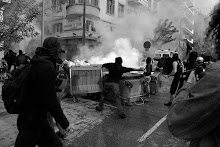
From the moment that 14 year old Alexi Grigoropoulos was gunned down by a patrolling policeman on December 6 2008, the morphology of Greece’s capital city and many others, both on the mainland and in many of the islands, changed. The force of the people’s anger against the State and its paid killers expressed itself with limpid clarity: Athens, a European metropolis, had no cop station left untouched, no bank left functioning. Huge stores, banks and public buildings were gutted by fire and hundreds of luxury cars and car showrooms went up in flames, as the streets were blocked off with flaming barricades and hundreds of police in riot gear were forced to run away from the rebels.
It is impossible to render what happened over there in words, because what took place was a social rebellion, where the outward face of capitalist society came under assault by massive numbers of disparate people, acting as one.
Anarchist comrades who had been in the thick of the rebellion around the Polytechnic in Athens were visibly overwhelmed. Stunned by the events, their eyes shining with passion and wonder, they were the first to admit that they had lived moments that they had never imagined even in their wildest dreams, and which had completely surpassed them.
Many words have been written about these days, beautiful words, reproduced and diffused in many languages. But it seemed that something was missing...
This candid account by one anarchist who suddenly found himself acting in a completely different terrain to that which he was familiar with, and the fears and questions that this awakened in him, is a valuable testimony that opens up many questions for all anarchists.

***
The evening of December 6 2008 I was at home preparing for one of my usual Saturday nights. Then a friend called me on the phone telling me that something very bad had happened, cops in Exarchia had killed somebody. I made some phone calls, some of my friends didn’t know and some had already heard. Like them, we immediately went to the Polytechnic school. It took a little time before clashes began around it. After some hours some of my comrades and I decided to carry out an attack on a police station in the centre of Athens. It was important for us to do this at that time. We made an appointment in a busy area of Athens where we could be hidden inside the crowd after the attack. As a friend and I were walking towards the place of the appointment we encountered a spontaneous demo of a few hundred leftist people who are not normally seen clashing with the police, ready to attack. The head of the demo stopped to ask us what was going on at the Polytechnic because they wanted to go there. We told them that it might be difficult as there were some police units around, then left, each in their own direction. I was struck by the look in their eyes, something very strange for them, because I know them well. It was anger and a readiness to clash with the police, not just anger but the urgency to clash with the police. These guys are people that usually fight with the anarchists on the issue of clashing or not clashing with the police, always in favour of the latter. The look on their faces was in contradiction with their whole appearance as Greek leftist students with their carefully trimmed beards and spectacles.
We went to the appointment. We were about 100 people, which is not the usual number for a group that wants to attack a police station. It would normally be 12 to 20. We attacked the police station with molotovs and stones. We didn’t do all that much real damage as it was a spontaneous action and not well planned. We continued by smashing and burning luxury shops and chain stores before returning to the crowded area we started off from.
I went back to the Polytechnic school where clashes with police were continuing and someone called me from the law school telling me that there were also clashes there. The leftists we had met before had obviously ended up there. I remember that when I was on the road from to the Polytechnic, despite the fact that there were clashes around, we didn’t feel the sense of fear and anxiety one normally has in such situations.
At the school of law there were also clashes with the police but I think that there was a different sense. The attacks on the police were maybe more amateur than at the Polytechnic but definitively this was more a mass situation. Even the insults exchanged with the police were different, more sophisticated.
A few hours later I returned to the Polytechnic and tried to get some sleep as it was nearly morning. I didn’t manage to sleep of course and I think that it was at that moment that I began to realise what had actually happened with this young comrade who had been shot. At that moment the human tragedy that had occurred suddenly hit me and I cried. Eventually I managed to doze off for a couple of hours and when I woke up, because of all these thoughts, I was even angrier than before.
Sunday’s demo saw several thousand people and we began to move up Alexandras Avenue towards the police headquarters of Athens. Very soon clashes began and as always many shops and banks were set on fire.
The clashes with the police that day were very hard, we exchanged an unimaginable hail of stones with the police and they discharged huge amounts of teargas upon us. The anger and lack of sleep had left me totally out of control. I was wounded by a stone and ended up in hospital for some stitches. The friend who had come with me to the hospital phoned me later telling me that there were a lot of clashes around Athens in some normal areas as well as around the school of economics and other schools.
Next day, Monday, I didn’t go to work. A friend called me on the phone to tell me that some school pupils had attacked the police headquarters of Pireus, the port of Athens. Later I heard that there had been another attack in Pireus against a police station and from that moment I began to receive information about many attacks on police stations in very ordinary parts of Athens and all over Greece. Even then I had not realised what was going on. I met my father some time later and he had seen the attack on the police headquarters of Pireus while at work. He told me laughing that the pupils had overturned the police cars and smashed the facade of the building and there were ordinary people around clapping their hands.
Like some of my friends, I was considering not going on the afternoon demo, thinking that nothing much would happen there. I decided to go at the last moment and arrived just a few minutes before it began. When I came out of the metro station I saw a huge crowd, thousands of people, tens of thousands, some say between 30 and 40 thousand. There was already a burning barricade in a side street, and some young people were clashing with a police unit. As soon as the demo began—but rather than a demo, it was a crowd, a great mass of angry people—some people began to smash and loot the shops, any shops. At first some people tried to stop them but very soon the situation was chaotic with buildings, shops, everything set on fire, even a big hotel which was something that made me feel very scared, thinking there would be people trapped inside.
Despite the fact that I’m used to violent events, and not as an observer, all that was happening all of a sudden was not quite compatible with my anarchist mentality. The people around me were totally unknown, again something that was unusual for me.
When I reached Omonia Square right in the centre of Athens, many people were trying to set fire to a very central prestigious building of the national bank of Greece where a woman was trapped inside. Other people were moving towards Omonia police station to attack it, everything burning and being looted all around us. I met 2 women anarchist comrades that I don’t know very well. But we were the only people who knew each other there and they asked me what I suggested doing because, as they told me, they were not sure if they really wanted to be there. I told them that I couldn’t answer because I felt the same way.
As the chaos continued a police unit attacked the crowd very aggressively from one side, discharging a lot of teargas, while leftwing people were desperately trying to retain a sense of demo amidst this chaos. At that moment the crowd was trapped in a thick cloud of gas, the situation was very dangerous. Thankfully the crowd managed to spread out and disperse and I, on reaching Syntagma square, found other masses of people going in different directions in crowds. Then some demonstrators set fire to the huge Christmas tree in the big square in front of the Greek parliament. From this moment, because of this incident, the slogan ‘Christmas has been cancelled this year’ was born and the image of the burning tree has gone around the world giving joy to many. But at that precise moment I felt the same fear that I felt when I saw huge buildings burning, some with people inside them. The fear wasn’t for my personal security but, as I see myself as part of the Greek anarchist movement, I was afraid that after all this it might be impossible to be an anarchist in Greece as I was before, that the movement couldn’t bear the weight of what might happen.
In Syntagma square some police units tried to regain control of the situation, attacking the mass and trying to arrest people. I saw a young girl being arrested, I ran towards the police unit not knowing exactly what I wanted to do, and then I realised that I was almost rounded up by another police unit running towards me. I saw a few other people behind me doing the same thing. Thankfully I managed to run through the police unit as did the others behind me, except perhaps one that I couldn’t do anything about.
Later I found a friend of mine and we decided to go towards the School of Law which was close to us and we knew that there were some riots around it. The burning and smashing hadn’t stopped around the city centre. We went to the School of Law where opposite a large historic building was up in flames. Later on we learned was the library of the School of Law. The size of the fire was so great that it was terrifying. It was not the only building in Athens in this situation. Going up on to the roof of the School of Law we saw the smoke of all the buildings that were burning in the centre of Athens. The fires had created a great glow, like a livid sunset over the city. We suddenly heard a very loud noise coming from the burning building opposite - maybe a part of its roof had collapsed.
A friend called me from the Polytechnic. He’s a comrade who is always very eager to be involved in riots and burning. He told me that there were so many riots around the Polytechnic that he was tired, and that I could not imagine what was going on there. I went later to the Polytechnic, the riots had calmed down but everything around had been burned and looted. A five-storey building near the school had been burnt to the ground.
I found a very good friend and comrade at the side entrance to the Polytechnic. I noticed that he was completely alone, sitting staring into space. He told me that he was very disappointed that he had lost the demo; I replied that I was not so sure that he would really have liked to have been there. He asked me why and I told him that they had burnt and destroyed things like the Law School library and that the situation was totally out of control. He told me that the same happened there and that he and some of his comrades had tried to prevent people from looting shops, which they saw as out of the context of the reason for the anger, the murder of a young boy in Exarchia.
Then I saw and heard something very strong that was to repeat itself constantly over the days to come: young people gathered behind a barricade of burnt cars screaming slogans at the police, using the burnt-out cars as drums. I saw an amazing image of a guy standing on top of a car in front of a big fire, arms and legs open, his silhouette etched by the flames.
From that day on the people who came to the Polytechnic were not exactly anarchists but young and very young people, a lot of them immigrants, some junkies and also some ‘emo’ kids maybe from the better-off areas of Athens, a mixture that had also been present in the demo earlier.
Over recent years the road outside the Polytechnic has been the scene of many street battles with the riot police. For the first two days following Alexi’s murder those fighting were still mainly anarchists, possibly in the widest sense, but still anarchists or at least people of the antagonist movement. Many, many comrades who until these days had never lifted a stone were involved in fighting the police. Leftists whose negative attitude towards riots or clashes with the police had until then monopolised our encounters with them were in many cases involved, and sometimes passionately, in the clashes.
On Monday, the third day, this changed. A mixture of young people but also many other people impossible to categorise became the driving force. Many anarchists were embarrassed by this situation. The violence that these people were releasing surpassed the limits of the mainstream anarchist mentality. These limits were faithfully adhered to by the school of economics occupation close by, predominantly occupied by anarchists without the presence of the ‘rabble’. In fact, the Polytechnic came to be referred to as ‘Bagdad’, whereas the ASOEE (school of Economics) was ‘Switzerland’.
The ASOEE became the centre of many discussions and also actions which also gave ideas for the publishing of a lot of stuff. In my opinion, all these discussions, actions and published stuff remained within the limits of the typical anarchist mentality - maybe in a wider and improved sense, but always inside these limits, determined by the character of the crowd that was gathering in the ASOEE, which was an anarchist, or in the wider sense a movement-involved crowd at the time when in the Polytechnic school something different and new was happening.
The Polytechnic school was a place where a mass of many different people gathered: very young people, school students, some ‘emo’ style maybe from wealthier families, simultaneously with first and second generation immigrants, many of whom didn’t speak Greek, many people who couldn’t be specifically catgorised, and inside this confusion of hundreds, sometimes thousands, of people there was a minority of anarchists desperately trying to retain some political character in the occupation.
In ASOEE there were some stories going around about dealings - drugs - or comrades who were violently trying to prevent looting in the surrounding area. These stories may or may not have been true, or were exaggerated, but they are characteristic of the image that people in ASOEE had of the Polytechnic school.
It has been common for riots or violent clashes to take place outside the Polytechnic from 1973 onwards, since the insurrection on Nov 17. If something very important happens, it’s to be expected that everybody will go there, but it’s not so common to go to ASOEE. Maybe the fact that so many anarchists went to ASOEE indicates the unwillingness of the main body of the Greek anarchist movement to be involved with this ‘rabble’. In my opinion, this also shows our inability to surpass our limits and to be able to adjust to an unknown and unpredictable situation.
This situation in the occupied schools lasted from the 6th of December until the Christmas holidays. In a way, Christmas had come to be seen as a kind of closure, not only due to some clear fall in the level of the situation, but also as a kind of expectation from the main body of anarchists, particularly in the ASOEE.
What happened to all those people that we the anarchists encountered all these days of December? Some of the Greek students were incorporated into the main body of the anarchists, but all the others, immigrants, ‘scum’, or just masses of uncategorised people simply vanished into urban anonymity. We didn’t see them, or maybe we didn’t want to see them, again.
For many anarchists December was a success in quantitative terms.
For a few, it opened up a glimpse into the elsewhere.
Maybe these days revealed our incapacity to encounter new possibilities.

Thursday, 6 May 2010

Some notes about the movement in Italy

In spite of their common boundaries, European countries are traditionally separate from each other and this separation and reciprocal lack of knowledge also applies to the revolutionary movement in struggle against individual States. The names that come to mind when one thinks of the Italy of years gone by tend to go no further than Lotta Continua, Prima Linea and the Red Brigades and, today, Autonomia and the Cobas.
In order to grasp what is happening now concerning a part of the Italian anarchist movement it is necessary to take a brief glimpse of the struggle in that country from the early seventies up until the present time.
Following the great insurrectional explosions of ’68, the next intensification of social struggle was to culminate in 1977 in the so-called ‘lead years’ folkloristically symbolised by the media through the P38. The Metropolitan Indians, mass demos and clashes with police, attacks on trade unionists, the looting of supermarkets, the spread of small acts of sabotage on various structures of exploitation were the order of the day. Hard demonstrations in the streets, tear gas and police bullets to disperse them. Comrades killed. Fights to the death between fascist youth and young communists.
Various extraparliamentarian organisations emerged during that period: Lotta continua, Potere Operaio, Potere Rosso in the communist milieu, and at a certain point clandestinity became the next step for many young comrades and was extended considerably as a result of intensive recruiting from within the organisations themselves. Not only the Red Brigades with their columns in many parts of the country, but numerous other communist tendencies went underground in the conviction that the time was ripe to attack the heart of the State, to overthrow a corrupt political and economic system and set themselves up in its place.
Such a discourse was naturally far from the intentions of the anarchists who, although present in the social struggles, attacks, sabotage, debate and various other initiatives, maintained a critique of the armed party in word and deed. Within the anarchist movement itself a heated debate was also taking place. This was centred around a critique of the ‘organisation of synthesis’ such as anarcho-syndicalism and the anarchist federation, and incorporated further debate concerning the use of revolutionary violence, i.e. the need to attack power in all its forms but using methods that were idoneous to the aims of anarchists, that is the destruction of power in all its forms through mass self-managed rebellion and insurrection leading to a social revolution that started deep within each individual, finally to become protagonists of their own life.
An attempt was made to form a libertarian clandestine structure, Azione Rivoluzionaria, and the latter carried out a considerable number of attacks (see Insurrection no 1). This also led to fierce debate within the anarchist movement: is it possible for such a structure to evolve the way anarchists want, or does it not simply turn out to be an ideological mystification of the usual closed specialist structure, albeit anti-stalinist in outlook?
Many meetings took place but the voice of anarchist critique often fell on deaf ears. Debates also proceeded on the pages of some of the publications of the time. The anarchist review Anarchismo in particular carried a progressively articulate methodolical critique and, drawing inspiration from the wide range of anonymous acts of sabotage all over the country, small actions which required not hierarchical specialisation but individual decision far from the heavy vindicative atmosphere of the stalinist ideology aimed at striking the heart of the State. In fact the social and economic set up was eveolving in such a way that now more than ever before was spreading over the whole country and no longer confined to the big industrial cities as it had been in the fifties and sixties. The question of number ‘let’s get a big organisation together then we’ll see’ came to be seen in another light, that of politics, far from the reality of revolutionary effectiveness.
Naturally this development was taking place parallel to developments in science and technology, now definitively being applied to all spheres of life.
Now we also saw a wide refusal of militarism, in particular military service at individual level. The anarchists were clear on this point. Against war, against militarism (no matter what colour) but not against arms in themselves which, although not of central importance in the way that they are for the armed parties (the armed wing of the proletariat), they are nevertheless also necessary for the attack on the exploiting enemy. Actions in this field go from total objection against military service, to desertion, to bomb attacks on army barracks, the desacration of military iconography, etc.
The years passed. The armed attack on the State in terms of centrality had come to an end and many of the 5,000 arrested in the early eighties began negotiating with the State in order to get out of a prospect of decades of prison meted out in multiple life sentences. Tactics went from outright delation (and it is here that the strategy of the pentiti, the ‘repentant terrorist’, took root. Captured militants underwent levels of torture which until then only proletarians had been submitted to as the norm and that, or fear of a prospect of long imprisonment (also a consequence of recruiting as opposed to mature choice in the class war), led to this breaking up of a situation which, had it remained solid, would have forced the State to find a solution itself, for its own reasons and because of relations with neighbouring States which were moving closer together in economic collaboration through a sanitisation of struggles of the past. 5,000 would have been too great a number to hide under the carpet. Instead, special prisons were built and special emergency laws were decreed. The prison reality gradually devolved from rebellion, mass escape attempts and rioting to the insertion in re-educative programmes of repentant ex-militants who had signed their definitice renunciation of armed struggle.

THE ANARCHIST STRUGGLE AGAINST THE CONCENTRATION CAMP OF SAINT FOCA (Lecce, S. Italy)

Concentration camps for immigrants were introduced in Italy by a law passed in l998 by the ‘leftist’ government of Massimo D’Alema. They are called CENTRI DI PERMANENZA TEMPORANEA (CTP), ‘temporary stay camps’. The minister responsible for this law was Livia Turco, former Welfare Minister.
There is no substantial difference between the ‘leftist’ law on immigration and the one passed by the current Berlusconi’s government, the so-called Bossi-Fini law. The latter simply limits the number of visas to be given, a measure which meets the needs of the Italian capitalist system and therefore would have been taken by the previous government had it still been in charge. In other words, now fewer immigrants are allowed to stay in Italy than before, the ones who are useful to the Italian economy. All the others are located in concentration camps built by the ‘leftist government, waiting to be deported to their countries where they face once again those awful conditions (hunger, war, sickness, exploitation) that have been created by the western world.
In Salento in southern Italy, which is part of the Puglia region, can be found the concentration camp REGINA PACIS of Saint Foca. It is run by Italian the catholic organisation Caritas, or more precisely by Cesare Lodeserto, a priest who is the manager of the camp, and his boss Cosmo Francesco Ruppi, archbishop of Otranto.
A number terrible deeds have occurred in ‘Regina Pacis’ since it was created, including beatings, forced administration of psychotropic drugs, attempted suicides… not to mention the many escape attempts which were unfortunately mostly unsuccessful. There have been protests against such a hellish detention centre since it was built. Both Lecce Social Forum (composed of leftist parties and various humanitarian and green associations) and the anarchists of Lecce have always taken part in the struggle against ‘Regina Pacis’, but no agreement has ever been made between the two categories of protestors. At the beginning the main difference concerned the existence of the camp–while the Social Forum claimed for the improvement of the material living conditions in the camp, the anarchists wanted its immediate suppression. But was only after Berlusconi came to power that the Social forum started asking for the closure of the camp too,
The contrast between the anarchists and the other protestors, however, has always been one concerning methods of struggle, as Social Forum has always refused any find of direct attack against the camp. The anarchists, on the contrary, maintain that what really counts is sharp attack, aiming to transform the struggle against the concentration camps into a concrete fact. Not only the help given to the immigrants, but also and mainly the attack against the people responsible for their suffering. That’s how, along with demonstrations, sit-ins, debates, distribution of leaflets, meetings, etc, the anarchists have always been planning a series of attacks against the core of Regina Pacis management.
More than once, Social Forum members have sent delegations, also comprised of a number of members of parliament, inside the camp in order to talk with the manager and eventually acquire some meaningless promise from him. On the other hand, the anarchists have always refused any dialogue with the people who capture immigrants for deportation and draw up the troops to prevent them from entering Italy. Somany tragedies have occurred in the Adriati Sea over the past few years, not only tragic shipwrecks of immigrants’ boats but also massacres due directly to some military measures taken to block access to the Italian shores. [Kater I Rades] No bartering is possible with those who sell weapons to the armies and take war into the countries from where most of the immigrants escape. No dialogue is possible with the exploiters of their labour and resources, the same who reduce them to starvation, then build prisons for capturing them and give protection to those who beat, torture and kill them. Only recently the manager of ‘Regina Pacis’ Cesare Lodeserto has been charged with ill-treatment and injuries after many years of investigation which had never led to any charges in spite of all the evidence of Lodeserto’s guilt. And it was following this serious episode that Social Forum interrupted its dialogue with ‘Regina Pacis’ manager.
The contrast between Social Forum and the anarchists has shown itself during many demonstrations in front of the camp. In particular Social Forum, especially before Lodeserto was officially charged, were clearly worried about certain slogans shouted out by anarchists against the manager. Social Forum used to say that ‘don Cesare’ was not such a bad person nd that all the guilt belonged to Berlusconi’s government (we should remember that Italian camps for immigrants were set up by the current Berlusconi’s opponents). And they have always dissociated themselves with indignation from the acts of sabotage carried out by the anarchists both during demonstrations in Saint Foca (damage to Caritas vans, attempts to communicate with the imprisoned immigrants, writings on the walls surrounding the camps) and at any other time in any other place. […]


Main actions:

Counter-information in the places where the camps are located in order to let the inhabitants know what really happens in those prisons.
Saint Foca, where the camps are located, is a little sea-side town which is full of people on holiday in the summer. During that period the anarchists organise unauthorised public debates and distribution of leaflets. Social Forum only comes to the big demonstrations against the camp which have previously been authorised by the police.
Cooperation on a large scale with the comrades who struggle against the many other concentration camps in the country.
Acts of sabotage aimed at striking anything anything and anyone connected to the camps:
managers and their armed guards
firms providing any kind of service (food, laundry, etc)
lawyers defending the people who work in the camps and are responsible for the ill-treatment of the immigrants
etc

The information produced by the anarchists is in sharp contrast with that provided by the media and journalists, whose aims and methods are opposite to those of the anarchists.

Chronology

31 August 2002 - group of demonstrators interrupts a meeting of Melendugno Council with trumpets. They also show the banner ‘No Borders, No Foreigners’ and shout their content against the mayor who had banned an exhibition on immigration in Saint Foca. Distribution of leaflets and among the people of the Council.

21 September 2002 – 4 immigrants attempt to escape from Regina Pacis and have a fight with the police who are always in the camp. Unfortunately 2 are arrested.

3 November 2002 – Demonstration in front of the church in Monteroni (Lecce) where Archbishop Ruppi is celebrating a religious event. Exposition of banner, exhibition on immigration and distribution of leaflets. Ruppi doesn’t show up to greet the crowd who were waiting for his blessing, but runs away by the back door.

12 November 2002 – Group of demonstrators gathers outside the palace of the Prefecture in Lecce where 11 Home Secretaries of the Adriatic-Ionic area are about to have a gala dinner. The next day the same ministers are supposed to have a summit to strengthen measures and a plan of ‘alert and rapid reaction’ against illegal immigration. The demonstrators show their anger with whistles, trumpets, megaphones. Thousands of leaflets are handed out and road blocks are carried out.

13 November 2002 – During a Social Forum against the summit of the 11 ministers, the anarchists throw some rotten fruit and eggs against the cops, the journalists and the security service of the Social Forum.

20 November 2002 – Casarano (Lecce) – a conference organised by Alleanza Nazionale (the Italian fascist party) on immigration in which Lodeserto participates is interrupted by 15 demonstrators who show a banner against the deportation of immigrants.

22 November 2002 – 40 immigrants escape from Rgina Pacis after a fight with the police. In the following days most of them are captured again, only 7 succeed in gaining freedom. The immigrants captured again are violently beaten for reprisal.

26 April 2003 – 4 Rumenian attempt to escape from Regina Pacis and beat two carabinieri cops who try to stop them.

3 May 2003 – A group of North African immigrants destroy the canteen of Regina Pacis in protest against their deportation notice. 8 carabinieri are injured.

10 May 2003 – Lecce – soon before the start of ‘Giro d’Italia’, the most important cycling event in Italy, some writings appear on the roads of the trajectory: ‘Free all Immigrants, Ruppi is a killer’.

11 June 2003 – Lecce – The front door of the ancient baroque cathedral is set on fire. On the walls these writings appear: ‘Free the Immigrants from the concentration Camps’. ‘Ruppi and Lodeserto are Criminal Bastards’.

September/October 2003 – Lecce – the local newspapers write about the many writings on the churches and palaces of Lecce against Regina Pacis and its management.

October 2003 – 4 attempted suicides in Regina Pacis.

8 November 2003 - in Lecce and Lequile two cash machines of ‘Banca Intesa’ are set on fire and destroyed. That bank is involved in Regina Pacis management. In Lequile a few bank nots also burn and the inside walls of the bank are damaged. On the spot a few leaflets are left about Regina Pacis.

9 November 2003 – Lecce – another cash machine of Banca Intesa is blocked with glue.

24 November 2003 – An Algerian prisoner in Regina Pacis attacks Lodeserto with a stick and injures him.

3 December 2003 – Calimera, Lecce – a lot of posters and writings against Catia Cazzato appear on the walls of the village. The woman is employed in Regina Pacis and is responsible for writing false reports about the beatings of immigrants, maintaining that the prisoners’ injuries were self-inflicted in order to try to escape from the camp.

Statement to the court, Lecce 2007, Cristian Paladini

There are two fundamental reasons for which I am sitting in this court as a defendant, the only role that, in spite of my will, I can play in a court room.
First of all I am a revolutionary and an anarchist; and if you consider how many comrades are still being held in Italian jails, that in itself seems to be reason enough. After all, what can those who want to break this damned murderous social organization based on misery and exploitation, expect from the ruling class, which does not intend to renounce its power, and the interests of which this court is bound to defend?
The second reason is closely linked to the first, or rather it is its direct and logical consequence: the struggle that, as an anarchist and revolutionary in this society, I have been carrying over the past few years.
So, after the ground had been prepared with a long period of preventive criminalization thanks to the usual journalists of the press and TV, imprisonment was not surprising. First imprisonment in a proper cell of 8 square metres, that three people shared twenty hours a day, then house arrest where the b,ars on the doors and windows cannot be seen, yet are there. House arrest, which is certainly less hard in certain respects, serves the project of total isolation carried out by the State even better: you do not have any contact with other prisoners and your only way of communicating is by mail, which, as this prosecutor well knows, is not at all reliable.
One year and ten months have passed since May 10 2005, during which my comrades and I have endured isolation, transfers, continuous intimidation and abuse of all kinds, but always cheered by practical solidarity by many other exploited like ourselves. Certainly it was not easy, as it never has been for all the men and women who have locked up throughout time all over the world, but I do not intend to complain or to present myself as a simple dissident who, by a judicial mistake or for whatever other reason, finds himself involved in a sensational judicial frame-up and is now waiting for justice.
Nothing is more extraneous to my way of thinking and living. Condemnation or absolution, justice – real justice – cannot be found in a courtroom.
It is true that this is a frame-up, quite a clumsy one, and in some aspects even a ridiculous one. The prosecutor, in fact, not having any evidence in his hands, relied on the old and always useful habit of inventing it by deforming reality, transforming conversations that he infamously listened to and omitting the context in which they occurred, so that he could make us members of a subversive association punishable by article 270bis. When you are a liar by profession, as time goes by you probably end up losing track. I think that it is how this prosecutor, trying to conciliate what cannot be conciliated, went quite further and established that anarchists, who refuse all authority, were part of a hierarchical structure composed of leaders and followers.
Apart from these dirty tricks, power was right as regards me: it has singled out an individual who refuses the State, does not care about its laws and strongly desires the subversion of this system, the destruction of all authority and the creation of a free life for everybody. This is the dangerous idea that power cannot tolerate, in spite of what they declare, and which is well beyond the worn-out old chatter about liberty and rights upon which the ideology of the regime is based.
Actually there is no freedom in rights. The latter are a concession given to vassals and as such they can be suspended or suppressed, and they strengthen the power of those who concede them. In other words, the State concedes and removes rights according to its needs. This said, it is not surprising that article 270bis, which we are accused of, comes from old article 270, which was first produced by the fascist dictatorship (Rocco code) in order to repress rebels, and eventually passed from the fascist regime to the Republic that boasts it was born from the Resistance. In other words, the most efficient legal weapon against dissent during the time of dictatorship is being used today; moreover it has been refined and adapted to the different social conditions, going through decades and governments of all colours, as a sign of continuity between two powers that, basically, are not so different from each other. This article, which establishes a six-month imprisonment that can be reconfirmed every six months up to two years, cost us to be locked up for quite a long time before any jury decides our sentence. In this way the principle of ‘presumed innocence’, which any good democratic subject feels he is protected by, has been clamorously denied.
Many of the specific charges against us concern the struggle for the closure of all detention centres for immigrants and in particular the infamous Regina Pacis in San Foca, which was run profitably by the homonymous Foundation Regina Pacis [a foundation of the Lecce clergy] up until March two years ago. CPTs and deportations are another thread that links past and present: fascist and nazi concentration camps, before becoming centres of systematic massacre, were places where people were locked up without having committed any crime. It is exactly what happens in all CPTs. That is why I have always called them concentration camps. In these places immigrants who managed to reach Italy but do not have the right documents to stay in the country are locked up, after enduring terrible journeys during which they risked their life: The Mediterranean sea bed is now a cemetery without crosses or names. For them, guilty of being poor and foreigners on the run desperately searching for a better life, State racism has established that they be imprisoned, following what is a mere administrative question for an Italian. They are kept there until they are identified – officially 60 days – and, with the collaboration of companies such as Alitalia and Trenitalia they are eventually deported to their country of origin or, and this is what counts, somewhere else outside fortress Europe. Otherwise they are handed a deportation order compelling them to leave the country within a few days. Those who do not obey are put in prison. As they do not have any other choice in the face of misery, hunger, and war that they have escaped from, they are forced to live in hiding, constantly chased by the police, escaping raids and facing prejudice and hostility stirred up by the media propaganda that depicts illegal immigrants as criminals and possible ‘terrorists’. In order to survive they have to accept even more hideous working conditions because they can be easily blackmailed under the threat of deportation. They live constantly with the terror of being captured, thrown in CPTs and then sent back from what was their journey of hope. The condition of ‘clandestine’ hanging over immigrants, therefore, serves a precise project of exploitation: on the one hand the bosses ask the State for legal labourers, according to the established quota; on the other the latter have at their disposal a considerable number of undesirables without any rights that they can exploit to death. These 'undesirables' are used to threaten the legal immigrants so that the latter do not stand up for better working conditions (without a work contract immigrants cannot stay in the country).
Everything in this world is submitted to the rules of economy. It is such an obvious truth that power does not even try to conceal it; on the contrary it tries to make us think that it is an inevitable reality from which everybody will gain something.
When they do have to conceal reality, on the contrary, their most effective trick is to call things with names that do not match their meaning. It this way the expression ‘humanitarian war’ was introduced, concentration camps for immigrants are called ‘welcome centres’ and the prisoners inside these structures are called ‘guests’, as Cesare Lodeserto, a ‘benefactor-jailer’ ex-director of Regina Pacis did in this court. According to the stories of many prisoners, the detention centre of San Foca was a theatre of violence, beatings and abuse of all kinds, especially after revolts had broken out. But even if such atrocities had never occurred, my struggle for the closure of Regina Pacis would have been the same because the real problem is not the way a CPT is managed but its mere existence as a place where people are locked up. For a long while now these places have been called concentration camps even by the left that contributed to creating them and by a large part of civil society, without any practical consequences. The new governors, who out of pure political calculation had expressed their intention to vaguely ‘go beyond’ the CPTs, have now changed their cards: this ‘going beyond’ is nothing else but a different setting. The CPTs would be reduced in number, become more secure and serve as prisons ‘only’ for the ‘irreducible’, that is to say those who do not collaborate with the police to be identified and voluntarily deported. A real disappointment for the people who voted the new governors. The truth is, as the political class admit, that the CPTs are necessary to the current politics of immigration. The State cannot do without them, even if they represent the total demystification of the democratic lie and show how exclusion is at the base of democracy. As far as I am concerned, this does not make any difference, as I have always known that Cpts will disappear only if and when we have the social strength to impose it. This is the reason why, today like yesterday, I am continuing my struggle against detention camps and deportation, focusing my attention on the responsibility of those (managers and collaborators) who allow their existence and activity. Furthermore, I always bear well in mind that there exists a strong link between CPT, permanent war and the militarization of society.
The regime’s incessant propaganda has always used fear as a means to produce consensus. The continuous creation of a threat, highlighted according to the circumstances, justifies a more and more suffocating control over all aspects of life and allows power to introduce more and more liberticidal laws. The enemy is everywhere, it is called ‘terrorist’ and can be an immigrant or a revolutionary. Reality is turned upside down: those who massacre entire populations in order to control resources accuse those who struggle for freedom of terrorism. But if terrorism is, according to its historical definition, the indiscriminate use of violence aimed at conquering and consolidating power, then it is well clear that THE STATE IS THE TERRORIST!

LECCE, June 28 2007

Cristian Paladini

Wednesday, 5 May 2010

Statement to the court in Lecce, Salvatore Signore

‘Finally there are situations when a passionate man must write. When the platform is empty and the people are crushed, when a society of slaves has a shopkeeper as king, when all those who think are condemned, it is well necessary that the latter, exiled from the present, dwell upon the future’.

Ernest Coeurderoy, Days of Exile


First of all I want to clarify that this declaration does not intend to be a justification because I have no reason to justify myself. Then, any clarification in this court is pointless because my words can hardly be understood in all their meaning in this place. Not that I think you are stupid but because we belong to opposing ‘sides’ – you represent power and I represent its enemy – and our ways of understanding and interpreting reality are absolutely different and alien to each other. This trial, however, is obviously and exclusively political, and therefore social, and I cannot help expressing what I think. I want to point out that my thoughts are addressed outside this court, to the vast mass of exploited and excluded to which I belong and to which I have always addressed myself with the means and methods that I have acquired through time.
The first thing that I want to say is that I send back to the sender the epithet of ‘terrorist’, which has been used to define me since this story begun, and also before that, aimed at producing satisfactory public opinion, which ‘is made by idiots’, as Stendhal rightly said, and the ensuing persecution and repression; I will come back to this later. For my part, as I have already done many times, I reaffirm that terrorism has always been the favourite weapon of States, be they old empires, more recent nazi-fascist or socialist dictatorships or advanced democracies. Even if those who hold power, and therefore the manipulators of History and Culture try to change its meaning, the word ‘terrorism’ means ‘use of indiscriminate violence with the aim of conquering, consolidating and defending political power’. Anarchists, on the contrary, even when they have decided to use violence, have never used it in an indiscriminate way. Then it is absolutely ridiculous to think that anarchists want to conquer power, given that their aim is to destroy it! After all, the bombs in the squares and on the trains, the massacre of entire populations and the ‘exporation of democracy’ are certainly not anarchist practises.
As far as the appellation of subversive is concerned, I candidly admit that that is what I am. What is an individual who despises all kinds of power and struggles for a completely different society and for the freedom of all living beings without distinctions, if not subversive? All this is certainly subversive in a world where social relations are based on exploitation, robbery, exclusion and abuse of the weakest. Furthermore, I could never belong to any subversive ‘association’, which would really be a very miserable thing and would not match with the fact that I am anarchist, which I assert and for which I am defendant in this trial. As an anarchist, I have two fundamental principles: the individual and anti-authoritarianism. Therefore I could never organize myself in a vertical way – even if I have been defined ‘leader’ and ‘chief’ and, according to the prosecution, I occupied a ‘leader’ s position’. I strongly refute these words. I could never organize myself in a rigid way either, because in that case the organisation itself would dominate me and I would become a mere instrument and appendix of it, and my being a unique individual among other unique individuals would disappear behind it. On the contrary I establish my relations according to the necessity of the moment, to the love, friendship and affinity that link me to others. I can agree for a moment on one question and soon after be in total disagreement on another. But this relation is always horizontal, informal and never hierarchical, according to the principle of anti-authoritarianism. In this free and temporary relation, I am free to move by myself or with whoever wants to move with me. On the contrary, in an organized structure, individuals only move inside the ‘association’, exactly like in political parties. If I acted in this way I would follow a religion, but as anarchist I am against political parties and religions, no matter what they say. I would even be against anarchism if the latter were to become a dogma and therefore religion.
Another accusation made against me and that I want to clarify because I find it disgusting is that I would make ‘proselytism’. This practise does not belong to me; it belongs, for example, to the armed forces that go around schools in order to convince kids to enlist, and to priests and to missionaries all over the world. But I have always been extraneous to the ‘missionary logic’. I do not think that social change is a historical mission that I have to carry out nor do I think that it is an inevitable event according to some determinist dream. On the contrary I think that it is an open possibility that can become true or not, that can be fair or not. And it will not be any ‘party’ of anarchists to radically transform the world; it will be the exploited that organize themselves together with anarchists. If I were to live my life and thought according to an historical mission, this too would overcome my will and would transform it into an instrument of something that does not belong to me and that would be the opposite of individuality. I would disappear behind the historical mission, behind the ideology. On the contrary I have never had the arrogance to claim that I know the truth in the place of ignorant masses that have not understood anything and that I should ‘convert’ and ‘indoctrinate’; in this way I would be putting myself in a vanguardist position, which anarchists historically refuse; I have never wanted to be a vanguard. What I do, through articles in our papers, posters, demonstrations, meetings, distribution of books, and which is being judged in this court, is called propaganda, that is to say an instrument for expressing my thoughts and ideas. Mind you, I said Ideas, not mere and stupid opinions. Opinions only represent the empty shell of ideas, as they do not have the subversive potential of the latter. Ideas are something more, they are dangerous, especially in times of social anaesthesia as those we are living in, and it is for this reason that they scare.
This is the real point: what is on trial, exactly, in this court? Not certainly ‘crimes’, to justify most of which the investigators had to construe ‘evidence’ and interpret in their own way words, sentences, concepts, highlighting what was convenient for them and omitting all the rest. No, it is not this. Here it is the Idea that is on trial, anarchist thought and practise. Nobody can believe in the old story of the ‘State of Right’, also because, as Hobbes rightly said, ‘rights being equal, strength wins’.
It is therefore clear that courts defend class interests, the class of the included against the big majority of the excluded, which is growing. It is sufficient to observe the social provenance of prisoners in the very democratic Italian jails to find the best confirmation to my statements. So it becomes intolerable that individuals wanting freedom, the destruction of all power and a dignified life for everybody are set free. It is not by chance that there exists a continuous and constant attack against what can be defined the ‘anarchist movement’. This attack has been increasing over the last ten years, and this is also due to the politics of emergency that the State has been adopting for a long while and upon which it now bases its very existence: it is a consolidated rule to create a fictitious enemy towards which to address subjects’ fears so that they create a common front against the ‘danger’ of the moment and cannot see who are really responsible for their misery: one day it is the mafia emergency, another it is environmental emergency, then the immigration emergency comes out. Following this logic today there stands an external enemy – foreigners in general and Arabs in particular – and an internal enemy – all those who oppose the present state of things, and anarchists in particular.
Dozens of conspiracy court cases were set against anarchists, most of which have ended up in nothing. What the prosecution is trying here, therefore, is not so much to put me and some other comrades in prison, which would be too little a thing, but to obtain a final sentence that could be useful in future penal procedures and help to get rid of anarchists for a few years, while sending a warning to all the others. The thinking heads of the State have certainly realized that, for a series of reasons, Lecce is the right place where such a precedent could be created: it is a little town on the suburbs of the Empire, where in their opinion there would be little resistance, and then there are no specific precedents. The most extraordinary thing, however, is that to obtain such a sentence, instruments that have failed elsewhere are being used, i.e. the usual old joke that fills the documents of investigators and public prosecutors about anarchist organising themselves on a double level – one public and the other clandestine – and the intentionally distorted interpretation of a comrade’ s words that have been published in a number of books. There is, in fact, a repressive thread on a national level, which is put into practice on a local level only to make it easier. A few more steps in this direction and, who knows, anyone who has certain books in his house will be criminalized! After all, it is exactly books that were seized in the course of the searches carried out when we were arrested… It is perhaps useful to remind that the ‘dangerous books’ hunt was carried out during the holy Inquisition and during Nazism, and it is also useful to remember that a few days ago in Bologna searches were made and an investigation on conspiracy was opened on the pretext that comrades were distributing a book that criticized the infamous ‘Biagi law’. And it is quite bizarre that some books are being considered the source of certain theories and strategies, in spite of the fact that your own magistrates have sentenced the falseness of these constructions!
Contrary to what the prosecution is trying to establish, I am a dangerous individual not because I speak and act in a clandestine way but because of the exact opposite: because I do not need to do so. I think I am a free individual coherent with himself, at least I try, so I openly say what I think and do what I say: theory becomes practise and practise becomes theory. I understand how this can be disturbing and unpleasant to power. It must be in fact unpleasant to mayor Poli [the right-wing mayor of Lecce] that in her ‘polis’, that is to say a town ruled by a bunch of exploiters under which slaves are submitted, there is still somebody who wants to take back the ‘agora’, that is to say a free piazza where there can be free discussion and where the Idea, this thing so frightening, can be widespread. After all, as the inquisitors tried a lot of times to stop me, they know very well that I cannot stand the closeness of what they call ‘hens’ – our sites - especially as the excluded to whom I address myself are not habitual frequenters of such places.
My anarchist thoughts and practice are even more dangerous to the inquisitors when they are aimed at striking the terrorism of very important men and the violence perpetrated inside the new concentration camps of the State, the so-called CPTs. The pretext under which I was put in jail and I am under trial is exactly my radical opposition to these places.
I claim with strength my struggle against the detention centres for immigrants and against Regina Pacis in particular. It was an infamous place that was luckily closed down but whose corpse keeps on spreading an horrible smell and whose walls are still impregnated with the blood and anger of millions of individuals who were locked up there and raped of their lives. In my opinion such places should not only be closed down, but also totally razed to the ground so that there will be not even the memory of their infamy. Yes, for a few years there has been the habit to celebrate the ‘remembrance day’ [in memory of the victims who died in nazi concentration camps]: if we did not live in an upside-down world, they would probably celebrate the ‘oblivion day’, the total destruction of any concentration camps. And I want to point out that I do not use the word ‘concentration camp’ out of rhetoric or because it became fashionable among left-wing politicians who created the modern concentrations camps, I use it because it is a rigorous definition. As in the old colonial and nazi camps, in fact, people locked up in the CPTs did not commit any crime, they are only undesirables at the mercy of police and exploited by the bosses of the moment. Besides being jails for immigrants, the CPTs are places where foreign labourers, who can be blackmailed more easily, are selected. It is in fact important to remind that the exploitation of this kind of labourers is very important to capital.
The last question that I would like to express concerns the particular moment my comrades and I were arrested. It was soon after the arrest of Cesare Lodeserto, the director of Regina Pacis, and when many members of his staff, including doctors, operators, and cops were (and some still are) under investigation. It was necessary to take the public attention away from these episodes that has uncovered the real nature of that CPT and opened a crack in the wall that I had been trying for years to open myself so that everybody could look through it. It was at this point that attention had to be deviated and directed to the worst enemies of the State. This does not surprise me: it is one arm of the State that goes to secure its other arm. There is a popular saying that synthesizes the concept: ‘one hands washes the other and both wash the face’.
During the period I was detained I could personally experience the fury that the State has towards words, against which it has waged a war, as also proved by years of phone and environmental tapping against me and by the big quantity of papers that was seized in my house. It is hatred towards all the aspects of the word: the written and spoken word and therefore, basically, the thought. It is the attempt to kill Cartesio’s statement ‘I think, therefore I am’ because in a social system where ‘to have’ is much more important than ‘to be’, individuals must stop being, and it is not only a question of auxiliary verbs substituting each other.
I could realize that when censorship went for (and still does) my letters and books when I was in prison. The inner meaning of the matter can be found in one single sentence that has been repeated many times by a prison officer who, when I insisted to have books that had been kept for two months by the censors, used to say; ‘You read too much!’.
In my opinion this short sentence is quite meaningful and summarizes the sense of my incarceration and trial: ‘You read too much!’. If this is true, I am sorry, but I can’t reassure you, I will keep on thinking, reading, writing, speaking and therefore struggling. It does not matter if in the next years I will find myself on the one side or the other of the bars of this open prison that is called society, because I am convinced that in the court justice is not administrated but vengeance is executed instead.
Unless you agree with Dostoevskji, who wrote: ‘When they became criminals they invented the Justice and imposed a series of codes to preserve it, and to preserve the codes they invented the guillotine’. In this case, innocence is the worst thing ever.
I do not have anything else to tell you.


Lecce, June 28 2007

Salvatore Signore

Statement to the court in Lecce

The arrest of five comrades in Lecce, which was carried out simultaneously with others all over Italy, has offered the occasion for a deceiving and denigrating campaign.
The accusation of having formed a subversive association aiming at subverting the democratic order of the State exists only because it has been theorized by the investigators. The media have also played an important role in this context. Having repeated statements such as ‘anarchist cell’, ‘association’, ‘violent actions’ etc, something will remain in people’s minds, no matter what the conclusion of the trial is. This terrible way of speaking is still employed today and often ends up in total invention of news.
With fury and hysteria they have tried to silence anarchists and present them as monsters, as happens with all rebels. For this reason some of us have been held under arrest for almost two years, while the appeals that the prosecution incessantly presents against our release make our freedom a kind of lottery. Rules are mere instruments of interpretation: those who decide do not care about the individuals involved, individuals who in this case are aware of what they are and what they want. In fact, in spite of everything, anarchists have kept on defending their dignity and their ideas. Hence the fact that they are considered dangerous: in an era when dissent must be erased, this trial, like many others, is more than a trial against intentions, it is a trial against our convictions, desires, ways of being, thinking and acting.
Anarchists love freedom and are against any kind of prison, but they do not only say that. They express, demonstrate and practise that with their best weapon: solidarity. And it is also for this reason that they are considered dangerous. In a society where individuals are more and more isolated and where terror is inculcated in everyone’s mind, real solidarity, that which links people who do not know each other or that is the product of their common feelings, cannot be considered anything but dangerous. For this reason, even when protests are clearly social and derive from the awareness of the people promoting them, they are labelled as terrorism. Today it is sufficient to write on a wall to be considered a terrorist. Solidarity is suspicious to the inquisitors just as love and friendships are. Glaringly clear evidence of that is given by this court, where various witnesses for the prosecution have talked about relations, meetings, links and closeness between people. It is not specific crimes, therefore, that are being persecuted, but an idea and the individuals who hold it. It could be argued that the democratic State allows everybody to express their opinion in respect of personal rights and guarantees. Well, my arrest has been justified by the fact that in 2004 I sent emails in which I communicated the arrest of my partner.
I think that these miserable manoeuvres, which aim at humiliating and frightening us and making us renounce our lives, affections, past and future, demonstrate yet again the groundlessness of this theorem and their concern to keep it alive.
Another element that I consider even more damaging for my identity is the attempt to confine me in a rigid, closed organisation. This proves the inquisitors’ inability to understand a horizontal way of life that does not know hierarchies and is based on mutual respect; on the contrary they have individuated leaders and subjects among people who, like us, refuse these concepts. Moreover, as the prosecution records state, if you are a woman you can only be the fiancĂ©e or partner of the most influential male, or, according to occasional circumstances, his manipulator. That a man and woman have a horizontal relationship cannot be understood.
It is however important to talk about what is being discussed in this trial, that is to say the existence of a terrorist organisation. If we consider the classic definition of terrorism, ‘use of indiscriminate violence aimed at conquering, consolidating and defending political power’, we can well understand who the terrorists are and where they can be found. Imposition, authority and violence inflicted on harmless people are their instruments and their weapons. They declare and wage wars that kill millions of civilians and, by deception, present them as useful and necessary; they impose by strength infrastructures that devastate nature and the life of its inhabitants and take vital resources away from them. All these considerations are linked to another element of this trial: the criminalizing of the struggle against the detention centres for immigrants. Today they are called concentration camps even by the left that introduced them to Italy and intend to keep them there, whereas many individuals have been trying for a long time to unveil their real nature and affirm that, even if the media and the investigators still call them welcome centres, CPTs are prisons for foreigners whose only guilt is that they do not have regular documents and who, almost always, have escaped from wars, misery and catastrophe or are simply looking for better living conditions, and this search often costs them their life. If on the one hand there is the attempt to present all illegal immigrants as criminals and to hide the real nature of the places where they are imprisoned (of which the CPT in San Foca was an outstanding example), on the other there is the attempt to silence and isolate with all means necessary the anarchists who consider these places an intolerable reality. This has happened in Lecce, where, also thanks to the media, anarchists were called terrorists with the aim of frightening public opinion. This was not sufficient, so repression also struck anyone who demonstrated his/her solidarity to the accused anarchists so that that would be the end of them in Lecce.
Furthermore two places open to the public, where initiatives, concerts, discussions, social dinners have been held and books were at everybody’s disposal have been labelled as criminal dens. Relations between individuals have been presented as an organized group with a leader. Any action that took place in Lecce and surroundings has been attributed to these individuals, whereas phrases, quotations and opinions, have been rigorously quoted out of context, and their superficial and false interpretation have been used to insinuate vicious activity by these individuals. This method has constantly been used in this court, where the prosecution has systematically omitted everything that could be on the defendants’ side. This grotesque picture has been completed by the exasperating attention that the men in uniform have given to books, magazines, leaflets, posters and other material that has been around for years. I think that is why the inquisitors try to get rid of anarchists and give them so many years in prison as if it were nothing, simply because anarchists think and write too much.
In conclusion, I want to say that the repression hitting us is being inflicted day after day on the rebels and excluded of this wealthy society on the edge of the abyss, and that the lack of freedom inflicted on us during these months (isolation, deprivation of affection, morbid and obsessive control of our personal life), is also experienced, sometimes quite dramatically, by the millions of prisoners in Italy and all over the world and by the foreigners locked up in the CPTs, whereas a generalized delirium points at the question of security and conceals the widespread precariousness that is affecting more and more people. And it is exactly because I am a foreigner among the foreigners that I’d like to remember Vasile Costantin, a Rumanian who remained completely paralysed on August 10 2004 while attempting to escape the detention centre in San Foca. His story, like many others, testifies where the real violence is, a violence that takes life away from millions of individuals day after day. The management of this deprivation, which is propagandised as charity, but which is so false that it has been uncovered even by the magistrates, has often been justified by those in charge (such as in the case of Regina Pacis) as a simple and necessary execution of the law. The many escapes and revolts that have occurred in the CPTs, including the Regina Pacis, demonstrate better than anything else the reality of such places and what that law was and still is: the product of racism, exploitation and repression. After all, even the nazi camps were legal and so were the Italian racial laws, but they certainly were not legitimate.
With these words, I return the appellation of terrorist back to the sender.

Lecce, June 28 2007

Marina Ferrari