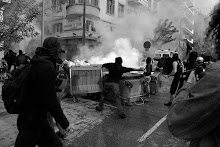
I am certainly not nonviolent. All the same I can understand
someone who hates violence to the point of
wanting to banish it from their life; someone who
would never kill, would never use force in order to
be heard; who, because of their character and aptitude,
prefers not to have recourse to it. But I can
only understand all this if it is a question of individual
choice. When nonviolence is presented as a method
of struggle, a road to be followed, when individual
ethics become morals and a collective project, it
seems absolute nonsense to me, useful only to justify
lack of action and an obstacle against those who rebel,
an absolute value to impose on the weak to allow the
strong to forget them in comfort. On the edge of the
abyss, with the earth more and more under enemy
fire, the invitation to use only good manners can look
just like that. Do as you like but don’t preach to me.
That said, I am not a fanatic of violence either. I
don’t like those who boast about their own feats in
such a context, I don’t justify their apology as an end
in itself, I detest those who consider it the only solution
possible. I consider it a necessity in the struggle
against power, nothing more. Like Malatesta, I too
don’t believe in ‘placid sunsets’. I don’t believe that
the reinforced concrete with which power has covered
our existence will melt upon the blooming of the
flower of freedom lovingly planted by the spreading
of our ideas.
Precisely because I am not nonviolent I cannot stand
moralistic condemnation of acts of violence. The
hypocrisy makes me sick. But precisely because I
am not a fanatic of violence, I also cannot stand any
acritical exaltation of these acts. The stupidity of that
really gets on my nerves.
Recently there has been a great prominence of actions
of attack carried out by unknown comrades,
first against the police station of Genoa, then against
the Spanish prison regime. Taking for granted the
hysterical reaction of the media, the reaction of the
police is just as predictable. But what is the reaction
of comrades? Apart from the usual idiots given to
hindsight, the most common reaction is silence. A
necessary silence, to avoid making distinctions between
those in favour and those against such acts
that would only turn out to be useful to the police
investigations. But for too long this silence hasn’t limited
itself to reigning in the days following the attacks,
it protracts itself much longer than that. It is
no longer silence in the face of the enemy who would
like to know, it is also the silence among comrades
who would like to agree. One has passed from the
presence of a minimal form of solidarity to the absence
of any critical discussion. But why ever should
action, whatever it is, not be submitted to critical reflection?
Why a should a hypothetical debate on such
questions be seen as an obstacle, something aimed
at preventing other actions? Why could it not rather
be support, a way of clarifying the meaning of what
one wants to do, to strengthen and improve action?
For me, taking recent events as a starting point I
have decided to write and circulate this text. Its
anonymous form is not due to fear of taking responsibility
for my words, but just a way not to differentiate
myself from the other comrades in the eyes of
the repression.
Claim yes, claim no
As far as I know, not being an expert on the subject
I could be mistaken, to find the first document claiming
an attack by a revolutionary organization we must
go back to Russia in 1878. It was a pamphlet Smert’
za smert’ (Death for a death) circulated by the group
Narodnaja Volja (Will of the people) after the killing
of general Mezencov head of the Russian secret
police. Thirteen days after the murder the pamphlet
claiming it was sent to a Petersbourg daily and in the
days that followed many copies came out in other
cities and were sent to numerous civil servants. At
the time this action made a great sensation – and of
course the criticisms were not lacking of those who
thought that such means could not take the place of
the more important instrument of propaganda of ideas
and rebellion among the masses.
From then this scene has repeated itself hundreds of
times. The details, obviously, change from time to
time but the substance doesn’t change. You could
almost say that the experience of these Russian revolutionaries
became a kind of archetype, an original
model whose future manifestations in reality are nothing
but filiations or imitations. The only variation within
this schema has been brought by the anarchists who
have never considered it necessary to politically claim
their actions of attack against power. The Russian
group ‘People’s will’, in fact, although gathering ‘militants’
of the most diverse ideas, nevertheless placed
itself as a centralized vanguard. Within this organi-
zation, as a militant was to remember in her memoirs,
there was a discussion as to whether the program
to be followed was to be that of ‘forcing the
government to allow the people to freely express their
will to reconstruct political and economic life without
obstacles… or whether that organization must first
move to take power into its own hands, to then decree
a constitution from above that was favourable
to the people’.
With such premises one can well see their need to
claim, to communicate the reasons for their actions
to the masses whom they intended to elevate and to
the enemy whose counterpart they believed themselves
to be. After all, that group wanted to address
the people in that nearly all its members came from
the more well off classes, and negotiate with constituted
power in their name, to the point of sending a
letter to the heir of the Tzar to advise him on what
politic to follow. But when one doesn’t want to represent
anyone, nor places oneself as anyone’s coun-
terpart, why circulate communiques? If one thinks
that action of attack against power must nevertheless
have as a horizon the social revolution, and not
be its parody in the form of armed struggle against
the state, what can the aim of a specific armed organization
be?
It doesn’t seem to me that anarchists in the past distinguished
themselves by claiming actions. The anarchists
who sacrificed themselves by carrying out
individual deeds like Bresci and Caserio didn’t do it
for obvious reasons. Neither did the comrades who
had intended to undertake more continuous activity
such as Ravachol or Henry, nor those who united
themselves with them and others in armed action: Di
Giovanni didn’t do it, neither did Durruti or Ascaso.
And the reason must have been quite obvious. Desiring
a revolution from the base, not imposed or
thrown down from above, all of these anarchists considered
it opportune to act in the shadows keeping
themselves away from everything that could take
them into the limelight. They preferred the reasons
for their actions to come from the base, that it was
the movement itself to express them, rather than take
advantage of the clamour raised to spread them from
above, like the official message of those who had
made a revolt to those who hadn’t. The significance
of an action, if it is not made clear by its social context
could be found in leaflets, newspapers, reviews
and within theoretical debates developed by the movement
as a whole, not in the communique of one single
organization. I’ll give an example: if the movement is
able to express its theoretical critique of prison, when
someone then passes to a practical critique there is
no need to write a communique explaining the reasons
for it. The reasons for its gestures are clear
already comprehensible. When someone wants to
claim one’s responsibility it is only because they want
to put themselves on show. The attack on the Genoa
police headquarters, for example, was so significant
(for the choice of objective and the moment) as to
make all words superfluous. Why was a communique
circulated that said nothing but banalities?
It is true that the Angry Brigade constitute a kind of
exception, still being a question of anarchists claiming
their own actions. Not by chance, precisely that
experience seems to constitute a kind of model for
many comrades who are attacking power today. Yet,
unless one wants to throw oneself into attitudes of
emulation, the example doesn’t seem repeatable to
me. On the one hand it is impossible not to bear in
mind that the Angry Brigade should be inserted into
the historical context within which it matured, that is
in the 70s. In an era in which numerous Stalinist
groups were seminating terrible ideological bricks to
propagandize their own political project and were
lending themselves to taking over the dimension of
armed attack, it doesn’t seem strange to me that some
anarchists wanted to distinguish themselves by not
running the risk of involuntarily working for others.
From the choice of name to that of objectives, to the
style of the communiques, everything tended to distinguish
itself from the mess around them. But once
the whole Stalinist ideology had been surpassed, why
characterize oneself in the anarchist sense, what is
the point in continuing with this self-representation?
Perhaps in countries like Spain, where all the actions,
including anonymous ones, are immediately
attributed to the Eta, but certainly not here in Italy. In
fact for years actions of attack did not produce any
communiques, except sometimes something very
brief and simple and that refused the use of any acronym
of identification. It should be superfluous to
explain the reasons for this: an action can only belong
to everyone if nobody attributes it to himself. As
soon as it is claimed and given an identity, a kind of
separation is created between those who carried it
out and everybody else. Moreover, it should not even
be necessary to remember the danger inherent in
any claim. It is dangerous to consign it, to send it,
and above all it is dangerous to write because the
more one writes the more indications one gives to
the police (all anything but hypothetical danger, given
that there exists at least one negative precedent that
struck anarchist comrades). An anonymous attack
does not allow anyone to emerge and does not facilitate
the police’s repressive work.
If the reasons for anonymity have been expressed
more than once, those against it haven’t. For a few
years now things have changed without there having
been any debate on the subject. In any case it is very
difficult today for an action not to be accompanied
by a beautiful communique, followed by slogans and
signatures. Why? Silence… And so, carrying on like
this, doesn’t one end up in vanguardism? The risk is
so evident that among the very authors of claims there
are those who proclaim themselves to be against
vanguardism, in the hope that it will be enough to say
so in order to be so. But ‘to excuse yourself is to
accuse yourself’. It is the method itself that is
vanguardist and, sometimes, also the explicitly de-
clared contents (as demonstrated in the afflicted communique
of the ARA following the attack on Palazzo
Marino). It matters little if the slogans incite social
war rather than the dictatorship of the proletariat. It
matters little if the signatures change continually.
That just demonstrates that anarchist ‘vanguards’ are
more elastic than the Stalinists, but nevertheless feel
the need to distinguish themselves from the rest of
the movement.
It is not enough to take the Angry Brigade as a starting
point to resolve the problem. I know perfectly
well that the Angry Brigade affirmed ‘We are not in
a position to say whether any one person is or isn’t a
member of the Angry Brigade. All we say is: the
Brigade is everywhere. Without any Central Committee
and no hierarchy to classify our members, we
can only know strange faces as friends through their
actions.’
I also know that their participants did not consider
themselves an organization or a single group ‘but an
expression of rage and discontent…’. But all that
just shows the good faith of these comrades, their
preoccupation not to present themselves as a vanguard,
but it doesn’t demonstrate whether they actually
succeeded in their intentions. A signature that
wants to be a symbol of generalized anger doesn’t
make sense. For everyone to be able to recognize
himself or herself in it the actions and the words explaining
them must be understood and shared by everyone.
You can’t offer a general collective identity
and claim that each one renounces their individuality.
That can only be done if the actions realized and
the words spoken remain at a level that is so low as
to limit dissent as far as possible: very simple exemplary
actions accompanied by maximalist slogans. All
that – given that it might be worth it – can only work
for a brief period, after which other factors intervene
that are a part of any process that makes the
continuation of the experiment impossible: there are
those who want to move on to more powerful instru-
ments, who want to strike more selective objectives,
who want to express more precise concepts… Even
the ALF, who struggle for a motivation that is basically
simple and univocal such as animal liberation,
saw their first defections as soon as they began to
expand. Some other animal liberation groups – tired
of the confusion of the project, the minimalism of the
objectives, the declarations of the spokespersons –
formed. Not only, but, it is the worst aspect, all of
these groups saw themselves forced to give themselves
a new name to avoid being included automatically
in the main cauldron. Because the instrument
of claiming is a strictly political one, with all the harm
that that implies as long as one remains in anonymity
one can do what one wants, without involving or exploiting
others. But as soon as some emerge, they
also force the others to come out so as not to be
considered mere army columns. This mechanism of
identification/assimilation can only be avoided through
anonymity, the diversification of means and fantasy
in the choice of objectives, otherwise, no matter how
many precautions one may take, one could never
prevent the media from putting it into act (so much
more than with the communiques that one sends precisely
to them).
What objectives?
The vanguardist logic is rigid, as soon as one adopts
it, it is applied everywhere. It is enough to think of
the choice of objectives, the depressing road that
throughout the years has led from an anonymously
slain pylon to a letter bomb – with letter included –
sent to the television. In the first case they want to
sabotage an enemy, jamming the functioning of its
system by putting a peripheral structure out of use.
It is a question of a practical action of attack, perhaps
a little fastidious to bring about, but without putting
anyone at risk. In the second case one just wants
to be talked about, make publicity for one’s own firm,
and that is why they turn directly to the doors of the
Rai [Italian equivalent of BBC].. It is just a symbolic
action, far easier to realize, and if the risk of being
wounded falls to some unfortunate postal worker or
TV employee… who cares. It seems that it is not
only the Jesuits who think that the end justifies the
means but also some anarchists. And concerning letter
bombs…
I have been unfair. I said that those who send them
just want to be talked about. I forgot to add that, self
gratification aside, they also want something else to
be talked about. For example the prison conditions
of some anarchists and rebels imprisoned in Spain.
The Russian revolutionary socialists in 1878 had a
similar preoccupation. In one of their famous documents
they wrote: ‘If the press don’t defend the prisoners,
we will’. Today there are the groups of the
5C [one of the informal Fai groups]. Anarchists, not
revolutionary-socialists. Anarchists like May
Picqueray who in 1921 sent a parcel bomb to the
American ambassador in Paris to protest against the
silence that weighed upon the incarceration of Sacco
and Vanzetti. The action was very successful because
the abuse committed by the American government
finally became publicly known, launching a
struggle that had had difficulty in taking off.
But after taking act of the similarity between past
and present, one must have blinkers on not to see the
colossal differences. The Russian socialists killed the
chief of the secret police following the death in prison
of one of their comrades: a death for a death, exactly.
The French anarchist, to make public the infamy
of American justice, struck the maximum representative
of the American government present in
France. Today, the anarchists of the 5C send their
presents no less than to the workers of the Rai or the
secretaries of Spanish travel agencies. The difference
should leap out at us. Of course, those materially
responsible for the penitentiary regime that is
being imposed on the comrades are far away and
probably too well protected to be reached, whereas
the interests of the Spanish State are everywhere
and can therefore be struck. But are these interests
embodied in the employees working in travel agencies?
And because one insists on making an impact
on the media, how can one ignore the fact that the
great means of communication only amplify the words
of the rebels if they can distort their meaning? And
how not realize that such actions make this operation
of distortion all too easy? By sending incendiary
letters left and right one will undoubtedly make them
talk about the comrades detained in Spain, everybody
will talk about them, but in what terms? In the
terms imposed by the media, of course, who will rush
to reinforce the idea already implanted in many that,
after all, if these prisoners have such unscrupulous
champions, perhaps they deserve harsh regimes.
The trouble is that those who think that they are further
ahead, more radical than everybody else, think
so for a very precise reason. This consists in the use
of certain instruments: those who talk just chatter,
those who attack with weapons are acting. All those
who support armed struggle are in love with their
instruments, they love them to the point that they
cease to see them as such and to see them as an end
in themselves, their reason for being. They don’t
choose the means best suited to the end they want to
achieve, they transform the means into end in itself.
If I want to kill a fly on the wall I use a rolled up
newspaper, if I want to kill a mouse I use a stick, if I
want to kill a man I use a revolver, if I want to demolish
a building I use dynamite. According to what
I want to do, I choose the means that I consider most
adapt from all those that I have available. The armedstrugglist,
no. He doesn’t think like that. He wants to
use his favourite instrument, the one that gives him
most satisfaction, that makes him feel more radical,
that allows him to bask in his media celebrity, and he
uses it independently of the aim he has given himself:
he shoots flies, machine-guns the mouse, dynamites
the man and if he could, would use a nuclear
bomb to blow up the building. For the armed-strugglist
the radicality of the struggle does not consist of its
extension and depth and its capacity to question social
peace. For the armed-strugglist, radicality is only
a question of fire power: a calibre 22 handgun is less
radical than a 38, which is less radical than a
Kalashnikov, which is less radical than plastic explosives.
That is why, thirsty for fame and rendered
obtuse by his own technical idolatry, he sends incendiary
letters to simple employees to combat the Fies
prison regime. He does that because it is the only
thing he knows how to do; technics do not accompany
intelligence but take the place of it, and so one
doesn’t even stop to ask for a second whether the
means is suitable for the end one wants to attain. As
far as scruples are concerned, he doesn’t have any
for the simple reason that in his head everything is
split up into black and white, without nuances of colour.
On the one side there is the State, on the other the
anarchists. There is no one in the middle. If one isn’t
anarchist one belongs to the State, so one is an enemy.
The exploited are responsible for the conditions
that they put up with just as much as the exploiters
who impose them on them: they are all enemies, so
that’s their problem.
Strangely this typically militaristic logic is gaining
ground among certain anarchists, among whom there
are even some who support the Palestinian kamikaze.
Incredible if one thinks that such levels of
abjection were far even from the Russian revolutionaries
at the end of the nineteenth century:
vanguardist authoritarians yes, but with a rigorous
ethic, ready to kill an exploiter but without touching a
hair of any of the exploited. And if the authoritarians
took this care, think of the anarchists! The examples
in this sense are many: even Schicchi, well known
also for his fiery language, was capable of going back
to where he had left a bomb in order to defuse it
when he realized that some passerby might have been
wounded.
But the image of the anarchist of the past, the perfect
gentleman, is too goody goody, not very gratifying
for some anarchists of today. There are anarchists
who only manage to give a sense to their lives
if they feel they have been struck by public con
tempt. The more something is condemned, the more
they are attracted. The more the newspapers and
the judges depict anarchists as unscrupulous people,
the more they rush to fill this role. Devoid of any
prospects of their own, they let themselves be told
by their enemies what they are and what they must
do.
Another consequence of what is happening is the
total overturning of the meaning of the term
‘insurrectionalist’, which today is coming to be used
as a simple synonym for ‘violent’ or even simply beyond
dialogue with the institutions. Anarchists who
put bombs are insurrectionalists, anarchists who break
windows are insurrectionalists, anarchists who clash
with the police are insurrectionalists, insurrectionalist
are the anarchists who contest the demonstrations
of the political parties and so on. Not a word about
ideas. In a certain sense one is repeating exactly what
happened at the beginning of the century with the
adjective ‘individualist’. Once there was the convic
tion that anyone who supported violent individual acts
was an individualist, then this term came to be applied
more or less everywhere and often out of place.
In the frenzy of events, who stopped to clarify the
confusion that was spreading? Recourse to individual
violence is not at all a typical characteristic of individualism,
so much so that there were also pacifist
individualist anarchists (such as Tucker) or nonviolent
(like Mackay). And again, was Galleani an individualist
perhaps? Yet he was a supporter of individual
actions… as was Malatesta in certain circumstances.
And there have also been communists in
favour of individual acts. Unfortunately the equivocation
became rooted to such a point that there were
even those who declared themselves individualist even
though they were not at all (as did Schicchi in the
Pisa trial). Misunderstanding, incomprehension… it
is better not to add to such confusion. That the media
do it is quite obvious and comprehensible. But
why should we do it too?
Insurrection is a social event. It is not the challenge,
a singular duel with the State launched by those who
believe that the mass are just sheep waiting to be
sheared. Recourse to violence is inevitable and necessary
in an insurrectional project, just as it is before
(because the social aspect of insurrection can never
be carried to justify waiting). Therefore, also now.
But this violence cannot separate itself from the rest
of the project, it cannot take its place. It is violence
that is one instrument at the service of the project,
not the project that is in the service of violence.
Whoever thinks that an insurrection isn’t possible,
having lost (or never had) faith in the possibility that
the exploited will rebel, should realize the distance
that separates them from any insurrectional project.
If he wants to fight his private war against power,
because that is what it has become, let him do so, but
without passing this off as social war. If he wants to
go down in history for his actions, because this is a
question of pure self-gratification, then let him sit under
the glare of the media, but without claiming to have
the whole movement behind him.
It’s obvious that anybody is free to do what he or she
likes. Someone who thinks that they are above criticism
and should be applauded, understood and followed
without even having bothered to explain the
reasons behind their methods, is a lot less so.
Translated from Italian May 2007 and published
by Elephant Editions, this text first
appeared on the website Anarcotico in 2003.
Showing posts with label insurrection. Show all posts
Showing posts with label insurrection. Show all posts
Monday, 27 December 2010

Friday, 7 May 2010
A glimpse into the elsewhere
recounted by an
anarchist who ventured there for
a moment in December 2008
From the moment that 14 year old Alexi Grigoropoulos was gunned down by a patrolling policeman on December 6 2008, the morphology of Greece’s capital city and many others, both on the mainland and in many of the islands, changed. The force of the people’s anger against the State and its paid killers expressed itself with limpid clarity: Athens, a European metropolis, had no cop station left untouched, no bank left functioning. Huge stores, banks and public buildings were gutted by fire and hundreds of luxury cars and car showrooms went up in flames, as the streets were blocked off with flaming barricades and hundreds of police in riot gear were forced to run away from the rebels.
It is impossible to render what happened over there in words, because what took place was a social rebellion, where the outward face of capitalist society came under assault by massive numbers of disparate people, acting as one.
Anarchist comrades who had been in the thick of the rebellion around the Polytechnic in Athens were visibly overwhelmed. Stunned by the events, their eyes shining with passion and wonder, they were the first to admit that they had lived moments that they had never imagined even in their wildest dreams, and which had completely surpassed them.
Many words have been written about these days, beautiful words, reproduced and diffused in many languages. But it seemed that something was missing...
This candid account by one anarchist who suddenly found himself acting in a completely different terrain to that which he was familiar with, and the fears and questions that this awakened in him, is a valuable testimony that opens up many questions for all anarchists.
***
The evening of December 6 2008 I was at home preparing for one of my usual Saturday nights. Then a friend called me on the phone telling me that something very bad had happened, cops in Exarchia had killed somebody. I made some phone calls, some of my friends didn’t know and some had already heard. Like them, we immediately went to the Polytechnic school. It took a little time before clashes began around it. After some hours some of my comrades and I decided to carry out an attack on a police station in the centre of Athens. It was important for us to do this at that time. We made an appointment in a busy area of Athens where we could be hidden inside the crowd after the attack. As a friend and I were walking towards the place of the appointment we encountered a spontaneous demo of a few hundred leftist people who are not normally seen clashing with the police, ready to attack. The head of the demo stopped to ask us what was going on at the Polytechnic because they wanted to go there. We told them that it might be difficult as there were some police units around, then left, each in their own direction. I was struck by the look in their eyes, something very strange for them, because I know them well. It was anger and a readiness to clash with the police, not just anger but the urgency to clash with the police. These guys are people that usually fight with the anarchists on the issue of clashing or not clashing with the police, always in favour of the latter. The look on their faces was in contradiction with their whole appearance as Greek leftist students with their carefully trimmed beards and spectacles.
We went to the appointment. We were about 100 people, which is not the usual number for a group that wants to attack a police station. It would normally be 12 to 20. We attacked the police station with molotovs and stones. We didn’t do all that much real damage as it was a spontaneous action and not well planned. We continued by smashing and burning luxury shops and chain stores before returning to the crowded area we started off from.
I went back to the Polytechnic school where clashes with police were continuing and someone called me from the law school telling me that there were also clashes there. The leftists we had met before had obviously ended up there. I remember that when I was on the road from to the Polytechnic, despite the fact that there were clashes around, we didn’t feel the sense of fear and anxiety one normally has in such situations.
At the school of law there were also clashes with the police but I think that there was a different sense. The attacks on the police were maybe more amateur than at the Polytechnic but definitively this was more a mass situation. Even the insults exchanged with the police were different, more sophisticated.
A few hours later I returned to the Polytechnic and tried to get some sleep as it was nearly morning. I didn’t manage to sleep of course and I think that it was at that moment that I began to realise what had actually happened with this young comrade who had been shot. At that moment the human tragedy that had occurred suddenly hit me and I cried. Eventually I managed to doze off for a couple of hours and when I woke up, because of all these thoughts, I was even angrier than before.
Sunday’s demo saw several thousand people and we began to move up Alexandras Avenue towards the police headquarters of Athens. Very soon clashes began and as always many shops and banks were set on fire.
The clashes with the police that day were very hard, we exchanged an unimaginable hail of stones with the police and they discharged huge amounts of teargas upon us. The anger and lack of sleep had left me totally out of control. I was wounded by a stone and ended up in hospital for some stitches. The friend who had come with me to the hospital phoned me later telling me that there were a lot of clashes around Athens in some normal areas as well as around the school of economics and other schools.
Next day, Monday, I didn’t go to work. A friend called me on the phone to tell me that some school pupils had attacked the police headquarters of Pireus, the port of Athens. Later I heard that there had been another attack in Pireus against a police station and from that moment I began to receive information about many attacks on police stations in very ordinary parts of Athens and all over Greece. Even then I had not realised what was going on. I met my father some time later and he had seen the attack on the police headquarters of Pireus while at work. He told me laughing that the pupils had overturned the police cars and smashed the facade of the building and there were ordinary people around clapping their hands.
Like some of my friends, I was considering not going on the afternoon demo, thinking that nothing much would happen there. I decided to go at the last moment and arrived just a few minutes before it began. When I came out of the metro station I saw a huge crowd, thousands of people, tens of thousands, some say between 30 and 40 thousand. There was already a burning barricade in a side street, and some young people were clashing with a police unit. As soon as the demo began—but rather than a demo, it was a crowd, a great mass of angry people—some people began to smash and loot the shops, any shops. At first some people tried to stop them but very soon the situation was chaotic with buildings, shops, everything set on fire, even a big hotel which was something that made me feel very scared, thinking there would be people trapped inside.
Despite the fact that I’m used to violent events, and not as an observer, all that was happening all of a sudden was not quite compatible with my anarchist mentality. The people around me were totally unknown, again something that was unusual for me.
When I reached Omonia Square right in the centre of Athens, many people were trying to set fire to a very central prestigious building of the national bank of Greece where a woman was trapped inside. Other people were moving towards Omonia police station to attack it, everything burning and being looted all around us. I met 2 women anarchist comrades that I don’t know very well. But we were the only people who knew each other there and they asked me what I suggested doing because, as they told me, they were not sure if they really wanted to be there. I told them that I couldn’t answer because I felt the same way.
As the chaos continued a police unit attacked the crowd very aggressively from one side, discharging a lot of teargas, while leftwing people were desperately trying to retain a sense of demo amidst this chaos. At that moment the crowd was trapped in a thick cloud of gas, the situation was very dangerous. Thankfully the crowd managed to spread out and disperse and I, on reaching Syntagma square, found other masses of people going in different directions in crowds. Then some demonstrators set fire to the huge Christmas tree in the big square in front of the Greek parliament. From this moment, because of this incident, the slogan ‘Christmas has been cancelled this year’ was born and the image of the burning tree has gone around the world giving joy to many. But at that precise moment I felt the same fear that I felt when I saw huge buildings burning, some with people inside them. The fear wasn’t for my personal security but, as I see myself as part of the Greek anarchist movement, I was afraid that after all this it might be impossible to be an anarchist in Greece as I was before, that the movement couldn’t bear the weight of what might happen.
In Syntagma square some police units tried to regain control of the situation, attacking the mass and trying to arrest people. I saw a young girl being arrested, I ran towards the police unit not knowing exactly what I wanted to do, and then I realised that I was almost rounded up by another police unit running towards me. I saw a few other people behind me doing the same thing. Thankfully I managed to run through the police unit as did the others behind me, except perhaps one that I couldn’t do anything about.
Later I found a friend of mine and we decided to go towards the School of Law which was close to us and we knew that there were some riots around it. The burning and smashing hadn’t stopped around the city centre. We went to the School of Law where opposite a large historic building was up in flames. Later on we learned was the library of the School of Law. The size of the fire was so great that it was terrifying. It was not the only building in Athens in this situation. Going up on to the roof of the School of Law we saw the smoke of all the buildings that were burning in the centre of Athens. The fires had created a great glow, like a livid sunset over the city. We suddenly heard a very loud noise coming from the burning building opposite - maybe a part of its roof had collapsed.
A friend called me from the Polytechnic. He’s a comrade who is always very eager to be involved in riots and burning. He told me that there were so many riots around the Polytechnic that he was tired, and that I could not imagine what was going on there. I went later to the Polytechnic, the riots had calmed down but everything around had been burned and looted. A five-storey building near the school had been burnt to the ground.
I found a very good friend and comrade at the side entrance to the Polytechnic. I noticed that he was completely alone, sitting staring into space. He told me that he was very disappointed that he had lost the demo; I replied that I was not so sure that he would really have liked to have been there. He asked me why and I told him that they had burnt and destroyed things like the Law School library and that the situation was totally out of control. He told me that the same happened there and that he and some of his comrades had tried to prevent people from looting shops, which they saw as out of the context of the reason for the anger, the murder of a young boy in Exarchia.
Then I saw and heard something very strong that was to repeat itself constantly over the days to come: young people gathered behind a barricade of burnt cars screaming slogans at the police, using the burnt-out cars as drums. I saw an amazing image of a guy standing on top of a car in front of a big fire, arms and legs open, his silhouette etched by the flames.
From that day on the people who came to the Polytechnic were not exactly anarchists but young and very young people, a lot of them immigrants, some junkies and also some ‘emo’ kids maybe from the better-off areas of Athens, a mixture that had also been present in the demo earlier.
Over recent years the road outside the Polytechnic has been the scene of many street battles with the riot police. For the first two days following Alexi’s murder those fighting were still mainly anarchists, possibly in the widest sense, but still anarchists or at least people of the antagonist movement. Many, many comrades who until these days had never lifted a stone were involved in fighting the police. Leftists whose negative attitude towards riots or clashes with the police had until then monopolised our encounters with them were in many cases involved, and sometimes passionately, in the clashes.
On Monday, the third day, this changed. A mixture of young people but also many other people impossible to categorise became the driving force. Many anarchists were embarrassed by this situation. The violence that these people were releasing surpassed the limits of the mainstream anarchist mentality. These limits were faithfully adhered to by the school of economics occupation close by, predominantly occupied by anarchists without the presence of the ‘rabble’. In fact, the Polytechnic came to be referred to as ‘Bagdad’, whereas the ASOEE (school of Economics) was ‘Switzerland’.
The ASOEE became the centre of many discussions and also actions which also gave ideas for the publishing of a lot of stuff. In my opinion, all these discussions, actions and published stuff remained within the limits of the typical anarchist mentality - maybe in a wider and improved sense, but always inside these limits, determined by the character of the crowd that was gathering in the ASOEE, which was an anarchist, or in the wider sense a movement-involved crowd at the time when in the Polytechnic school something different and new was happening.
The Polytechnic school was a place where a mass of many different people gathered: very young people, school students, some ‘emo’ style maybe from wealthier families, simultaneously with first and second generation immigrants, many of whom didn’t speak Greek, many people who couldn’t be specifically catgorised, and inside this confusion of hundreds, sometimes thousands, of people there was a minority of anarchists desperately trying to retain some political character in the occupation.
In ASOEE there were some stories going around about dealings - drugs - or comrades who were violently trying to prevent looting in the surrounding area. These stories may or may not have been true, or were exaggerated, but they are characteristic of the image that people in ASOEE had of the Polytechnic school.
It has been common for riots or violent clashes to take place outside the Polytechnic from 1973 onwards, since the insurrection on Nov 17. If something very important happens, it’s to be expected that everybody will go there, but it’s not so common to go to ASOEE. Maybe the fact that so many anarchists went to ASOEE indicates the unwillingness of the main body of the Greek anarchist movement to be involved with this ‘rabble’. In my opinion, this also shows our inability to surpass our limits and to be able to adjust to an unknown and unpredictable situation.
This situation in the occupied schools lasted from the 6th of December until the Christmas holidays. In a way, Christmas had come to be seen as a kind of closure, not only due to some clear fall in the level of the situation, but also as a kind of expectation from the main body of anarchists, particularly in the ASOEE.
What happened to all those people that we the anarchists encountered all these days of December? Some of the Greek students were incorporated into the main body of the anarchists, but all the others, immigrants, ‘scum’, or just masses of uncategorised people simply vanished into urban anonymity. We didn’t see them, or maybe we didn’t want to see them, again.
For many anarchists December was a success in quantitative terms.
For a few, it opened up a glimpse into the elsewhere.
Maybe these days revealed our incapacity to encounter new possibilities.
anarchist who ventured there for
a moment in December 2008
From the moment that 14 year old Alexi Grigoropoulos was gunned down by a patrolling policeman on December 6 2008, the morphology of Greece’s capital city and many others, both on the mainland and in many of the islands, changed. The force of the people’s anger against the State and its paid killers expressed itself with limpid clarity: Athens, a European metropolis, had no cop station left untouched, no bank left functioning. Huge stores, banks and public buildings were gutted by fire and hundreds of luxury cars and car showrooms went up in flames, as the streets were blocked off with flaming barricades and hundreds of police in riot gear were forced to run away from the rebels.
It is impossible to render what happened over there in words, because what took place was a social rebellion, where the outward face of capitalist society came under assault by massive numbers of disparate people, acting as one.
Anarchist comrades who had been in the thick of the rebellion around the Polytechnic in Athens were visibly overwhelmed. Stunned by the events, their eyes shining with passion and wonder, they were the first to admit that they had lived moments that they had never imagined even in their wildest dreams, and which had completely surpassed them.
Many words have been written about these days, beautiful words, reproduced and diffused in many languages. But it seemed that something was missing...
This candid account by one anarchist who suddenly found himself acting in a completely different terrain to that which he was familiar with, and the fears and questions that this awakened in him, is a valuable testimony that opens up many questions for all anarchists.
***
The evening of December 6 2008 I was at home preparing for one of my usual Saturday nights. Then a friend called me on the phone telling me that something very bad had happened, cops in Exarchia had killed somebody. I made some phone calls, some of my friends didn’t know and some had already heard. Like them, we immediately went to the Polytechnic school. It took a little time before clashes began around it. After some hours some of my comrades and I decided to carry out an attack on a police station in the centre of Athens. It was important for us to do this at that time. We made an appointment in a busy area of Athens where we could be hidden inside the crowd after the attack. As a friend and I were walking towards the place of the appointment we encountered a spontaneous demo of a few hundred leftist people who are not normally seen clashing with the police, ready to attack. The head of the demo stopped to ask us what was going on at the Polytechnic because they wanted to go there. We told them that it might be difficult as there were some police units around, then left, each in their own direction. I was struck by the look in their eyes, something very strange for them, because I know them well. It was anger and a readiness to clash with the police, not just anger but the urgency to clash with the police. These guys are people that usually fight with the anarchists on the issue of clashing or not clashing with the police, always in favour of the latter. The look on their faces was in contradiction with their whole appearance as Greek leftist students with their carefully trimmed beards and spectacles.
We went to the appointment. We were about 100 people, which is not the usual number for a group that wants to attack a police station. It would normally be 12 to 20. We attacked the police station with molotovs and stones. We didn’t do all that much real damage as it was a spontaneous action and not well planned. We continued by smashing and burning luxury shops and chain stores before returning to the crowded area we started off from.
I went back to the Polytechnic school where clashes with police were continuing and someone called me from the law school telling me that there were also clashes there. The leftists we had met before had obviously ended up there. I remember that when I was on the road from to the Polytechnic, despite the fact that there were clashes around, we didn’t feel the sense of fear and anxiety one normally has in such situations.
At the school of law there were also clashes with the police but I think that there was a different sense. The attacks on the police were maybe more amateur than at the Polytechnic but definitively this was more a mass situation. Even the insults exchanged with the police were different, more sophisticated.
A few hours later I returned to the Polytechnic and tried to get some sleep as it was nearly morning. I didn’t manage to sleep of course and I think that it was at that moment that I began to realise what had actually happened with this young comrade who had been shot. At that moment the human tragedy that had occurred suddenly hit me and I cried. Eventually I managed to doze off for a couple of hours and when I woke up, because of all these thoughts, I was even angrier than before.
Sunday’s demo saw several thousand people and we began to move up Alexandras Avenue towards the police headquarters of Athens. Very soon clashes began and as always many shops and banks were set on fire.
The clashes with the police that day were very hard, we exchanged an unimaginable hail of stones with the police and they discharged huge amounts of teargas upon us. The anger and lack of sleep had left me totally out of control. I was wounded by a stone and ended up in hospital for some stitches. The friend who had come with me to the hospital phoned me later telling me that there were a lot of clashes around Athens in some normal areas as well as around the school of economics and other schools.
Next day, Monday, I didn’t go to work. A friend called me on the phone to tell me that some school pupils had attacked the police headquarters of Pireus, the port of Athens. Later I heard that there had been another attack in Pireus against a police station and from that moment I began to receive information about many attacks on police stations in very ordinary parts of Athens and all over Greece. Even then I had not realised what was going on. I met my father some time later and he had seen the attack on the police headquarters of Pireus while at work. He told me laughing that the pupils had overturned the police cars and smashed the facade of the building and there were ordinary people around clapping their hands.
Like some of my friends, I was considering not going on the afternoon demo, thinking that nothing much would happen there. I decided to go at the last moment and arrived just a few minutes before it began. When I came out of the metro station I saw a huge crowd, thousands of people, tens of thousands, some say between 30 and 40 thousand. There was already a burning barricade in a side street, and some young people were clashing with a police unit. As soon as the demo began—but rather than a demo, it was a crowd, a great mass of angry people—some people began to smash and loot the shops, any shops. At first some people tried to stop them but very soon the situation was chaotic with buildings, shops, everything set on fire, even a big hotel which was something that made me feel very scared, thinking there would be people trapped inside.
Despite the fact that I’m used to violent events, and not as an observer, all that was happening all of a sudden was not quite compatible with my anarchist mentality. The people around me were totally unknown, again something that was unusual for me.
When I reached Omonia Square right in the centre of Athens, many people were trying to set fire to a very central prestigious building of the national bank of Greece where a woman was trapped inside. Other people were moving towards Omonia police station to attack it, everything burning and being looted all around us. I met 2 women anarchist comrades that I don’t know very well. But we were the only people who knew each other there and they asked me what I suggested doing because, as they told me, they were not sure if they really wanted to be there. I told them that I couldn’t answer because I felt the same way.
As the chaos continued a police unit attacked the crowd very aggressively from one side, discharging a lot of teargas, while leftwing people were desperately trying to retain a sense of demo amidst this chaos. At that moment the crowd was trapped in a thick cloud of gas, the situation was very dangerous. Thankfully the crowd managed to spread out and disperse and I, on reaching Syntagma square, found other masses of people going in different directions in crowds. Then some demonstrators set fire to the huge Christmas tree in the big square in front of the Greek parliament. From this moment, because of this incident, the slogan ‘Christmas has been cancelled this year’ was born and the image of the burning tree has gone around the world giving joy to many. But at that precise moment I felt the same fear that I felt when I saw huge buildings burning, some with people inside them. The fear wasn’t for my personal security but, as I see myself as part of the Greek anarchist movement, I was afraid that after all this it might be impossible to be an anarchist in Greece as I was before, that the movement couldn’t bear the weight of what might happen.
In Syntagma square some police units tried to regain control of the situation, attacking the mass and trying to arrest people. I saw a young girl being arrested, I ran towards the police unit not knowing exactly what I wanted to do, and then I realised that I was almost rounded up by another police unit running towards me. I saw a few other people behind me doing the same thing. Thankfully I managed to run through the police unit as did the others behind me, except perhaps one that I couldn’t do anything about.
Later I found a friend of mine and we decided to go towards the School of Law which was close to us and we knew that there were some riots around it. The burning and smashing hadn’t stopped around the city centre. We went to the School of Law where opposite a large historic building was up in flames. Later on we learned was the library of the School of Law. The size of the fire was so great that it was terrifying. It was not the only building in Athens in this situation. Going up on to the roof of the School of Law we saw the smoke of all the buildings that were burning in the centre of Athens. The fires had created a great glow, like a livid sunset over the city. We suddenly heard a very loud noise coming from the burning building opposite - maybe a part of its roof had collapsed.
A friend called me from the Polytechnic. He’s a comrade who is always very eager to be involved in riots and burning. He told me that there were so many riots around the Polytechnic that he was tired, and that I could not imagine what was going on there. I went later to the Polytechnic, the riots had calmed down but everything around had been burned and looted. A five-storey building near the school had been burnt to the ground.
I found a very good friend and comrade at the side entrance to the Polytechnic. I noticed that he was completely alone, sitting staring into space. He told me that he was very disappointed that he had lost the demo; I replied that I was not so sure that he would really have liked to have been there. He asked me why and I told him that they had burnt and destroyed things like the Law School library and that the situation was totally out of control. He told me that the same happened there and that he and some of his comrades had tried to prevent people from looting shops, which they saw as out of the context of the reason for the anger, the murder of a young boy in Exarchia.
Then I saw and heard something very strong that was to repeat itself constantly over the days to come: young people gathered behind a barricade of burnt cars screaming slogans at the police, using the burnt-out cars as drums. I saw an amazing image of a guy standing on top of a car in front of a big fire, arms and legs open, his silhouette etched by the flames.
From that day on the people who came to the Polytechnic were not exactly anarchists but young and very young people, a lot of them immigrants, some junkies and also some ‘emo’ kids maybe from the better-off areas of Athens, a mixture that had also been present in the demo earlier.
Over recent years the road outside the Polytechnic has been the scene of many street battles with the riot police. For the first two days following Alexi’s murder those fighting were still mainly anarchists, possibly in the widest sense, but still anarchists or at least people of the antagonist movement. Many, many comrades who until these days had never lifted a stone were involved in fighting the police. Leftists whose negative attitude towards riots or clashes with the police had until then monopolised our encounters with them were in many cases involved, and sometimes passionately, in the clashes.
On Monday, the third day, this changed. A mixture of young people but also many other people impossible to categorise became the driving force. Many anarchists were embarrassed by this situation. The violence that these people were releasing surpassed the limits of the mainstream anarchist mentality. These limits were faithfully adhered to by the school of economics occupation close by, predominantly occupied by anarchists without the presence of the ‘rabble’. In fact, the Polytechnic came to be referred to as ‘Bagdad’, whereas the ASOEE (school of Economics) was ‘Switzerland’.
The ASOEE became the centre of many discussions and also actions which also gave ideas for the publishing of a lot of stuff. In my opinion, all these discussions, actions and published stuff remained within the limits of the typical anarchist mentality - maybe in a wider and improved sense, but always inside these limits, determined by the character of the crowd that was gathering in the ASOEE, which was an anarchist, or in the wider sense a movement-involved crowd at the time when in the Polytechnic school something different and new was happening.
The Polytechnic school was a place where a mass of many different people gathered: very young people, school students, some ‘emo’ style maybe from wealthier families, simultaneously with first and second generation immigrants, many of whom didn’t speak Greek, many people who couldn’t be specifically catgorised, and inside this confusion of hundreds, sometimes thousands, of people there was a minority of anarchists desperately trying to retain some political character in the occupation.
In ASOEE there were some stories going around about dealings - drugs - or comrades who were violently trying to prevent looting in the surrounding area. These stories may or may not have been true, or were exaggerated, but they are characteristic of the image that people in ASOEE had of the Polytechnic school.
It has been common for riots or violent clashes to take place outside the Polytechnic from 1973 onwards, since the insurrection on Nov 17. If something very important happens, it’s to be expected that everybody will go there, but it’s not so common to go to ASOEE. Maybe the fact that so many anarchists went to ASOEE indicates the unwillingness of the main body of the Greek anarchist movement to be involved with this ‘rabble’. In my opinion, this also shows our inability to surpass our limits and to be able to adjust to an unknown and unpredictable situation.
This situation in the occupied schools lasted from the 6th of December until the Christmas holidays. In a way, Christmas had come to be seen as a kind of closure, not only due to some clear fall in the level of the situation, but also as a kind of expectation from the main body of anarchists, particularly in the ASOEE.
What happened to all those people that we the anarchists encountered all these days of December? Some of the Greek students were incorporated into the main body of the anarchists, but all the others, immigrants, ‘scum’, or just masses of uncategorised people simply vanished into urban anonymity. We didn’t see them, or maybe we didn’t want to see them, again.
For many anarchists December was a success in quantitative terms.
For a few, it opened up a glimpse into the elsewhere.
Maybe these days revealed our incapacity to encounter new possibilities.
Sunday, 27 December 2009
Chile – Communique from Insurrectionist Internationalist Revolutionary Organisations to the world
11/06/08
On June 4 2008, following unanimous agreement between the organisations that signed this document, the second Informal International Meeting of Insurrectionist Revolutionary Anarchism, which was held in some place of the Chilean metropolitan area, has concluded.
This declaration is part of the final document elaborated to make public the debate and the conclusions expressed by the participants at this meeting. Therefore we publish clandestine words full of violence against the state and dreams strengthened by anarchist reconstruction of human society.
From this place we declare:
1. We recognize that a Social War is going on and manifests itself in the different dimensions of human strength and intellect at different levels of intensity. We did not invent this war nor did we wage it; it has been actually proclaimed for centuries by the bosses and the defenders of political systems that oppress the vast majority of people with coercion, fear and ‘reason’.
2. We publicly recognize the enthusiasm and efforts of anonymous brothers and sisters of past and present generations, who have dedicated and still dedicate their life to libertarian struggle. Their ideas and actions take us all the way long. A warm greeting to all of you.
3. We declare ourselves libertarian and insurrectionist fighters. We did not serve any authoritarian leftist ideology nor do we fall into the trap of reading ‘classics’. What they suffered is different in many aspects, though not in all, from what we are enduring now. Our idea is permanently defining itself, always free and ferocious.
4. We are claiming and making concrete the right to think and struggle for the construction of really free societies, led by supreme respect for nature and characterized by social and individual behaviour aimed at strengthening the dignity and common wealth of the men and women who live on the planet. We are claiming and cultivating the right to multiply solidarity and egalitarian practices in every aspect of the existent. We claim mutual support between individuals and independent and free communities, the right to intervene directly against the catastrophe menacing the planet every single second, the right of human beings to think and act for a free world, the right to live without bosses, leaders, police or authority, in freedom and self-discipline.
5. We identify our direct enemies as those who govern and defend this system of slavery, which is based on the existence of pyramidal and authoritarian organisations, for example State structures, business companies, churches and also their false critics.
6. We claim the right to exercise collective and individual abilities towards the destruction of everything that is turning us all into slaves.
7. We affirm our engagement to carry on the libertarian struggle.
8. We claim all the actions carried out in different areas by every organisation present at this meeting.. We made explosions against police stations, banks, companies and churches. We have contributed to stirring up and radicalising wild strikes. We have hurled stones and molotovs against cops. Yes, we claim our full and conscious responsibility for these actions. If they want to consider us ‘guilty’ we are such. We declare ourselves guilty of sabotaging the functioning of this slave society that reduces people to starvation. We declare ourselves guilty of knowing this functioning in order to attack it. We declare ourselves guilty of illegal possession of autonomous thoughts of struggle for freedom. But we know that the ‘guilt’ we take on ourselves every day is the knowledge that the vast majority of people suffer and die under the action of the lords of the world, whereas the latter live in the opulence of a fantasy from which we are waking them up.
9. Clarification. The authorities of this country have said that we act against property and that we do not want to kill anyone. We answer that property is our actual target. Property is theft, therefore to destroy it conceptually and effectively is our duty. But we remind that property is created and defended by individuals armed with laws and soldiers. To eliminate these parasites is inevitable in the social war.
We have control of all the sectors in which we realize our direct actions. Before attacking public places we have always made telephone calls so that these places were evacuated. Police and the media tell a lie when they claim that we did not. The explosive attack against the Opus Dei University, carried out by the Insurrectionist Federation in the night of April 23, had been announced with telephone calls to the police station in Los Dominicos, the 133 police line and to the Cooperative radio 15 minutes before the explosion. As the comrades already declared, the reason for the attack was not to execute some fascist children of the bosses of this country. If such had been the case a different spot of the building would have been targeted, which would have represented only a grain of the violence that the fathers of these students and these students themselves inflict on us the exploited.
The same Federation claims the incendiary attack against the Church of Opus Dei on Lastarria road in Santiago. This attack occurred at 2.30 of Tuesday June 3. The police and the media did not make any mention of it. But the attacks will not stop.
10. We denounce the creation of a state secret structure that tries to criminalize the revolutionary organisations that dare react to institutional violence. This new ‘office’ concentrate the efforts of the State against the wide libertarian forces by gathering two departments of institutions headed by murderers and torturers (Arturo Herrera, chief investigator, and Jos? Bernales, chief of the carabineros) born by the Pinochet dictatorship, and by the government repressive services, which since 1990 are headed by leftist politicians intoxicated with power. From the carabineros; Direccion de Intelligencia Policial (DIPOLCAR), Grupo de Operaciones Especiales (GOPE), Departemento de Investigacion de Organizaciones Criminales (0S-9); from investigative sectors: Brigada de Investigaciones Policiales Especiales (BIPE), Brigada de Intelligencia Policial (BIP), Brigada Contra el Crimen Organizado (BRICO); from the government: Agencia Nacional de Inteligencia (ANI), and the new prosecutors, especially those of the East Area. They meet in secret places in order to investigate details and communications of all the people and in order to plan the repressive fury that reminds that suffered during the military dictatorship. They try to control everything. Their goal is the same of the old and hated landowner: that only the boss enjoys the land and that the inhabitants do not make trouble.
Following these events we have formulated a few questions:
Why do they not employ all these people to investigate the deaths caused by police bullets or by this capitalist system? What about speculation carried out by traders, real-estate agencies, financial usurers, what about the daily aggression of transantiago, what about the repressive and unworthy education, the existence of armed forces that have licence to shoot on whatever pretext, the oppression against aboriginal people, the existence of an impoverished and exploited population? Are these crimes investigated? Are the names of the responsible made clear?
Answer: they are not. That is because these criminals and their wrongdoing are essential parts of the world they compel us to suffer.
11. We express our joy at the death of cop Jose Bernales, which occurred in Panama. He was nothing more than a despicable being, a torturer and murderer of the exploited and emarginated. The socialist Chilean government mourned his death and they also dared call him ‘general of the people’. But he will be remembered as General Murderer of the People, as stated by his long curriculum of torture and the recent assassinations of Rodrigo Cisternas, Matias Catrileo and Johnny Cariqueo. We dance on the body torn to pieces of the man who headed the ‘special forces’ and ‘intelligence forces’ of the police, who ordered the occupation of part of the Mapuche territory, who tried to silence any libertarian voice in the continent. But what happened? It seems that he precipitated from his helicopter while he was asleep, as wished by the many threats against he who used to suck the powerful’ socks.
As we celebrate his death we tell his successor, criminal Eduardo Gordon Valcarel, not to fall asleep because he can die at any moment like his predecessor, and not necessarily by precipitating from a helicopter.
12. We invite the conscious youth to despise the institutions and any form of social consensus. You have to know that it is all a farce. Despise and fight against servile behaviour before capital, the State and its organised mafia, historic enemies of social revolution as well as political parties (especially the communist one and the organisations that define themselves leftist) are. They only want to alternate in the exercise of power and administrate it (as in the case of the Chilean communist party).
Act inside and outside this space in which we hit at the enemy. Do not listen to pure critics who block your energy and reflective abilities. The control exercised by this system has its base in the fear instilled inside you, a fear of your thoughts, desires and actions. Break it. Anarchy can be reality. What counts is that you are its starting point.
13. We are launching an appeal so that attacks against the centres of power and social control multiply, spread and strengthen. We stress the collective proposal to carry out actions in the areas where you live and where the enemy reproduces itself. The wealthy sectors of this society must be destroyed by fire and explosions, and only we, the ever persecuted, excluded, scorned and suspect can do that.
14. We are aware that every single word we are writing will be analysed by the police of various States, especially by their ‘intelligence’ offices and by judges who waste their days trying to lock up even the air. We are not worried about that. Probably they will intensify their recourse to classic and technologically new mechanisms of social control. Further funds will be destined to pay the cowards and traitors who turn themselves into infamous informants, people who are not even worth the bullets that will execute them one day. Further shadowing, cameras, phone and internet tapping will occur. However, they are warned that we, revolutionary forces, managed to infiltrate their operations, so we will keep on sabotaging the investigations against us. We are already doing this.
15. Do you want to know the names of the members of the local organisations that sign this document? The names of the brothers and sisters who came to this meeting from other areas? As a collective answer we smile and say that it is impossible for them to identify us. They can watch the images on their cameras, examine the phone tapping on the entire population, the traffic of all emails, the register of customs at the borders, the fingerprints on every bomb that explodes under their nose, investigate everything they want, but our libertarian cause has neither names nor numbers to add to their controls on the population.
We are human beings who are breaking free from chains, bodies full of revolutionary energy that their eyes cannot see, blinded by the ghosts of the dead who weigh on their conscience. They can never stop or silence our idea. We are everywhere you look. We are the gardener who watches your moves, the porter you ignore on your way to work, the shop assistant of the shop you visit, the window-cleaner who approaches your car when you stop at the traffic light, the teacher who educates your children, the person next to you while you queue at the bank, the football player of your team, the anonymous people who pierce your controlled borders, the human beings you look at with disgust and annoyance. Present and alert. We sow the idea that is eroding your brain and your police system. We carry a new world in our heart and bombs in our hands, which will destroy your universe of chains and exploitation.
16. Next meeting will follow soon. Our direct actions are due when the enemy least expects them…
Banda Antipatriota Severino di Giovanni
Columna Buenaventura Durruti
Columna Luiggi Lucchenni
Columnas Armadas y Desalmadas Jean Marc Rouillan
Federacion Insurrectionalista
Federacion Insurrectionalista / Comando Ciudad de Panama - Brigada Barrio de Calidonia
Federacion Revuelta
Federacion Revuelta-Comando Antonio Ramon Ramon
Federacion Revuelta 14F – Brigada Gaetano Bresci
Fuerzas Autonomicas y Destructivas Leon Czolgosz
Grupos de Ataque Antiautoritario
Miguel Arcangel Roscigna
Tanmyo Gavilan
On June 4 2008, following unanimous agreement between the organisations that signed this document, the second Informal International Meeting of Insurrectionist Revolutionary Anarchism, which was held in some place of the Chilean metropolitan area, has concluded.
This declaration is part of the final document elaborated to make public the debate and the conclusions expressed by the participants at this meeting. Therefore we publish clandestine words full of violence against the state and dreams strengthened by anarchist reconstruction of human society.
From this place we declare:
1. We recognize that a Social War is going on and manifests itself in the different dimensions of human strength and intellect at different levels of intensity. We did not invent this war nor did we wage it; it has been actually proclaimed for centuries by the bosses and the defenders of political systems that oppress the vast majority of people with coercion, fear and ‘reason’.
2. We publicly recognize the enthusiasm and efforts of anonymous brothers and sisters of past and present generations, who have dedicated and still dedicate their life to libertarian struggle. Their ideas and actions take us all the way long. A warm greeting to all of you.
3. We declare ourselves libertarian and insurrectionist fighters. We did not serve any authoritarian leftist ideology nor do we fall into the trap of reading ‘classics’. What they suffered is different in many aspects, though not in all, from what we are enduring now. Our idea is permanently defining itself, always free and ferocious.
4. We are claiming and making concrete the right to think and struggle for the construction of really free societies, led by supreme respect for nature and characterized by social and individual behaviour aimed at strengthening the dignity and common wealth of the men and women who live on the planet. We are claiming and cultivating the right to multiply solidarity and egalitarian practices in every aspect of the existent. We claim mutual support between individuals and independent and free communities, the right to intervene directly against the catastrophe menacing the planet every single second, the right of human beings to think and act for a free world, the right to live without bosses, leaders, police or authority, in freedom and self-discipline.
5. We identify our direct enemies as those who govern and defend this system of slavery, which is based on the existence of pyramidal and authoritarian organisations, for example State structures, business companies, churches and also their false critics.
6. We claim the right to exercise collective and individual abilities towards the destruction of everything that is turning us all into slaves.
7. We affirm our engagement to carry on the libertarian struggle.
8. We claim all the actions carried out in different areas by every organisation present at this meeting.. We made explosions against police stations, banks, companies and churches. We have contributed to stirring up and radicalising wild strikes. We have hurled stones and molotovs against cops. Yes, we claim our full and conscious responsibility for these actions. If they want to consider us ‘guilty’ we are such. We declare ourselves guilty of sabotaging the functioning of this slave society that reduces people to starvation. We declare ourselves guilty of knowing this functioning in order to attack it. We declare ourselves guilty of illegal possession of autonomous thoughts of struggle for freedom. But we know that the ‘guilt’ we take on ourselves every day is the knowledge that the vast majority of people suffer and die under the action of the lords of the world, whereas the latter live in the opulence of a fantasy from which we are waking them up.
9. Clarification. The authorities of this country have said that we act against property and that we do not want to kill anyone. We answer that property is our actual target. Property is theft, therefore to destroy it conceptually and effectively is our duty. But we remind that property is created and defended by individuals armed with laws and soldiers. To eliminate these parasites is inevitable in the social war.
We have control of all the sectors in which we realize our direct actions. Before attacking public places we have always made telephone calls so that these places were evacuated. Police and the media tell a lie when they claim that we did not. The explosive attack against the Opus Dei University, carried out by the Insurrectionist Federation in the night of April 23, had been announced with telephone calls to the police station in Los Dominicos, the 133 police line and to the Cooperative radio 15 minutes before the explosion. As the comrades already declared, the reason for the attack was not to execute some fascist children of the bosses of this country. If such had been the case a different spot of the building would have been targeted, which would have represented only a grain of the violence that the fathers of these students and these students themselves inflict on us the exploited.
The same Federation claims the incendiary attack against the Church of Opus Dei on Lastarria road in Santiago. This attack occurred at 2.30 of Tuesday June 3. The police and the media did not make any mention of it. But the attacks will not stop.
10. We denounce the creation of a state secret structure that tries to criminalize the revolutionary organisations that dare react to institutional violence. This new ‘office’ concentrate the efforts of the State against the wide libertarian forces by gathering two departments of institutions headed by murderers and torturers (Arturo Herrera, chief investigator, and Jos? Bernales, chief of the carabineros) born by the Pinochet dictatorship, and by the government repressive services, which since 1990 are headed by leftist politicians intoxicated with power. From the carabineros; Direccion de Intelligencia Policial (DIPOLCAR), Grupo de Operaciones Especiales (GOPE), Departemento de Investigacion de Organizaciones Criminales (0S-9); from investigative sectors: Brigada de Investigaciones Policiales Especiales (BIPE), Brigada de Intelligencia Policial (BIP), Brigada Contra el Crimen Organizado (BRICO); from the government: Agencia Nacional de Inteligencia (ANI), and the new prosecutors, especially those of the East Area. They meet in secret places in order to investigate details and communications of all the people and in order to plan the repressive fury that reminds that suffered during the military dictatorship. They try to control everything. Their goal is the same of the old and hated landowner: that only the boss enjoys the land and that the inhabitants do not make trouble.
Following these events we have formulated a few questions:
Why do they not employ all these people to investigate the deaths caused by police bullets or by this capitalist system? What about speculation carried out by traders, real-estate agencies, financial usurers, what about the daily aggression of transantiago, what about the repressive and unworthy education, the existence of armed forces that have licence to shoot on whatever pretext, the oppression against aboriginal people, the existence of an impoverished and exploited population? Are these crimes investigated? Are the names of the responsible made clear?
Answer: they are not. That is because these criminals and their wrongdoing are essential parts of the world they compel us to suffer.
11. We express our joy at the death of cop Jose Bernales, which occurred in Panama. He was nothing more than a despicable being, a torturer and murderer of the exploited and emarginated. The socialist Chilean government mourned his death and they also dared call him ‘general of the people’. But he will be remembered as General Murderer of the People, as stated by his long curriculum of torture and the recent assassinations of Rodrigo Cisternas, Matias Catrileo and Johnny Cariqueo. We dance on the body torn to pieces of the man who headed the ‘special forces’ and ‘intelligence forces’ of the police, who ordered the occupation of part of the Mapuche territory, who tried to silence any libertarian voice in the continent. But what happened? It seems that he precipitated from his helicopter while he was asleep, as wished by the many threats against he who used to suck the powerful’ socks.
As we celebrate his death we tell his successor, criminal Eduardo Gordon Valcarel, not to fall asleep because he can die at any moment like his predecessor, and not necessarily by precipitating from a helicopter.
12. We invite the conscious youth to despise the institutions and any form of social consensus. You have to know that it is all a farce. Despise and fight against servile behaviour before capital, the State and its organised mafia, historic enemies of social revolution as well as political parties (especially the communist one and the organisations that define themselves leftist) are. They only want to alternate in the exercise of power and administrate it (as in the case of the Chilean communist party).
Act inside and outside this space in which we hit at the enemy. Do not listen to pure critics who block your energy and reflective abilities. The control exercised by this system has its base in the fear instilled inside you, a fear of your thoughts, desires and actions. Break it. Anarchy can be reality. What counts is that you are its starting point.
13. We are launching an appeal so that attacks against the centres of power and social control multiply, spread and strengthen. We stress the collective proposal to carry out actions in the areas where you live and where the enemy reproduces itself. The wealthy sectors of this society must be destroyed by fire and explosions, and only we, the ever persecuted, excluded, scorned and suspect can do that.
14. We are aware that every single word we are writing will be analysed by the police of various States, especially by their ‘intelligence’ offices and by judges who waste their days trying to lock up even the air. We are not worried about that. Probably they will intensify their recourse to classic and technologically new mechanisms of social control. Further funds will be destined to pay the cowards and traitors who turn themselves into infamous informants, people who are not even worth the bullets that will execute them one day. Further shadowing, cameras, phone and internet tapping will occur. However, they are warned that we, revolutionary forces, managed to infiltrate their operations, so we will keep on sabotaging the investigations against us. We are already doing this.
15. Do you want to know the names of the members of the local organisations that sign this document? The names of the brothers and sisters who came to this meeting from other areas? As a collective answer we smile and say that it is impossible for them to identify us. They can watch the images on their cameras, examine the phone tapping on the entire population, the traffic of all emails, the register of customs at the borders, the fingerprints on every bomb that explodes under their nose, investigate everything they want, but our libertarian cause has neither names nor numbers to add to their controls on the population.
We are human beings who are breaking free from chains, bodies full of revolutionary energy that their eyes cannot see, blinded by the ghosts of the dead who weigh on their conscience. They can never stop or silence our idea. We are everywhere you look. We are the gardener who watches your moves, the porter you ignore on your way to work, the shop assistant of the shop you visit, the window-cleaner who approaches your car when you stop at the traffic light, the teacher who educates your children, the person next to you while you queue at the bank, the football player of your team, the anonymous people who pierce your controlled borders, the human beings you look at with disgust and annoyance. Present and alert. We sow the idea that is eroding your brain and your police system. We carry a new world in our heart and bombs in our hands, which will destroy your universe of chains and exploitation.
16. Next meeting will follow soon. Our direct actions are due when the enemy least expects them…
Banda Antipatriota Severino di Giovanni
Columna Buenaventura Durruti
Columna Luiggi Lucchenni
Columnas Armadas y Desalmadas Jean Marc Rouillan
Federacion Insurrectionalista
Federacion Insurrectionalista / Comando Ciudad de Panama - Brigada Barrio de Calidonia
Federacion Revuelta
Federacion Revuelta-Comando Antonio Ramon Ramon
Federacion Revuelta 14F – Brigada Gaetano Bresci
Fuerzas Autonomicas y Destructivas Leon Czolgosz
Grupos de Ataque Antiautoritario
Miguel Arcangel Roscigna
Tanmyo Gavilan
Subscribe to:
Posts (Atom)