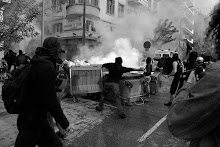
Police lack sense of humour
An anti-religion demonstration took place in the centre of Lecce [southern Italy] on April 30, 2010 with an exhibition, leaflets, megaphone and discussions on sexuality, abortion, personal freedoms, obscurantism. All these questions are obsessively brandished by the Church, as it tries to intrude its tentacles in the intimacy of everyone.
Nothing strange so far, except that the terrible demonstrators, just for fun, were offering desecrated wafers, wine of the Madonna and sweets of free love to passer-bys. Funny games were also being played to cheer the sunny afternoon of the very bigoted and bourgeois city of Lecce. But, as everybody knows, the pigs in uniform don’t like having fun except when they massacre those who end up in their barracks and police stations. So the pigs showed off their contempt: defamation, defamation, this is public defamation! First a few Digos officers tried to film passers-by and demonstrators intent at playing darts with a picture of Ratzinger [the current pope], but were soon driven away. Then they came back in greater number in anti-riot gear in order to seize the vituperated picture. Meantime dozens of people strolling in the piazza realized how the police, headed by chief Digos officer Raffaele Attanasi, were acting violently in their attempt to apply censorship. Not yet satisfied with creating such a chaos, Mr Attanasi threatened to kill an anarchist comrade if the latter dared touch him: ‘I’m going to chase you and kill you’, said the officer. Needless to say, the mess created by the police (but shouldn’t they guarantee public order?) attracted the attention of many passer-bys and onlookers, who stopped to watch the exhibition and to take leaflets. More police and carabinieri arriving on the spot were compelled to step back in front of the demonstrators denouncing them publicly through the megaphone.
Anarchists from Lecce
Text of the leaflet distributed during the initiative:
In a different way
To claim that violence and sexual abuse of minors are consequences of being homosexual [as an Italian high prelate recently did] is a proper terrorist act. It means to deny free sexual choice by considering it as a disease to be eradicated in order to avoid the most disgusting crimes that can be imagined. This is what high prelates of the Italian church felt obliged to say in the middle of so-called ‘paedophilia scandal’ that involves priests all over the world with the cover-up of the Vatican – including the pope. Besides suppressing all possibilities of auto-determination, this affirmation aims at banning the ‘diverse’ and legitimises, on a social and cultural level, the persecution against them. The more and more frequent aggressions against homosexuals are a clear example of this.
The stabbing of a homosexual is never mentioned whereas much is said against the abortion pill in the name of the defence of the ‘non-born’. Similarly, the murder of a pro-abortion doctor by a catholic fundamentalist is also silenced. Obviously not all lives are considered equal and worth being lived in the same way. After all, this reflects the entire history of discrimination characterising the catholic church and all the religions in the world.
If, on the one hand, the Vatican tries to divert the attention from the infamy committed by its representatives, on the other, relying on a particularly favourable socio-political climate, it tries to condition the life of everyone through practises of control on bodies and minds by pursuing its millennial aim: the submission and obedience of the masses through obscurantism.
Interfering with women's wombs and spying under people's sheets are practises aimed at social control: in this respect the Church and the State have always worked together in order to survive and reproduce themselves. Not by chance the campaign against the abortion pill can count on the support of the most conservative and reactionary politicians. This is an obvious example of the new form of collaboration between the State and the Church, which has seen the leaders of the Veneto and Piedmont regions backing the ban of the abortive pill in their local hospitals. Furthermore, when cardinal Bertone argued that it is homosexuality that leads to sexual violence on minors, there was total silence on the part of all [Italian] political representatives.
To talk about collaboration between the State and the Church might sound strange to some, but it is sufficient to look back in history to realize how the authority of these two institutions has always been the same.
Because of this collaboration, the revolutionaries shot priests and burnt churches during the Spanish civil war. If this had happened everywhere, maybe we wouldn’t be talking about all this now…
Showing posts with label detention centres. Show all posts
Showing posts with label detention centres. Show all posts
Friday, 7 May 2010

To the immigrants
translated from guerra sociale
We asked for labour power, men came.
Max Frisch
No one emigrates from their country for pleasure – this is a simple truth that many want to hide. If someone leaves their land and loved ones peacefully, we don’t define them as migrants, but simply as travellers or tourists. Migration is a coercive form of moving, a roaming in search of better living conditions.
At the moment there are 150 million ‘foreigners’ around the world due to wars, ecological disasters, famine, or simply the management of industrial production (the destruction of countryside and forests, mass lay-offs, and so on). All these aspects form a mosaic of oppression and misery in which the effects of exploitation become more or less direct causes of suffering and uprooting in a never ending spiral that makes any distinction between “displaced”, “migrants”, asylum seekers, refugees, survivors, hypocritical. Just think how social so called ecological emergencies (lack of water, growing desertification, field sterility) are: the explosion of an oil refinery, together with the destruction of every local autonomy on which it rested, can sometimes change the fate of an entire population.
Contrary to what racist propaganda would have us believe, only 17% of immigration concerns the rich North, it involves all continents (the African and Asian ones in particular); that means that for every poor country there is an even poorer one which immigrants are running away from. The total mobilization imposed by economy and States is a planetary symptom, an undeclared civil war that crosses every national border: millions of exploited people roam through the hell of the commercial heaven, jolted from border to border, forced into refugee camps, surrounded by police and army, handled by so-called charity organisations – partners in tragedies whose causes they don’t denounce for the mere purpose of exploiting the consequences – piled up in “waiting zones” in airports or stadiums (macabre circenses for those who don’t even have bread), locked up in Lagers called “detention centres” and, finally, packaged and expelled in the most total indifference. For many reasons we could say that the face of these unwelcome people is the face of our time – and that’s also why we’re so afraid of them. Immigrants scare us because in their misery we can see the reflection of our own, because in their wanderings we recognise our daily condition: the condition of persons who feel more and more like strangers both to this world and to themselves.
Uprooting is the most widespread condition in our present society – we might call it its centre – not a threat coming from a terrifying and mysterious elsewhere. Only by directing our gaze at our daily lives can we understand what gets all of us into the condition of immigrants. First though we must define a fundamental concept: that of clandestinity.
The creation of the clandestine, the creation of the enemy
[…] what are you? […]
You are not of this castle, you are not of this village, you are nothing.
But you are something too, unfortunately, you are a foreigner, someone that is always
inopportune and in the way, one that brings a lot of troubles, […]
whose intentions no one knows.
F. Kafka
An alien is simply someone who doesn’t have regular papers. And this is certainly not due to the pure pleasure of risk or illegality, but rather because in the majority of cases, in order to own such papers he or she would have to give certain guarantees the possession of which wouldn’t have made them aliens in the first place, but simply tourists or foreign students. If the same standards were forced on everybody, millions would have been thrown overboard. Which unemploy-ed Italian, for instance, could give the guarantee of a legal wage? What about all the precarious people here who work for temporary job agencies, whose contracts are not even worth a visa for immigrants? And by the way, are there as many Italians living in a 60 squares metres flat with no more than two other people? If we read all these decrees (from both the left and the right wing) about immigration, it will be clear that clandestinization is a precise project of States. Why?
An illegal immigrant is easier to blackmail, to make accept, under the threat of expulsion, even more hateful conditions of work and existence (precariousness, endless wandering, makeshift accommo-dation, and so on). With the threat of the police, bosses obtain tame wage slaves, or rather real forced labour workers. Even the most reactionary and xenophobic right wing parties are perfectly aware that hermetically closed borders are not only technically impossible, but are not even profitable. According to the United Nations, in order to keep the present “balance between active and inactive population”, from here to 2025, Italy should “take” inside its borders a quantity of immigrants five times the present yearly fixed amount. Confindustria, in fact, continuously suggest doubling the quantity fixed so far.
The granting or rejection of year-long or season-long permits contributes to creating a specific social hierarchy among the poor. The same distinction between immediate forced repatriation and expulsion (or the obligation, for an irregular immigrant, who shows up at the borders to be sent back home) allows them to choose who to make clandestine or to expel right away – a choice based on ethnic principles, economical-political agreement with the governments of the countries the immigrant comes from and the needs of the labour market. In fact, the authorities are perfectly aware that no one will ever spontaneously show up at the border to be expelled; surely not people who have spent all that they owned – sometimes even more – to pay for their trip here. Businessmen define the features of the goods they buy (immigrants are goods, like everything else after all), the State records data, police carry out orders.
The warnings of politicians and mass media, anti-immigration claims build up imaginary enemies to drive the exploited from here to lay on an easy scapegoat the growing social tension and reassure them, letting them admire the show of poor and even more precarious and blackmailed people than themselves, and let them feel part of a ghost called Nation. Making of “irregularity” – that same irregularity that they create – synonymous with crime and danger, States justify police control and the criminalisation of class conflict that is getting more and more seditious. In this context, for instance, should be seen the manipulation of consensus after September 11, summed up in the despicable slogan “clandestine=terrorist” which combines, if read in both senses, racist paranoia with the demand for repression against the enemy within (rebels, subversives).
They shout out, from the right as well as the left, against the Mafia that organises the journeys for clandestine people (described by the media as an invasion, a scourge, the advance of an army), when it’s by their very laws that they are promoted. They shout out against “organised crime” exploiting so many immigrants (which is true but only partially), when it’s they who supply it with desperate and ready-for-everything resources. In their historical symbiosis, State and Mafia stand united by the same liberal principle: business is business.
Racism, a means for economic and political necessity, finds room to spread in a context of generalised standardisation and isolation, when insecurity creates fears that can be opportunely manipulated. A moral or cultural condemnation of racism is of little use, since it is not an opinion or an argument, but psychological misery, an “emotional plague”. It’s in the present social conditions that the reason of its spreading ought to be sought and also, at the same time, the power to fight it.
The welcome of a lager
To call the detention camps for immigrants waiting for expulsion Lagers– centres introduced in Italy in 1998 by the left wing government by mean of the Turco-Napolitano law – is not rhetorical emphasis, as most of those who use this formula think. It is a strict definition. Nazi Lagers were concentration camps where people thought by the police to be dangerous for State security were locked up, even in the absence of criminally indictable behaviour. This precautionary measure – defined as “protective detention” – consisted in taking all civil and political rights away from certain citizens. Whether they were refugees, Jewish, gypsy, homosexuals or subversives, it was up to the police, after months or years, to decide what to do about them. So Lagers were not jails in which to expiate some crime, nor an extension of criminal law. They were camps where the Rule set its exception; in short terms, a legal suspension of legality. Therefore a Lager is not a consequence of the number of internees or of the number of murders (between 1935 and 1937, before the start of Jewish deportations, in Germany internees numbered 7500), but rather of its political and juridical nature.
Immigrants nowadays end up in the Centres regardless of possible crimes, without any criminal trial whatsoever: their internment, ordered by the police superintendents, are a simple police measure. Just as happened in 1940 under the Vichy government, when prefects could lock up all the individuals considered a “danger for national defence and public security” or (mind this) “foreigners in respect to the national economy”. We can refer to administrative detention in French Algeria, to the South Africa of apartheid or to the present ghettos for Palestinians created by the State of Israel.
It is not a coincidence if, with regard to the infamous conditions of the detention centres, the good democrats don’t appeal to the respect of any law at all, but to the respect of human rights – the last mask in front of women and men to whom nothing remains but belonging to the human species. It’s not possible to integrate them as citizens, so they are falsely integrated as Human Beings. The abstract equality of principles hides real inequalities everywhere.
A new eradication
Immigrants that for the
first time landed on Battery Park soon
realized that what they had been
told about the marvelous America
wasn’t true at all:
maybe land belonged to everybody,
but the first come
had largely served themselves already,
and to them there was nothing left
than to crowd together in tens in windowless
hovels
of the Lower East Side and work fifteen hours
a day. Turkeys didn’t fall roasted
straight in the dishes and the streets of New York
weren’t paved in gold.
Yet, most of the times, they weren’t
paved at all. And then they realised that
it was just to get them to pave these streets that they
were allowed to come. And to dig tunnels
and canals, to build up streets, bridges, big
embankments, railroads, to clear forests, to exploit
mines and caves, to make cars and cigars,/
carabines and clothes, shoes, chewing gum,
corned-beef and soap, and to build
skyscrapers higher
than the ones that they discovered when they first arrived.
Georges Perec
If we go a few steps back, it will become clear that eradication is a crucial moment in the expansion of the State and capitalistic domination. At its dawn, industrial production drew the exploited away from country and villages to gather them into the city. The ancient skills of farm workers and artisans were thereby substituted with the forced and repetitive activity of the factory – an activity impossible to control, in its means and its finalities, by the new proletarians. So the first children of industrialization lost both their ancient spaces of life and their ancient knowledge, that which had allowed them to autonomously provide for the most part of their means of subsistence. On the other hand, forcing millions of men and women to similar living conditions (same places, same problems, same knowledge), capitalism unified their struggles, got them to find new brothers and sisters to fight against that same unbearable life. The 20th century marked the apex of this productive and State gathering, whose symbols had been the factory-neighbourhood and the Lager, and at the same time the apex of the more radical social struggles for its destruction. In the last twenty years, due to technological innovation, capital has substituted the old factory with new productive cores ever smaller and more widely distributed throughout the territory, also breaking up the fabric of the society within which those fights had grown, thereby creating a new eradication.
There’s more. Technological reorganisation has made trade faster and easier, opening the whole world to the most ferocious competition, overthrowing the economies and the ways of life of entire Countries. So there is, in Africa, in Asia, in South America, the closure of many factories, mass lay offs. All this, within a social context that has been destroyed by colonisation from the deportation of inhabitants from their villages to the shantytowns, from their fields to the assembly lines, produced a crowd of poor people who became useless to their masters, of unwanted children of capitalism. Add to this the fall of self-styled communist Countries and the debt racket initiated by the International Monetary Fund and the World Bank and we will get quite a faithful cartography of migration, of ethnical and religious wars.
What we now call “flexibility” and “precariousness” is the consequence of all this: a further progress in the submission to the machines, fiercer competition, a worsening of material conditions (deals, health, etcetera). We’ve seen the reason why: capitalism has dismantled the community that it created. Anyway it would be partial to see precariousness in an economic sense alone, as the lack of a steady work place and the old pride for professionalism. It is isolation inside standardisation, or a fanatical conformity with lack of common spaces. In the distressing void of meaning and perspectives, mystified, the unfulfilled need of community returns, giving birth to new nationalistic, ethnical or religious counterpositions, a tragic re-proposition of collective identities just where any real communality among individuals has diminished. And it’s exactly within this void that the fundamentalist argument finds its place, false promise of a redeemed community.
Civil war
All this leads to a scenario that is more and more that of an ongoing civil war, with no distinction between “time of peace” and “time of war”. Conflicts are no longer declared – as the military intervention in the Balkans has shown –, but simply administrated to grant the establishment of the World Order. This endless fight goes through the entire society and the very individuals. Common spaces for dialogue and struggles are substituted by adherence to similar commercial models. The poor go to war against each other for a fashionable sweater or a hat, since the possession or not of particular goods creates the illusion of a social or clan-like hierarchy. Individuals feel more and more irrelevant, so ready to sacrifice themselves to the first nationalist blunderbuss or for whatever flag. Abused daily by the State, here they come defending zealously any Padania (desolated and polluted, with factories and mall everywhere – is this the “land of the forefathers”?). Tied to that mirage of property that is left to them, they are scared to face themselves for what they really are: interchangeable gears of the Megamachine, in need of psychotropic drugs to get to the end of the day, always more envious towards everyone who looks even just happier than themselves. To an always colder, more abstract and more calculating rationality, correspond increasingly brutal and untold drives. So, what better than someone different by colour of the skin or religion to throw their grudge upon? As a man from Mozambique said, “people have taken war inside them”. A few external conditions can be enough for all this to explode, just like in Bosnia. And these conditions are being carefully prepared. To capitalist Universalism is opposed, in a tragic game of mirrors, ethnic particularism. Under institutional order, with increasingly anonymous and controlled places, lies concealed the implosion of human relationships. It all looks like the same quicksand from whence in the 30’s totalitarian man arose.
Two possible ways out
Why have we talked so much about immigration and racism, as we are not directly touched by problems of wandering and expulsion? Dictated by some of its peculiarities such as precariousness and the impossibility to decide for our present, this same capitalism is joining our lives more and more: that’s why we feel like brothers, in deed, with the all the exploited who land on the shores of this Country.
In the face of the despoliation of millions of individuals towards a commercial imperialism that is forcing everybody to dream the same lifeless dream, there can be no appeal to dialogue or to democratic integration. Whatever the legalistic anti-racists might say, it’s too late for hypocritical civic education classes. When the fields in which misery is confined – from the shantytowns of Caracas to the suburbs of Paris, from the Palestinian territories to centres and stadia where aliens are locked up–are growing everywhere; when the state of exception – or the juridical suspension of every right – becomes the rule; when millions of human beings are literally left rotting into the reserves of the capitalist heaven; when entire neighbourhoods are getting militarised and armed (Genova doesn’t tell you anything?), to talk of immigration becomes a despicable joke. There are only two ways out from these conditions of desperation and fear, from this planetary civil war: the fraticidal clash (religious and clannish in all its manifestations), or the social tempest of class war.
Racism is the grave of every exploited individual’s fight against the exploiters, it’s the last trick – the dirtiest – played by those who would like to see ourselves killing one another. It can only evaporate in moments of common revolt, when we recognise our real enemies – the exploiters and their servants – and we recognise ourselves as exploited individuals that no longer want to be like that. The social fight that took place in Italy during the 60’s and 70’s – when the young workers immigrated from the South met those from the North in the field of sabotage, wild strikes and absolute disloyalty to the firm – has shown. The disappearance of the revolutionary struggles after the 70’s (from Nicaragua to Italy, from Portugal to Germany, from Poland to Iran) has crumbled the foundation of concrete solidarity among the dispossessed of the World. This solidarity will only be conquered again in the revolt, and not in the powerless words of the new Thirdworlders or the democratic anti-racists.
So, or religious and clannish massacre, or class war. And at the end of this we can only catch a glimpse of a world free from State and money in which there’ll be no need for money to live and no visa required to travel.
A machine that can be broken
A slogan in the 80’s said: “It’s not the noise of boot that should scared us today, but the silence of the slipper”. Now they’re both coming back. With a holy war speech (the police as “army of good” protecting citizens from the “army of evil”, as the Prime Minister said recently), day after day the State has put up curtains at the expense of immigrants. Their homes are devastated, aliens are rounded up in the streets, locked up in Lagers and expelled in total indifference. New detention camps are already under construction in many cities. The State, wants to limit the number of visas according to the exact length of the work contract, blacklist all immigrants, make being clandestine a crime and strengthen expulsion. The democratic mechanism of rights and citizenship, wide as that might be, will always presuppose the existence of excluded people. To criticise and try to prevent expulsions signifies realising a critique of racism and nationalism in act; it means creating a common space for revolt against the capitalist uprooting that affects us all; it means obstructing a hateful as it is important repressive mechanism; it means breaking the silence and indifference of the civilized ones who stand looking on; lastly, it means confronting the very concept of law dictated by the principle “we are all aliens”. Finally, it signifies an attack on one of the pillars of the State and class society: competition between the poor, the increasingly seditious substitution of social war with ethnic or religious wars.
In order to function the expulsion framework requires the collaboration of many public and private structures (from the Red Cross which cooperates in the management of Lagers, to companies which supply services, to airline companies which deport aliens, to the airports that put up waiting zones, to self-styled charity associations which operate in collaboration with the police). All those responsible can easily be seen and attacked. From actions against detention camps (as happened a couple of years ago in Belgium and a few months ago in Australia, when demonstrations ended up with the liberation of some clandestine immigrants) to those against “waiting zones” (as in France, against the Ibis hotels chain that supplies the police with rooms) or obstructing the flights of infamy (in Frankfurt, the sabotage of optic fibre cables some years ago put all the computers of an airport out of order for a couple of days) there are thousands of activities that a movement against expulsion can carry out.
Today like never before it’s in the street that it’s possible to rebuild class solidarity. In the complicity against police raids; in the struggle against military occupation of neighbourhoods; in the restless rejection of every division that the masters of society want to impose on us (nationals and foreigners, legal immigrants and aliens); aware that every outrage suffered by any dispossessed on Earth is an outrage to everyone – only in this way will the exploited people from a thousand countries recognise themselves.
We asked for labour power, men came.
Max Frisch
No one emigrates from their country for pleasure – this is a simple truth that many want to hide. If someone leaves their land and loved ones peacefully, we don’t define them as migrants, but simply as travellers or tourists. Migration is a coercive form of moving, a roaming in search of better living conditions.
At the moment there are 150 million ‘foreigners’ around the world due to wars, ecological disasters, famine, or simply the management of industrial production (the destruction of countryside and forests, mass lay-offs, and so on). All these aspects form a mosaic of oppression and misery in which the effects of exploitation become more or less direct causes of suffering and uprooting in a never ending spiral that makes any distinction between “displaced”, “migrants”, asylum seekers, refugees, survivors, hypocritical. Just think how social so called ecological emergencies (lack of water, growing desertification, field sterility) are: the explosion of an oil refinery, together with the destruction of every local autonomy on which it rested, can sometimes change the fate of an entire population.
Contrary to what racist propaganda would have us believe, only 17% of immigration concerns the rich North, it involves all continents (the African and Asian ones in particular); that means that for every poor country there is an even poorer one which immigrants are running away from. The total mobilization imposed by economy and States is a planetary symptom, an undeclared civil war that crosses every national border: millions of exploited people roam through the hell of the commercial heaven, jolted from border to border, forced into refugee camps, surrounded by police and army, handled by so-called charity organisations – partners in tragedies whose causes they don’t denounce for the mere purpose of exploiting the consequences – piled up in “waiting zones” in airports or stadiums (macabre circenses for those who don’t even have bread), locked up in Lagers called “detention centres” and, finally, packaged and expelled in the most total indifference. For many reasons we could say that the face of these unwelcome people is the face of our time – and that’s also why we’re so afraid of them. Immigrants scare us because in their misery we can see the reflection of our own, because in their wanderings we recognise our daily condition: the condition of persons who feel more and more like strangers both to this world and to themselves.
Uprooting is the most widespread condition in our present society – we might call it its centre – not a threat coming from a terrifying and mysterious elsewhere. Only by directing our gaze at our daily lives can we understand what gets all of us into the condition of immigrants. First though we must define a fundamental concept: that of clandestinity.
The creation of the clandestine, the creation of the enemy
[…] what are you? […]
You are not of this castle, you are not of this village, you are nothing.
But you are something too, unfortunately, you are a foreigner, someone that is always
inopportune and in the way, one that brings a lot of troubles, […]
whose intentions no one knows.
F. Kafka
An alien is simply someone who doesn’t have regular papers. And this is certainly not due to the pure pleasure of risk or illegality, but rather because in the majority of cases, in order to own such papers he or she would have to give certain guarantees the possession of which wouldn’t have made them aliens in the first place, but simply tourists or foreign students. If the same standards were forced on everybody, millions would have been thrown overboard. Which unemploy-ed Italian, for instance, could give the guarantee of a legal wage? What about all the precarious people here who work for temporary job agencies, whose contracts are not even worth a visa for immigrants? And by the way, are there as many Italians living in a 60 squares metres flat with no more than two other people? If we read all these decrees (from both the left and the right wing) about immigration, it will be clear that clandestinization is a precise project of States. Why?
An illegal immigrant is easier to blackmail, to make accept, under the threat of expulsion, even more hateful conditions of work and existence (precariousness, endless wandering, makeshift accommo-dation, and so on). With the threat of the police, bosses obtain tame wage slaves, or rather real forced labour workers. Even the most reactionary and xenophobic right wing parties are perfectly aware that hermetically closed borders are not only technically impossible, but are not even profitable. According to the United Nations, in order to keep the present “balance between active and inactive population”, from here to 2025, Italy should “take” inside its borders a quantity of immigrants five times the present yearly fixed amount. Confindustria, in fact, continuously suggest doubling the quantity fixed so far.
The granting or rejection of year-long or season-long permits contributes to creating a specific social hierarchy among the poor. The same distinction between immediate forced repatriation and expulsion (or the obligation, for an irregular immigrant, who shows up at the borders to be sent back home) allows them to choose who to make clandestine or to expel right away – a choice based on ethnic principles, economical-political agreement with the governments of the countries the immigrant comes from and the needs of the labour market. In fact, the authorities are perfectly aware that no one will ever spontaneously show up at the border to be expelled; surely not people who have spent all that they owned – sometimes even more – to pay for their trip here. Businessmen define the features of the goods they buy (immigrants are goods, like everything else after all), the State records data, police carry out orders.
The warnings of politicians and mass media, anti-immigration claims build up imaginary enemies to drive the exploited from here to lay on an easy scapegoat the growing social tension and reassure them, letting them admire the show of poor and even more precarious and blackmailed people than themselves, and let them feel part of a ghost called Nation. Making of “irregularity” – that same irregularity that they create – synonymous with crime and danger, States justify police control and the criminalisation of class conflict that is getting more and more seditious. In this context, for instance, should be seen the manipulation of consensus after September 11, summed up in the despicable slogan “clandestine=terrorist” which combines, if read in both senses, racist paranoia with the demand for repression against the enemy within (rebels, subversives).
They shout out, from the right as well as the left, against the Mafia that organises the journeys for clandestine people (described by the media as an invasion, a scourge, the advance of an army), when it’s by their very laws that they are promoted. They shout out against “organised crime” exploiting so many immigrants (which is true but only partially), when it’s they who supply it with desperate and ready-for-everything resources. In their historical symbiosis, State and Mafia stand united by the same liberal principle: business is business.
Racism, a means for economic and political necessity, finds room to spread in a context of generalised standardisation and isolation, when insecurity creates fears that can be opportunely manipulated. A moral or cultural condemnation of racism is of little use, since it is not an opinion or an argument, but psychological misery, an “emotional plague”. It’s in the present social conditions that the reason of its spreading ought to be sought and also, at the same time, the power to fight it.
The welcome of a lager
To call the detention camps for immigrants waiting for expulsion Lagers– centres introduced in Italy in 1998 by the left wing government by mean of the Turco-Napolitano law – is not rhetorical emphasis, as most of those who use this formula think. It is a strict definition. Nazi Lagers were concentration camps where people thought by the police to be dangerous for State security were locked up, even in the absence of criminally indictable behaviour. This precautionary measure – defined as “protective detention” – consisted in taking all civil and political rights away from certain citizens. Whether they were refugees, Jewish, gypsy, homosexuals or subversives, it was up to the police, after months or years, to decide what to do about them. So Lagers were not jails in which to expiate some crime, nor an extension of criminal law. They were camps where the Rule set its exception; in short terms, a legal suspension of legality. Therefore a Lager is not a consequence of the number of internees or of the number of murders (between 1935 and 1937, before the start of Jewish deportations, in Germany internees numbered 7500), but rather of its political and juridical nature.
Immigrants nowadays end up in the Centres regardless of possible crimes, without any criminal trial whatsoever: their internment, ordered by the police superintendents, are a simple police measure. Just as happened in 1940 under the Vichy government, when prefects could lock up all the individuals considered a “danger for national defence and public security” or (mind this) “foreigners in respect to the national economy”. We can refer to administrative detention in French Algeria, to the South Africa of apartheid or to the present ghettos for Palestinians created by the State of Israel.
It is not a coincidence if, with regard to the infamous conditions of the detention centres, the good democrats don’t appeal to the respect of any law at all, but to the respect of human rights – the last mask in front of women and men to whom nothing remains but belonging to the human species. It’s not possible to integrate them as citizens, so they are falsely integrated as Human Beings. The abstract equality of principles hides real inequalities everywhere.
A new eradication
Immigrants that for the
first time landed on Battery Park soon
realized that what they had been
told about the marvelous America
wasn’t true at all:
maybe land belonged to everybody,
but the first come
had largely served themselves already,
and to them there was nothing left
than to crowd together in tens in windowless
hovels
of the Lower East Side and work fifteen hours
a day. Turkeys didn’t fall roasted
straight in the dishes and the streets of New York
weren’t paved in gold.
Yet, most of the times, they weren’t
paved at all. And then they realised that
it was just to get them to pave these streets that they
were allowed to come. And to dig tunnels
and canals, to build up streets, bridges, big
embankments, railroads, to clear forests, to exploit
mines and caves, to make cars and cigars,/
carabines and clothes, shoes, chewing gum,
corned-beef and soap, and to build
skyscrapers higher
than the ones that they discovered when they first arrived.
Georges Perec
If we go a few steps back, it will become clear that eradication is a crucial moment in the expansion of the State and capitalistic domination. At its dawn, industrial production drew the exploited away from country and villages to gather them into the city. The ancient skills of farm workers and artisans were thereby substituted with the forced and repetitive activity of the factory – an activity impossible to control, in its means and its finalities, by the new proletarians. So the first children of industrialization lost both their ancient spaces of life and their ancient knowledge, that which had allowed them to autonomously provide for the most part of their means of subsistence. On the other hand, forcing millions of men and women to similar living conditions (same places, same problems, same knowledge), capitalism unified their struggles, got them to find new brothers and sisters to fight against that same unbearable life. The 20th century marked the apex of this productive and State gathering, whose symbols had been the factory-neighbourhood and the Lager, and at the same time the apex of the more radical social struggles for its destruction. In the last twenty years, due to technological innovation, capital has substituted the old factory with new productive cores ever smaller and more widely distributed throughout the territory, also breaking up the fabric of the society within which those fights had grown, thereby creating a new eradication.
There’s more. Technological reorganisation has made trade faster and easier, opening the whole world to the most ferocious competition, overthrowing the economies and the ways of life of entire Countries. So there is, in Africa, in Asia, in South America, the closure of many factories, mass lay offs. All this, within a social context that has been destroyed by colonisation from the deportation of inhabitants from their villages to the shantytowns, from their fields to the assembly lines, produced a crowd of poor people who became useless to their masters, of unwanted children of capitalism. Add to this the fall of self-styled communist Countries and the debt racket initiated by the International Monetary Fund and the World Bank and we will get quite a faithful cartography of migration, of ethnical and religious wars.
What we now call “flexibility” and “precariousness” is the consequence of all this: a further progress in the submission to the machines, fiercer competition, a worsening of material conditions (deals, health, etcetera). We’ve seen the reason why: capitalism has dismantled the community that it created. Anyway it would be partial to see precariousness in an economic sense alone, as the lack of a steady work place and the old pride for professionalism. It is isolation inside standardisation, or a fanatical conformity with lack of common spaces. In the distressing void of meaning and perspectives, mystified, the unfulfilled need of community returns, giving birth to new nationalistic, ethnical or religious counterpositions, a tragic re-proposition of collective identities just where any real communality among individuals has diminished. And it’s exactly within this void that the fundamentalist argument finds its place, false promise of a redeemed community.
Civil war
All this leads to a scenario that is more and more that of an ongoing civil war, with no distinction between “time of peace” and “time of war”. Conflicts are no longer declared – as the military intervention in the Balkans has shown –, but simply administrated to grant the establishment of the World Order. This endless fight goes through the entire society and the very individuals. Common spaces for dialogue and struggles are substituted by adherence to similar commercial models. The poor go to war against each other for a fashionable sweater or a hat, since the possession or not of particular goods creates the illusion of a social or clan-like hierarchy. Individuals feel more and more irrelevant, so ready to sacrifice themselves to the first nationalist blunderbuss or for whatever flag. Abused daily by the State, here they come defending zealously any Padania (desolated and polluted, with factories and mall everywhere – is this the “land of the forefathers”?). Tied to that mirage of property that is left to them, they are scared to face themselves for what they really are: interchangeable gears of the Megamachine, in need of psychotropic drugs to get to the end of the day, always more envious towards everyone who looks even just happier than themselves. To an always colder, more abstract and more calculating rationality, correspond increasingly brutal and untold drives. So, what better than someone different by colour of the skin or religion to throw their grudge upon? As a man from Mozambique said, “people have taken war inside them”. A few external conditions can be enough for all this to explode, just like in Bosnia. And these conditions are being carefully prepared. To capitalist Universalism is opposed, in a tragic game of mirrors, ethnic particularism. Under institutional order, with increasingly anonymous and controlled places, lies concealed the implosion of human relationships. It all looks like the same quicksand from whence in the 30’s totalitarian man arose.
Two possible ways out
Why have we talked so much about immigration and racism, as we are not directly touched by problems of wandering and expulsion? Dictated by some of its peculiarities such as precariousness and the impossibility to decide for our present, this same capitalism is joining our lives more and more: that’s why we feel like brothers, in deed, with the all the exploited who land on the shores of this Country.
In the face of the despoliation of millions of individuals towards a commercial imperialism that is forcing everybody to dream the same lifeless dream, there can be no appeal to dialogue or to democratic integration. Whatever the legalistic anti-racists might say, it’s too late for hypocritical civic education classes. When the fields in which misery is confined – from the shantytowns of Caracas to the suburbs of Paris, from the Palestinian territories to centres and stadia where aliens are locked up–are growing everywhere; when the state of exception – or the juridical suspension of every right – becomes the rule; when millions of human beings are literally left rotting into the reserves of the capitalist heaven; when entire neighbourhoods are getting militarised and armed (Genova doesn’t tell you anything?), to talk of immigration becomes a despicable joke. There are only two ways out from these conditions of desperation and fear, from this planetary civil war: the fraticidal clash (religious and clannish in all its manifestations), or the social tempest of class war.
Racism is the grave of every exploited individual’s fight against the exploiters, it’s the last trick – the dirtiest – played by those who would like to see ourselves killing one another. It can only evaporate in moments of common revolt, when we recognise our real enemies – the exploiters and their servants – and we recognise ourselves as exploited individuals that no longer want to be like that. The social fight that took place in Italy during the 60’s and 70’s – when the young workers immigrated from the South met those from the North in the field of sabotage, wild strikes and absolute disloyalty to the firm – has shown. The disappearance of the revolutionary struggles after the 70’s (from Nicaragua to Italy, from Portugal to Germany, from Poland to Iran) has crumbled the foundation of concrete solidarity among the dispossessed of the World. This solidarity will only be conquered again in the revolt, and not in the powerless words of the new Thirdworlders or the democratic anti-racists.
So, or religious and clannish massacre, or class war. And at the end of this we can only catch a glimpse of a world free from State and money in which there’ll be no need for money to live and no visa required to travel.
A machine that can be broken
A slogan in the 80’s said: “It’s not the noise of boot that should scared us today, but the silence of the slipper”. Now they’re both coming back. With a holy war speech (the police as “army of good” protecting citizens from the “army of evil”, as the Prime Minister said recently), day after day the State has put up curtains at the expense of immigrants. Their homes are devastated, aliens are rounded up in the streets, locked up in Lagers and expelled in total indifference. New detention camps are already under construction in many cities. The State, wants to limit the number of visas according to the exact length of the work contract, blacklist all immigrants, make being clandestine a crime and strengthen expulsion. The democratic mechanism of rights and citizenship, wide as that might be, will always presuppose the existence of excluded people. To criticise and try to prevent expulsions signifies realising a critique of racism and nationalism in act; it means creating a common space for revolt against the capitalist uprooting that affects us all; it means obstructing a hateful as it is important repressive mechanism; it means breaking the silence and indifference of the civilized ones who stand looking on; lastly, it means confronting the very concept of law dictated by the principle “we are all aliens”. Finally, it signifies an attack on one of the pillars of the State and class society: competition between the poor, the increasingly seditious substitution of social war with ethnic or religious wars.
In order to function the expulsion framework requires the collaboration of many public and private structures (from the Red Cross which cooperates in the management of Lagers, to companies which supply services, to airline companies which deport aliens, to the airports that put up waiting zones, to self-styled charity associations which operate in collaboration with the police). All those responsible can easily be seen and attacked. From actions against detention camps (as happened a couple of years ago in Belgium and a few months ago in Australia, when demonstrations ended up with the liberation of some clandestine immigrants) to those against “waiting zones” (as in France, against the Ibis hotels chain that supplies the police with rooms) or obstructing the flights of infamy (in Frankfurt, the sabotage of optic fibre cables some years ago put all the computers of an airport out of order for a couple of days) there are thousands of activities that a movement against expulsion can carry out.
Today like never before it’s in the street that it’s possible to rebuild class solidarity. In the complicity against police raids; in the struggle against military occupation of neighbourhoods; in the restless rejection of every division that the masters of society want to impose on us (nationals and foreigners, legal immigrants and aliens); aware that every outrage suffered by any dispossessed on Earth is an outrage to everyone – only in this way will the exploited people from a thousand countries recognise themselves.
Thursday, 6 May 2010
THE TRUE FACE OF WELCOME IN THE SALENTO CONCENTRATION CAMP OF SAINT FOCA
‘Welcome’: this is what bureaucrats, priests and politicians call the infamous practice of locking up in concentration camps like the Regina Pacis one in Saint Foca (Salento, southern Italy) all the people waiting to be deported because they don’t fit into the immigration quota which has been fixed by the bosses. We must come out and say it: immigrants are merchandise (like everything else in our society). The bosses decide on the quantity and character of what they want to buy, political power collects information, the police does its roundups, and finally the jailers look after the prisoners in the immigration camp in order to prevent them from moving freely. These camps are surrounded by huge walls and barbed wire, with bars on the windows and cameras and guards all around. In spite of the fact that they are presented as places of welcome and solidarity, they are actually prisons for those who are to be deported from the rich western world where there is only room for the ones who are useful to its awful machinery. This is their great welcome.
Monsignor Cosmo Francesco Ruppi, archbishop of Otranto and prestigious figure in political and religious circles of Salento, is fundamental to this perverse machinery. Through his lackey father Cesare Lodeserto he controls the prison Regina Pacis in Sain Foca where men women and children whose only guilt is that they landed on the shores of southern Italy without any identity documents in order to escape from miserable living conditions are locked up: for this stupid reason alone these human beings are called ‘clandestine’. The archbishop hides himself behind a false and reassuring mask of benefactor and succeeds in gaining many common people’s confidence. The truth is that he is just an unscrupulous criminal, a very mean man who takes advantage of hundreds of human beings’ hopes and desperation. Ruppi regards them as animals for the slaughter who serve only for him to get rich as quickly as possible during their imprisonment while waiting to be sent back to their countries to face hunger, war, misery, sickness, exploitation once again … These conditions are all being created by the western world. In addition to this, we have to consider the hundreds of people who die during these so-called ‘journeys of hope’. And Ruppi and his accomplice Cesare Lodeserto, a criminal of the same category, are also morally responsible for such deaths. These two vultures, along with anyone else who does the same job as theirs, are our enemies, whereas we are side by side with the immigrants who reach our shores. We know well that capitalism is making our existence similar to that of the exploited immigrants, full of uncertainty and the impossibility to decide about our present and our future. If we share the same conditions of exploitation, we can also share the struggle against this life which is becoming more and more deprived of any freedom.
ENEMIES OF ALL BORDERS
Monsignor Cosmo Francesco Ruppi, archbishop of Otranto and prestigious figure in political and religious circles of Salento, is fundamental to this perverse machinery. Through his lackey father Cesare Lodeserto he controls the prison Regina Pacis in Sain Foca where men women and children whose only guilt is that they landed on the shores of southern Italy without any identity documents in order to escape from miserable living conditions are locked up: for this stupid reason alone these human beings are called ‘clandestine’. The archbishop hides himself behind a false and reassuring mask of benefactor and succeeds in gaining many common people’s confidence. The truth is that he is just an unscrupulous criminal, a very mean man who takes advantage of hundreds of human beings’ hopes and desperation. Ruppi regards them as animals for the slaughter who serve only for him to get rich as quickly as possible during their imprisonment while waiting to be sent back to their countries to face hunger, war, misery, sickness, exploitation once again … These conditions are all being created by the western world. In addition to this, we have to consider the hundreds of people who die during these so-called ‘journeys of hope’. And Ruppi and his accomplice Cesare Lodeserto, a criminal of the same category, are also morally responsible for such deaths. These two vultures, along with anyone else who does the same job as theirs, are our enemies, whereas we are side by side with the immigrants who reach our shores. We know well that capitalism is making our existence similar to that of the exploited immigrants, full of uncertainty and the impossibility to decide about our present and our future. If we share the same conditions of exploitation, we can also share the struggle against this life which is becoming more and more deprived of any freedom.
ENEMIES OF ALL BORDERS
THE ANARCHIST STRUGGLE AGAINST THE CONCENTRATION CAMP OF SAINT FOCA (Lecce, S. Italy)
Concentration camps for immigrants were introduced in Italy by a law passed in l998 by the ‘leftist’ government of Massimo D’Alema. They are called CENTRI DI PERMANENZA TEMPORANEA (CTP), ‘temporary stay camps’. The minister responsible for this law was Livia Turco, former Welfare Minister.
There is no substantial difference between the ‘leftist’ law on immigration and the one passed by the current Berlusconi’s government, the so-called Bossi-Fini law. The latter simply limits the number of visas to be given, a measure which meets the needs of the Italian capitalist system and therefore would have been taken by the previous government had it still been in charge. In other words, now fewer immigrants are allowed to stay in Italy than before, the ones who are useful to the Italian economy. All the others are located in concentration camps built by the ‘leftist government, waiting to be deported to their countries where they face once again those awful conditions (hunger, war, sickness, exploitation) that have been created by the western world.
In Salento in southern Italy, which is part of the Puglia region, can be found the concentration camp REGINA PACIS of Saint Foca. It is run by Italian the catholic organisation Caritas, or more precisely by Cesare Lodeserto, a priest who is the manager of the camp, and his boss Cosmo Francesco Ruppi, archbishop of Otranto.
A number terrible deeds have occurred in ‘Regina Pacis’ since it was created, including beatings, forced administration of psychotropic drugs, attempted suicides… not to mention the many escape attempts which were unfortunately mostly unsuccessful. There have been protests against such a hellish detention centre since it was built. Both Lecce Social Forum (composed of leftist parties and various humanitarian and green associations) and the anarchists of Lecce have always taken part in the struggle against ‘Regina Pacis’, but no agreement has ever been made between the two categories of protestors. At the beginning the main difference concerned the existence of the camp–while the Social Forum claimed for the improvement of the material living conditions in the camp, the anarchists wanted its immediate suppression. But was only after Berlusconi came to power that the Social forum started asking for the closure of the camp too,
The contrast between the anarchists and the other protestors, however, has always been one concerning methods of struggle, as Social Forum has always refused any find of direct attack against the camp. The anarchists, on the contrary, maintain that what really counts is sharp attack, aiming to transform the struggle against the concentration camps into a concrete fact. Not only the help given to the immigrants, but also and mainly the attack against the people responsible for their suffering. That’s how, along with demonstrations, sit-ins, debates, distribution of leaflets, meetings, etc, the anarchists have always been planning a series of attacks against the core of Regina Pacis management.
More than once, Social Forum members have sent delegations, also comprised of a number of members of parliament, inside the camp in order to talk with the manager and eventually acquire some meaningless promise from him. On the other hand, the anarchists have always refused any dialogue with the people who capture immigrants for deportation and draw up the troops to prevent them from entering Italy. Somany tragedies have occurred in the Adriati Sea over the past few years, not only tragic shipwrecks of immigrants’ boats but also massacres due directly to some military measures taken to block access to the Italian shores. [Kater I Rades] No bartering is possible with those who sell weapons to the armies and take war into the countries from where most of the immigrants escape. No dialogue is possible with the exploiters of their labour and resources, the same who reduce them to starvation, then build prisons for capturing them and give protection to those who beat, torture and kill them. Only recently the manager of ‘Regina Pacis’ Cesare Lodeserto has been charged with ill-treatment and injuries after many years of investigation which had never led to any charges in spite of all the evidence of Lodeserto’s guilt. And it was following this serious episode that Social Forum interrupted its dialogue with ‘Regina Pacis’ manager.
The contrast between Social Forum and the anarchists has shown itself during many demonstrations in front of the camp. In particular Social Forum, especially before Lodeserto was officially charged, were clearly worried about certain slogans shouted out by anarchists against the manager. Social Forum used to say that ‘don Cesare’ was not such a bad person nd that all the guilt belonged to Berlusconi’s government (we should remember that Italian camps for immigrants were set up by the current Berlusconi’s opponents). And they have always dissociated themselves with indignation from the acts of sabotage carried out by the anarchists both during demonstrations in Saint Foca (damage to Caritas vans, attempts to communicate with the imprisoned immigrants, writings on the walls surrounding the camps) and at any other time in any other place. […]
Main actions:
Counter-information in the places where the camps are located in order to let the inhabitants know what really happens in those prisons.
Saint Foca, where the camps are located, is a little sea-side town which is full of people on holiday in the summer. During that period the anarchists organise unauthorised public debates and distribution of leaflets. Social Forum only comes to the big demonstrations against the camp which have previously been authorised by the police.
Cooperation on a large scale with the comrades who struggle against the many other concentration camps in the country.
Acts of sabotage aimed at striking anything anything and anyone connected to the camps:
managers and their armed guards
firms providing any kind of service (food, laundry, etc)
lawyers defending the people who work in the camps and are responsible for the ill-treatment of the immigrants
etc
The information produced by the anarchists is in sharp contrast with that provided by the media and journalists, whose aims and methods are opposite to those of the anarchists.
Chronology
31 August 2002 - group of demonstrators interrupts a meeting of Melendugno Council with trumpets. They also show the banner ‘No Borders, No Foreigners’ and shout their content against the mayor who had banned an exhibition on immigration in Saint Foca. Distribution of leaflets and among the people of the Council.
21 September 2002 – 4 immigrants attempt to escape from Regina Pacis and have a fight with the police who are always in the camp. Unfortunately 2 are arrested.
3 November 2002 – Demonstration in front of the church in Monteroni (Lecce) where Archbishop Ruppi is celebrating a religious event. Exposition of banner, exhibition on immigration and distribution of leaflets. Ruppi doesn’t show up to greet the crowd who were waiting for his blessing, but runs away by the back door.
12 November 2002 – Group of demonstrators gathers outside the palace of the Prefecture in Lecce where 11 Home Secretaries of the Adriatic-Ionic area are about to have a gala dinner. The next day the same ministers are supposed to have a summit to strengthen measures and a plan of ‘alert and rapid reaction’ against illegal immigration. The demonstrators show their anger with whistles, trumpets, megaphones. Thousands of leaflets are handed out and road blocks are carried out.
13 November 2002 – During a Social Forum against the summit of the 11 ministers, the anarchists throw some rotten fruit and eggs against the cops, the journalists and the security service of the Social Forum.
20 November 2002 – Casarano (Lecce) – a conference organised by Alleanza Nazionale (the Italian fascist party) on immigration in which Lodeserto participates is interrupted by 15 demonstrators who show a banner against the deportation of immigrants.
22 November 2002 – 40 immigrants escape from Rgina Pacis after a fight with the police. In the following days most of them are captured again, only 7 succeed in gaining freedom. The immigrants captured again are violently beaten for reprisal.
26 April 2003 – 4 Rumenian attempt to escape from Regina Pacis and beat two carabinieri cops who try to stop them.
3 May 2003 – A group of North African immigrants destroy the canteen of Regina Pacis in protest against their deportation notice. 8 carabinieri are injured.
10 May 2003 – Lecce – soon before the start of ‘Giro d’Italia’, the most important cycling event in Italy, some writings appear on the roads of the trajectory: ‘Free all Immigrants, Ruppi is a killer’.
11 June 2003 – Lecce – The front door of the ancient baroque cathedral is set on fire. On the walls these writings appear: ‘Free the Immigrants from the concentration Camps’. ‘Ruppi and Lodeserto are Criminal Bastards’.
September/October 2003 – Lecce – the local newspapers write about the many writings on the churches and palaces of Lecce against Regina Pacis and its management.
October 2003 – 4 attempted suicides in Regina Pacis.
8 November 2003 - in Lecce and Lequile two cash machines of ‘Banca Intesa’ are set on fire and destroyed. That bank is involved in Regina Pacis management. In Lequile a few bank nots also burn and the inside walls of the bank are damaged. On the spot a few leaflets are left about Regina Pacis.
9 November 2003 – Lecce – another cash machine of Banca Intesa is blocked with glue.
24 November 2003 – An Algerian prisoner in Regina Pacis attacks Lodeserto with a stick and injures him.
3 December 2003 – Calimera, Lecce – a lot of posters and writings against Catia Cazzato appear on the walls of the village. The woman is employed in Regina Pacis and is responsible for writing false reports about the beatings of immigrants, maintaining that the prisoners’ injuries were self-inflicted in order to try to escape from the camp.
There is no substantial difference between the ‘leftist’ law on immigration and the one passed by the current Berlusconi’s government, the so-called Bossi-Fini law. The latter simply limits the number of visas to be given, a measure which meets the needs of the Italian capitalist system and therefore would have been taken by the previous government had it still been in charge. In other words, now fewer immigrants are allowed to stay in Italy than before, the ones who are useful to the Italian economy. All the others are located in concentration camps built by the ‘leftist government, waiting to be deported to their countries where they face once again those awful conditions (hunger, war, sickness, exploitation) that have been created by the western world.
In Salento in southern Italy, which is part of the Puglia region, can be found the concentration camp REGINA PACIS of Saint Foca. It is run by Italian the catholic organisation Caritas, or more precisely by Cesare Lodeserto, a priest who is the manager of the camp, and his boss Cosmo Francesco Ruppi, archbishop of Otranto.
A number terrible deeds have occurred in ‘Regina Pacis’ since it was created, including beatings, forced administration of psychotropic drugs, attempted suicides… not to mention the many escape attempts which were unfortunately mostly unsuccessful. There have been protests against such a hellish detention centre since it was built. Both Lecce Social Forum (composed of leftist parties and various humanitarian and green associations) and the anarchists of Lecce have always taken part in the struggle against ‘Regina Pacis’, but no agreement has ever been made between the two categories of protestors. At the beginning the main difference concerned the existence of the camp–while the Social Forum claimed for the improvement of the material living conditions in the camp, the anarchists wanted its immediate suppression. But was only after Berlusconi came to power that the Social forum started asking for the closure of the camp too,
The contrast between the anarchists and the other protestors, however, has always been one concerning methods of struggle, as Social Forum has always refused any find of direct attack against the camp. The anarchists, on the contrary, maintain that what really counts is sharp attack, aiming to transform the struggle against the concentration camps into a concrete fact. Not only the help given to the immigrants, but also and mainly the attack against the people responsible for their suffering. That’s how, along with demonstrations, sit-ins, debates, distribution of leaflets, meetings, etc, the anarchists have always been planning a series of attacks against the core of Regina Pacis management.
More than once, Social Forum members have sent delegations, also comprised of a number of members of parliament, inside the camp in order to talk with the manager and eventually acquire some meaningless promise from him. On the other hand, the anarchists have always refused any dialogue with the people who capture immigrants for deportation and draw up the troops to prevent them from entering Italy. Somany tragedies have occurred in the Adriati Sea over the past few years, not only tragic shipwrecks of immigrants’ boats but also massacres due directly to some military measures taken to block access to the Italian shores. [Kater I Rades] No bartering is possible with those who sell weapons to the armies and take war into the countries from where most of the immigrants escape. No dialogue is possible with the exploiters of their labour and resources, the same who reduce them to starvation, then build prisons for capturing them and give protection to those who beat, torture and kill them. Only recently the manager of ‘Regina Pacis’ Cesare Lodeserto has been charged with ill-treatment and injuries after many years of investigation which had never led to any charges in spite of all the evidence of Lodeserto’s guilt. And it was following this serious episode that Social Forum interrupted its dialogue with ‘Regina Pacis’ manager.
The contrast between Social Forum and the anarchists has shown itself during many demonstrations in front of the camp. In particular Social Forum, especially before Lodeserto was officially charged, were clearly worried about certain slogans shouted out by anarchists against the manager. Social Forum used to say that ‘don Cesare’ was not such a bad person nd that all the guilt belonged to Berlusconi’s government (we should remember that Italian camps for immigrants were set up by the current Berlusconi’s opponents). And they have always dissociated themselves with indignation from the acts of sabotage carried out by the anarchists both during demonstrations in Saint Foca (damage to Caritas vans, attempts to communicate with the imprisoned immigrants, writings on the walls surrounding the camps) and at any other time in any other place. […]
Main actions:
Counter-information in the places where the camps are located in order to let the inhabitants know what really happens in those prisons.
Saint Foca, where the camps are located, is a little sea-side town which is full of people on holiday in the summer. During that period the anarchists organise unauthorised public debates and distribution of leaflets. Social Forum only comes to the big demonstrations against the camp which have previously been authorised by the police.
Cooperation on a large scale with the comrades who struggle against the many other concentration camps in the country.
Acts of sabotage aimed at striking anything anything and anyone connected to the camps:
managers and their armed guards
firms providing any kind of service (food, laundry, etc)
lawyers defending the people who work in the camps and are responsible for the ill-treatment of the immigrants
etc
The information produced by the anarchists is in sharp contrast with that provided by the media and journalists, whose aims and methods are opposite to those of the anarchists.
Chronology
31 August 2002 - group of demonstrators interrupts a meeting of Melendugno Council with trumpets. They also show the banner ‘No Borders, No Foreigners’ and shout their content against the mayor who had banned an exhibition on immigration in Saint Foca. Distribution of leaflets and among the people of the Council.
21 September 2002 – 4 immigrants attempt to escape from Regina Pacis and have a fight with the police who are always in the camp. Unfortunately 2 are arrested.
3 November 2002 – Demonstration in front of the church in Monteroni (Lecce) where Archbishop Ruppi is celebrating a religious event. Exposition of banner, exhibition on immigration and distribution of leaflets. Ruppi doesn’t show up to greet the crowd who were waiting for his blessing, but runs away by the back door.
12 November 2002 – Group of demonstrators gathers outside the palace of the Prefecture in Lecce where 11 Home Secretaries of the Adriatic-Ionic area are about to have a gala dinner. The next day the same ministers are supposed to have a summit to strengthen measures and a plan of ‘alert and rapid reaction’ against illegal immigration. The demonstrators show their anger with whistles, trumpets, megaphones. Thousands of leaflets are handed out and road blocks are carried out.
13 November 2002 – During a Social Forum against the summit of the 11 ministers, the anarchists throw some rotten fruit and eggs against the cops, the journalists and the security service of the Social Forum.
20 November 2002 – Casarano (Lecce) – a conference organised by Alleanza Nazionale (the Italian fascist party) on immigration in which Lodeserto participates is interrupted by 15 demonstrators who show a banner against the deportation of immigrants.
22 November 2002 – 40 immigrants escape from Rgina Pacis after a fight with the police. In the following days most of them are captured again, only 7 succeed in gaining freedom. The immigrants captured again are violently beaten for reprisal.
26 April 2003 – 4 Rumenian attempt to escape from Regina Pacis and beat two carabinieri cops who try to stop them.
3 May 2003 – A group of North African immigrants destroy the canteen of Regina Pacis in protest against their deportation notice. 8 carabinieri are injured.
10 May 2003 – Lecce – soon before the start of ‘Giro d’Italia’, the most important cycling event in Italy, some writings appear on the roads of the trajectory: ‘Free all Immigrants, Ruppi is a killer’.
11 June 2003 – Lecce – The front door of the ancient baroque cathedral is set on fire. On the walls these writings appear: ‘Free the Immigrants from the concentration Camps’. ‘Ruppi and Lodeserto are Criminal Bastards’.
September/October 2003 – Lecce – the local newspapers write about the many writings on the churches and palaces of Lecce against Regina Pacis and its management.
October 2003 – 4 attempted suicides in Regina Pacis.
8 November 2003 - in Lecce and Lequile two cash machines of ‘Banca Intesa’ are set on fire and destroyed. That bank is involved in Regina Pacis management. In Lequile a few bank nots also burn and the inside walls of the bank are damaged. On the spot a few leaflets are left about Regina Pacis.
9 November 2003 – Lecce – another cash machine of Banca Intesa is blocked with glue.
24 November 2003 – An Algerian prisoner in Regina Pacis attacks Lodeserto with a stick and injures him.
3 December 2003 – Calimera, Lecce – a lot of posters and writings against Catia Cazzato appear on the walls of the village. The woman is employed in Regina Pacis and is responsible for writing false reports about the beatings of immigrants, maintaining that the prisoners’ injuries were self-inflicted in order to try to escape from the camp.
Subscribe to:
Posts (Atom)