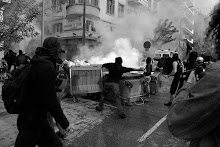
At the midnight of the 9th of June [2008] initiated in Portugal an illegal truck drivers and owners strike, with the declared objective of obtaining a reduction in the oil prices (as happened last week with the fishermen). From the beginning the truck drivers and truck owners took a distance from ANTRAM (the association of the sector of road transportations) because they didn’t feel represented…
From the first night there were flying pickets in almost every Portuguese road usually used by truck drivers. The people in the pickets blockaded the roads and highways with their own bodies as soon as they saw some truck approaching. This was to reveal itself to be tragic, with one man ending up dead, run over by a truck driver who wasn’t on strike. Some transportations and supermarket companies were openly defying the strike, explicitly ordering their drivers to not stop and sending groups of trucks escorted by police cars, with fear of attacks. But this didn’t turn out as expected.
On the second night of the strike dozens of trucks who belonged to or who were working for specific companies were attacked with stones while travelling, in very different parts of the country (Cantanhede, Figueira da Foz and at least in different parts of three highways). Dozens of winscreens were broken. At various places where non-striking truck drivers were parked several acts of sabotage occurred, such as slashed tires and battery and brake cables cut. At least twelve “non-striking trucks” parked in different parts of the country were attacked with fire and burnt down. A Judiciary Police source says dozens of these trucks were burnt down. The vandalism and sabotage went on the following night. Trucks that hours before were working escorted by riot police vehicles, hours later appeared burnt down, also with cables cut.
In the supermarkets there was almost no food, and lines of shelves were simply empty. Nothing to sell, what a beautiful vision. The gas stations all over Portugal didn’t have any oil or gas. The Lisbon airport had only enough fuel for military and emergency planes. Thousands of cops on the roads, no blockade would be permitted. The journalists asked for the government to be harder with the repression, that the country was in the hands of the truck drivers, and that the state of emergency be declared. The following day some journalists who wanted to do a live coverage of an assembly of workers nearby had some trouble: the camera cables were cut by anonymous hands. Anonymous in the middle of dozens of truck drivers.
Meanwhile, on Thursday, an ad-hoc “representative commission” that was constituted by some truck drivers and owners reached an agreement with the government, and it didn’t involve a reduction in oil prices. The same old story: end of strike, everyone back to work. The truck drivers on many flying pickets didn’t want to end the strike, at least not until the reduction in the oil prices. The deals were good, but for the big truck owners. The truck drivers didn’t feel represented by this ad-hoc commission, as happened also with ANTRAM; but they thought everyone else fell. Representation fucks you in mysterious ways.
In Spain, the truck drivers were also on strike, they made flying pickets across the whole country, and stopped thousands of trucks, including some Portuguese ones.
Some of the trucks whose drivers didn´t stop were attacked with stones, sabotaged or burned. The Spanish truck drivers also asked for the reduction of oil prices.
In Valença, some fishermen and boat owners blockaded a bridge with barricades and burning tires, in solidarity with the truck drivers.
A few days after the beginning of the strike, the riot cops started to attack the flying pickets, removing the trucks and identifying drivers; at least 90 people were arrested and a man was sentenced to 8 months in prison, accused of attacking a cop.
The consequences of the strike were similar to the Portuguese ones, the supermarkets were empty and thousands of trucks had to been escorted by the riot police.
In Almeria 4000 farmers clashed with the police, while they were doing a demo against the escalation of oil prices, al least 20 people got hurt.
Wednesday, 5 May 2010

The Affinity Group
Contrary to what is often believed, affinity between comrades does not depend on sympathy or sentiment. To have affinity means to have knowledge of the other, to know how they think on social issues and how they think they can intervene in the social clash. This deepening of knowledge between comrades is an aspect that is often neglected, impeding effective action.
One of the most difficult problems anarchists have had to face throughout their history is what form of organisation to adopt in the struggle.
At the two ends of the spectrum we find on the one hand the individualists who refuse any kind of stable relationship; on the other those who support a permanent organisation which acts on a pro-gramme established at the moment of its constitution.
Both of the forms sketched out here have characteristics that are criticisable from an insurrectional point of view.
In fact, when individualists single out and strike the class enemy they are sometimes far ahead of the most comba tive of the class components of the time, and their action is not understood. On the contrary, those who support the need for a permanent organisation often wait until there is already a considerable num-ber of exploited indicating how and when to strike the class enemy. The former carry out actions that turn out to be too far ahead of the level of the struggle, the latter too far behind.
One of the reasons for this defi-ciency is in our opinion lack of perspective.
Clearly no one has a sure recipe that contains no defects: we can however point out the limitations we. see in cer tain kinds of organisation, and indicate possible alternatives.
One of these is known as "affinity groups".
The term requires an explanation.
Affinity is often confused with sentiment. Although not distinctly separate, the two terms should not be considered synonymous. There could be comrades with whom we consider we have an affinity, but whom we do not find sympathetic and vice versa.
Basically, to have an affinity with a comrade means to know them, to have deepened one's knowledge of them. As that knowledge grows, the affinity can increase to the point of making an action together possible; but it can also diminish to the point of making it practically impossible.
Knowledge of another is an infinite process which can stop at any level according to the circumstances and objectives one wants to reach together. One could therefore have an affinity for doing some things and not others. It becomes obvious that when one speaks of knowledge that does not mean it is necessary to discuss one's personal problems, although these can become important when they interfere with the process of deepening knowledge of one another.
In this sense having knowledge of the other does not necessarily mean hav-ing an intimate relationship. What it is necessary to know is how the comrade thinks concerning the social problems which the class struggle confronts him with, how he thinks he can intervene, what methods he thinks should be used in given situations, etc.
The first step in the deepening of knowledge between comrades is discus-sion. It is preferable to have a clarifying premiss, such as something written, so the various problems can be gone into well.
Once the essentials are clarified the affinity group or groups are practical-ly formed. The deepening of knowledge between comrades continues in relation to their action as a group and the latter's encounter with reality as a whole. While this process is taking place their know-ledge often widens and strong bonds between comrades often emerge. This how-ever is a, consequence of the affinity, not its primal aim.
It often happens that comrades go about things the other way round, beginning some kind of activity and only pro ceeding to the necessary clarifications later, without ever having assessed the level of affinity required to do anything together. Things are left to chance, as though some kind of clarity were automatically to emerge from the group simply by its formation. Of course this does not happen: the group either stag-nates because there is no clear road for it to take, or it follows the tendency of the comrade or comrades who have the clear-est ideas as to what they want to do while others allow themselves to be pulled along, often with little enthusiasm or real engagement.
The affinity group on the other hand finds it has great potential and is immediately addressed towards action, basing itself not on the quantity of its adherents, but on the qualitative strength of a number of individuals working together in a projectuality that they develop together as they go along. From being a specific structure of the anarchist movement and the whole arc of activity that this presents-propaganda, direct action, perhaps producing a paper, work-ing within an informal organisation-it can also look outwards to forming a base nucleus or some other mass structure and thus intervene more effectively in the social clash.
One of the most difficult problems anarchists have had to face throughout their history is what form of organisation to adopt in the struggle.
At the two ends of the spectrum we find on the one hand the individualists who refuse any kind of stable relationship; on the other those who support a permanent organisation which acts on a pro-gramme established at the moment of its constitution.
Both of the forms sketched out here have characteristics that are criticisable from an insurrectional point of view.
In fact, when individualists single out and strike the class enemy they are sometimes far ahead of the most comba tive of the class components of the time, and their action is not understood. On the contrary, those who support the need for a permanent organisation often wait until there is already a considerable num-ber of exploited indicating how and when to strike the class enemy. The former carry out actions that turn out to be too far ahead of the level of the struggle, the latter too far behind.
One of the reasons for this defi-ciency is in our opinion lack of perspective.
Clearly no one has a sure recipe that contains no defects: we can however point out the limitations we. see in cer tain kinds of organisation, and indicate possible alternatives.
One of these is known as "affinity groups".
The term requires an explanation.
Affinity is often confused with sentiment. Although not distinctly separate, the two terms should not be considered synonymous. There could be comrades with whom we consider we have an affinity, but whom we do not find sympathetic and vice versa.
Basically, to have an affinity with a comrade means to know them, to have deepened one's knowledge of them. As that knowledge grows, the affinity can increase to the point of making an action together possible; but it can also diminish to the point of making it practically impossible.
Knowledge of another is an infinite process which can stop at any level according to the circumstances and objectives one wants to reach together. One could therefore have an affinity for doing some things and not others. It becomes obvious that when one speaks of knowledge that does not mean it is necessary to discuss one's personal problems, although these can become important when they interfere with the process of deepening knowledge of one another.
In this sense having knowledge of the other does not necessarily mean hav-ing an intimate relationship. What it is necessary to know is how the comrade thinks concerning the social problems which the class struggle confronts him with, how he thinks he can intervene, what methods he thinks should be used in given situations, etc.
The first step in the deepening of knowledge between comrades is discus-sion. It is preferable to have a clarifying premiss, such as something written, so the various problems can be gone into well.
Once the essentials are clarified the affinity group or groups are practical-ly formed. The deepening of knowledge between comrades continues in relation to their action as a group and the latter's encounter with reality as a whole. While this process is taking place their know-ledge often widens and strong bonds between comrades often emerge. This how-ever is a, consequence of the affinity, not its primal aim.
It often happens that comrades go about things the other way round, beginning some kind of activity and only pro ceeding to the necessary clarifications later, without ever having assessed the level of affinity required to do anything together. Things are left to chance, as though some kind of clarity were automatically to emerge from the group simply by its formation. Of course this does not happen: the group either stag-nates because there is no clear road for it to take, or it follows the tendency of the comrade or comrades who have the clear-est ideas as to what they want to do while others allow themselves to be pulled along, often with little enthusiasm or real engagement.
The affinity group on the other hand finds it has great potential and is immediately addressed towards action, basing itself not on the quantity of its adherents, but on the qualitative strength of a number of individuals working together in a projectuality that they develop together as they go along. From being a specific structure of the anarchist movement and the whole arc of activity that this presents-propaganda, direct action, perhaps producing a paper, work-ing within an informal organisation-it can also look outwards to forming a base nucleus or some other mass structure and thus intervene more effectively in the social clash.
Perspectives about the energetic collapse of the techno-industrial society
Practically everything we do, from eating an ice to crossing the Atlantic,
and from baking a loaf to writing a novel, involves the use of coal,
directly or indirectly. For all the arts of peace coal is needed; if war
breaks out it is needed all the more. In time of revolution the miner must
go on working or the revolution must stop, for revolution as much as
reaction needs coal. Whatever may be happening on the surface, the hacking
and shovelling have got to continue without a pause, or at any rate without
pausing for more than a few weeks at the most. In order that Hitler may
march the goose-step, that the Pope may denounce Bolshevism, that the
cricket crowds may assemble at Lords, that the poets may scratch one
another's backs, coal has got to be forthcoming. But on the whole we are
not aware of it; we all know that we 'must have coal', but we seldom or
never remember what coal-getting involves.
From “Down the mine”, essay by George Orwell
Let start with a proven fact: every production system is sustained on the finite availability of material, human and energetic resources. A lack of one of the latter will see the collapse of one production system to give way to another. Entire Imperi (from the Maya to the Romans) fell because of the burnout of natural or human resources, more than external enemy attacks. Before industrial and global civilization arrived there was a solution for the population: many could escape to other lands not so devastated by human action or to rural areas but now the situation is different because there are almost no lands free of human intervention.
Another thing: the discovery of new power sources involves more complex, hierarchical and massive social models. Not to mention the military/police forces required to conquer the few deposits of these sources. It’s obvious that in a system where human, vegetable and animal energy prevail over the rest it will be easier to obtain a certain autonomy as a protocol of control and centralization over the production, transport and transformation is not necessary.. Just like petroleum or other fossil resources, massive construction of solar cells, nuclear plants and giant mills require high specialization levels and an enormous amount of investment (which only a State or a big Corporation can afford).
Until now, industrial society has been possible thanks to these fossil energy sources. They were cheap, very efficient, and thanks to petroleum, very easy to handle. As the economy grew it was necessary to increase production as well. But everything has a limit, infinite growth is impossible and this or maybe last year we reached that limit, the global oil peak according to the theories of the engineer Hubbert arrived. Without enough petroleum the economy doesn’t grow and in capitalism that means crisis, inflation, unemployment and so (and we are living the first stages, wars for control included). But it won’t be a typical one, as the ex-environment French minister Yves Cochet said: “When petroleum reaches100 $ it won’t be a normal crisis, it will be the end of the world as we know it” (The recent financial crisis proves it clearly).
We are not talking of travelling less by car, we are talking about food, water, health, everything, because in this age everything depends on petroleum. The other day we could see a curious news item hidden among the rest of the news: the USA is going to ration rice because producing countries such as Vietnam and Cambodia are closing their frontiers to exports. More hidden news is riots and protests that are spreading over the Third World countries because of the price of grain. In contrast, as hunger spreads, the European Union wants 10% of fuel to be “biofuel”, paying farmers to quit their traditional crops, while the USA also support the use of corn as fuel. If that’s not a cover for mass murder what is it?
Far away are the utopia of the Leninist “electricity and Koljosh” which led to the Soviet nightmare, or the anarchist self management one, or the new ecologist dream of green cities and electric cars. Lies that hide the most important thing: material and energetic abundance are based on:
The harvest of the natural resources and the continuous fight (war) for them.
The existence of a caste of technocrats and specialists who govern each specific part of people's lives where politicians are nothing but the mere spokesmen of the latter. (And in a supposed assemblear and self managed system it won’t be any different as nobody would be able to question them).
The necessity of a central power who rule (or seem to rule) in this constant fight for resources.
The exploitation and alienation of humankind.
- The extermination of cultures that don’t share the productive mentality as well as the destruction of their land.
UTOPIA OR SURVIVAL
So, this new crisis, in contradistinction to others, will not have a solution. Roman Pax times are over and war will be our daily bread. Iraq and Afghanistan are just an
interlude. Of course the system will need to justify a lot of sacrifice and restrictions. Now we can see their new discourses: because of ecology (Climate Change) they need to build more nuclear plants, because of security (self-made terrorism like 11S, 11M, 7J…) they need to control the population and make special laws (i.e. Patriot Act), as well as invade other countries, because China and India are growing so much we have higher prices… We’ll find a kind of “ecofascism” that will probably not abandon its democratic rhetoric but in fact will try to control us very closely under the flag of sustainable development and environmental protection.
Now we are seeing the first symptoms in society, with the financial crisis, the Wall Street Crash, unemployment, inflation, house evictions... the next step will be riots and they know very well what to do. Recently a new military unit with 4000 soldiers was transferred from Iraq to the USA, ready to act in case of emergencies and terrorist attacks, but also equipped with “non-lethal” weapons as the Taser guns in case of “civil riots” as the Commander Robert Cloutier said.
In the early XX century our comrades had clear ideas and revolutionary programs: in times of crisis the workers must take control of the factories and the peasants control of the land - while mass insurrections destroy the repressive institutions - and organize themselves in councils based upon mutual aid and solidarity. But, is that possible now? What kind of workers and peasants are we talking about? Someone that knows how to produce a potato or a chair or a car without hyper-technified machines, microcomputers, the hierarchical structure or super-specialized engineers? Do we have a tradition of solidarity and mutual aid in labour struggles?
HIT WHERE IT HURTS
What options do we have in this panorama? Well, I think the first thing is to leave all our ideological baggage for a moment and start to discuss what we understand by “revolution” at this time, putting aside utopian dreams in order to objectively analyse reality and ourselves. The good things and the bad, the opportunity of a crisis for social disgregation, but also to recognize our weak points such as individualism, egoism or comfort-dependency (and revolutionaries are far from be free of these social tendencies).
For example, to say that the conquest of “media production” by the proletariat is a liberating utopia when today that media need a huge specialization degree, when the energetic and environmental cost is brutal, when production is so complex that pieces made in China and Malaysia are assembled in Romania to sell a computer in the USA... will bring us to suicide, a self-managed suicide, not governed by the bourgeoisie but by machines.
Well, and why not confront reality directly? A real revolutionary change will reduce the production of goods and will finish with the comforts and the abundance we are accustomed to and that everyone (capitalists, leftists, good-minded ecologists...) promises to maintain at all costs. Also many anarchists won’t accept this kind of society in the first stages because it will be very hard work to recover old production methods and communitarian life. It’s normal to be afraid if you can’t answer securely the question “Will I eat tomorrow?”. In Spain there was recently a very hard transporters' wildcat strike because of the high cost of fuel. During the first days people “assaulted” the supermarkets taking lots of goods such as rice, chocolate or milk. For me (and I was aware it could happen someday) it was shocking to see the food shelves empty and car queues at the gas stations trying to get a little diesel. Finally the government used the police to break up the lorry blockades (sometimes shooting with their guns) while the media called the transporters “terrorists”. What would have happened if the strike had lasted two weeks instead of four days?
The central question is “Is it possible to articulate a mass movement based upon a critique of economic growth and the “improvement” of standards of living? I think the answer is clearly NO. It will be a movement condemned to be minoritarian (now, but it could be different if the depletion of the resources forces social change where material improvement is not the basis).
But to be a minority is no reason to avoid acting. When the system starts decomposing itself and citizens doubt or don’t want to defend it there is a possibility of hitting it. The hedonistic, incredulous and immoral society created by the technoindustrial capitalism can be its own tomb because without values such as religion, patriotism or the “common good”, who will risk his life to defend it? Each one will try to save himself as people start to fight each other, the capitalists the same as the workers (maybe with some minoritarian exceptions).
I think the recent clashes in the French ghettos can give us some idea of the future. There some anarchists and revolutionaries who could take part in the riots but many of them, from the middle classes, were seen as enemies (no different from the police forces or the politicians). Some “anarchists” surprised by the violence and lack of political goals of the protesters try to justify them by talking about racism, unemployment, poor services... Some others expressed solidarity with the riots with actions of anticapitalist political content (as the attacks on car showrooms in Greece). But as we know no one arose seriously to attack the weak points of the system. A general blackout for example or some little ones could have given the rebels time to to spread the radius of their action and distract the repressive forces... but revolts are not revolutions and even less in this kind of society.
BUILDING REVOLUTION
So here we are, at the burial of the old theories that were our guidelines for decades, trying to find a light in a dark tunnel. What to do now? It’s not easy to answer that. Each individual, every group must discuss it analysing their social and natural environment. Two things are catalysts to bringing real social change: to recover community relationships and recover natural contact.
For example, selfmanaged social centres (if they go further than aesthetics, bars and labels) can be a place for selforganization, can have contact with the neighbourhood and social struggles, can organize self-defense, deliver information, do workshops to learn... and some of them, realizing that recyclying or approprating products (capitalist rubbish) is not enough start to grow their own food in squatted gardens.
But it’s not enough when you have to create a completely different kind of life and relationships, when your critique starts with the city and the industrial system itself. Can we imagine a different social system in a monster city like London? Everything is so big and artificial that a non-complex and non pyramidal way of living based on respect for nature is completely impossible. What will those 10 million people do when their bureaucratic and capitalist jobs become useless? They need to eat and they need housing but they don’t know how to do it, they need a legion of poor peasants and workers in the third world countries to produce it.
So, if we don’t want to have States or power centres, we must live without this kind of monster city, a rural change is necessary. There autonomy can be more than just a word and we can recover very important knowledge to produce on a small scale (food, housing, clothes...) with the necessary respect for the environment, facing with direct actions the attacks of urban/industrial capitalism to control the natural resources. It’s not only to criticize, it’s to find real solutions implementing non-specialized, non technified, non-hierarchical and low-energy lifestyles that can help to survive if the system collapses.
There isn’t a magical recipe to fight, in the cities it is difficult to get a great degree of autonomy but it’s easier to get in touch with social struggles and the contrary in the country. Communication between both is necessary, to support different struggles wherever they explode, to exchange knowledge and products, to defend ourselves, to have a deeper perspective of the situation and hit where it hurts.
There won’t be any revolution without autonomy and there won’t be any revolution in isolated rural comunes, so this text wants to start an imperative discussion to avoid being surprised in the critical moments we are going to live (and we don’t have much time).
and from baking a loaf to writing a novel, involves the use of coal,
directly or indirectly. For all the arts of peace coal is needed; if war
breaks out it is needed all the more. In time of revolution the miner must
go on working or the revolution must stop, for revolution as much as
reaction needs coal. Whatever may be happening on the surface, the hacking
and shovelling have got to continue without a pause, or at any rate without
pausing for more than a few weeks at the most. In order that Hitler may
march the goose-step, that the Pope may denounce Bolshevism, that the
cricket crowds may assemble at Lords, that the poets may scratch one
another's backs, coal has got to be forthcoming. But on the whole we are
not aware of it; we all know that we 'must have coal', but we seldom or
never remember what coal-getting involves.
From “Down the mine”, essay by George Orwell
Let start with a proven fact: every production system is sustained on the finite availability of material, human and energetic resources. A lack of one of the latter will see the collapse of one production system to give way to another. Entire Imperi (from the Maya to the Romans) fell because of the burnout of natural or human resources, more than external enemy attacks. Before industrial and global civilization arrived there was a solution for the population: many could escape to other lands not so devastated by human action or to rural areas but now the situation is different because there are almost no lands free of human intervention.
Another thing: the discovery of new power sources involves more complex, hierarchical and massive social models. Not to mention the military/police forces required to conquer the few deposits of these sources. It’s obvious that in a system where human, vegetable and animal energy prevail over the rest it will be easier to obtain a certain autonomy as a protocol of control and centralization over the production, transport and transformation is not necessary.. Just like petroleum or other fossil resources, massive construction of solar cells, nuclear plants and giant mills require high specialization levels and an enormous amount of investment (which only a State or a big Corporation can afford).
Until now, industrial society has been possible thanks to these fossil energy sources. They were cheap, very efficient, and thanks to petroleum, very easy to handle. As the economy grew it was necessary to increase production as well. But everything has a limit, infinite growth is impossible and this or maybe last year we reached that limit, the global oil peak according to the theories of the engineer Hubbert arrived. Without enough petroleum the economy doesn’t grow and in capitalism that means crisis, inflation, unemployment and so (and we are living the first stages, wars for control included). But it won’t be a typical one, as the ex-environment French minister Yves Cochet said: “When petroleum reaches100 $ it won’t be a normal crisis, it will be the end of the world as we know it” (The recent financial crisis proves it clearly).
We are not talking of travelling less by car, we are talking about food, water, health, everything, because in this age everything depends on petroleum. The other day we could see a curious news item hidden among the rest of the news: the USA is going to ration rice because producing countries such as Vietnam and Cambodia are closing their frontiers to exports. More hidden news is riots and protests that are spreading over the Third World countries because of the price of grain. In contrast, as hunger spreads, the European Union wants 10% of fuel to be “biofuel”, paying farmers to quit their traditional crops, while the USA also support the use of corn as fuel. If that’s not a cover for mass murder what is it?
Far away are the utopia of the Leninist “electricity and Koljosh” which led to the Soviet nightmare, or the anarchist self management one, or the new ecologist dream of green cities and electric cars. Lies that hide the most important thing: material and energetic abundance are based on:
The harvest of the natural resources and the continuous fight (war) for them.
The existence of a caste of technocrats and specialists who govern each specific part of people's lives where politicians are nothing but the mere spokesmen of the latter. (And in a supposed assemblear and self managed system it won’t be any different as nobody would be able to question them).
The necessity of a central power who rule (or seem to rule) in this constant fight for resources.
The exploitation and alienation of humankind.
- The extermination of cultures that don’t share the productive mentality as well as the destruction of their land.
UTOPIA OR SURVIVAL
So, this new crisis, in contradistinction to others, will not have a solution. Roman Pax times are over and war will be our daily bread. Iraq and Afghanistan are just an
interlude. Of course the system will need to justify a lot of sacrifice and restrictions. Now we can see their new discourses: because of ecology (Climate Change) they need to build more nuclear plants, because of security (self-made terrorism like 11S, 11M, 7J…) they need to control the population and make special laws (i.e. Patriot Act), as well as invade other countries, because China and India are growing so much we have higher prices… We’ll find a kind of “ecofascism” that will probably not abandon its democratic rhetoric but in fact will try to control us very closely under the flag of sustainable development and environmental protection.
Now we are seeing the first symptoms in society, with the financial crisis, the Wall Street Crash, unemployment, inflation, house evictions... the next step will be riots and they know very well what to do. Recently a new military unit with 4000 soldiers was transferred from Iraq to the USA, ready to act in case of emergencies and terrorist attacks, but also equipped with “non-lethal” weapons as the Taser guns in case of “civil riots” as the Commander Robert Cloutier said.
In the early XX century our comrades had clear ideas and revolutionary programs: in times of crisis the workers must take control of the factories and the peasants control of the land - while mass insurrections destroy the repressive institutions - and organize themselves in councils based upon mutual aid and solidarity. But, is that possible now? What kind of workers and peasants are we talking about? Someone that knows how to produce a potato or a chair or a car without hyper-technified machines, microcomputers, the hierarchical structure or super-specialized engineers? Do we have a tradition of solidarity and mutual aid in labour struggles?
HIT WHERE IT HURTS
What options do we have in this panorama? Well, I think the first thing is to leave all our ideological baggage for a moment and start to discuss what we understand by “revolution” at this time, putting aside utopian dreams in order to objectively analyse reality and ourselves. The good things and the bad, the opportunity of a crisis for social disgregation, but also to recognize our weak points such as individualism, egoism or comfort-dependency (and revolutionaries are far from be free of these social tendencies).
For example, to say that the conquest of “media production” by the proletariat is a liberating utopia when today that media need a huge specialization degree, when the energetic and environmental cost is brutal, when production is so complex that pieces made in China and Malaysia are assembled in Romania to sell a computer in the USA... will bring us to suicide, a self-managed suicide, not governed by the bourgeoisie but by machines.
Well, and why not confront reality directly? A real revolutionary change will reduce the production of goods and will finish with the comforts and the abundance we are accustomed to and that everyone (capitalists, leftists, good-minded ecologists...) promises to maintain at all costs. Also many anarchists won’t accept this kind of society in the first stages because it will be very hard work to recover old production methods and communitarian life. It’s normal to be afraid if you can’t answer securely the question “Will I eat tomorrow?”. In Spain there was recently a very hard transporters' wildcat strike because of the high cost of fuel. During the first days people “assaulted” the supermarkets taking lots of goods such as rice, chocolate or milk. For me (and I was aware it could happen someday) it was shocking to see the food shelves empty and car queues at the gas stations trying to get a little diesel. Finally the government used the police to break up the lorry blockades (sometimes shooting with their guns) while the media called the transporters “terrorists”. What would have happened if the strike had lasted two weeks instead of four days?
The central question is “Is it possible to articulate a mass movement based upon a critique of economic growth and the “improvement” of standards of living? I think the answer is clearly NO. It will be a movement condemned to be minoritarian (now, but it could be different if the depletion of the resources forces social change where material improvement is not the basis).
But to be a minority is no reason to avoid acting. When the system starts decomposing itself and citizens doubt or don’t want to defend it there is a possibility of hitting it. The hedonistic, incredulous and immoral society created by the technoindustrial capitalism can be its own tomb because without values such as religion, patriotism or the “common good”, who will risk his life to defend it? Each one will try to save himself as people start to fight each other, the capitalists the same as the workers (maybe with some minoritarian exceptions).
I think the recent clashes in the French ghettos can give us some idea of the future. There some anarchists and revolutionaries who could take part in the riots but many of them, from the middle classes, were seen as enemies (no different from the police forces or the politicians). Some “anarchists” surprised by the violence and lack of political goals of the protesters try to justify them by talking about racism, unemployment, poor services... Some others expressed solidarity with the riots with actions of anticapitalist political content (as the attacks on car showrooms in Greece). But as we know no one arose seriously to attack the weak points of the system. A general blackout for example or some little ones could have given the rebels time to to spread the radius of their action and distract the repressive forces... but revolts are not revolutions and even less in this kind of society.
BUILDING REVOLUTION
So here we are, at the burial of the old theories that were our guidelines for decades, trying to find a light in a dark tunnel. What to do now? It’s not easy to answer that. Each individual, every group must discuss it analysing their social and natural environment. Two things are catalysts to bringing real social change: to recover community relationships and recover natural contact.
For example, selfmanaged social centres (if they go further than aesthetics, bars and labels) can be a place for selforganization, can have contact with the neighbourhood and social struggles, can organize self-defense, deliver information, do workshops to learn... and some of them, realizing that recyclying or approprating products (capitalist rubbish) is not enough start to grow their own food in squatted gardens.
But it’s not enough when you have to create a completely different kind of life and relationships, when your critique starts with the city and the industrial system itself. Can we imagine a different social system in a monster city like London? Everything is so big and artificial that a non-complex and non pyramidal way of living based on respect for nature is completely impossible. What will those 10 million people do when their bureaucratic and capitalist jobs become useless? They need to eat and they need housing but they don’t know how to do it, they need a legion of poor peasants and workers in the third world countries to produce it.
So, if we don’t want to have States or power centres, we must live without this kind of monster city, a rural change is necessary. There autonomy can be more than just a word and we can recover very important knowledge to produce on a small scale (food, housing, clothes...) with the necessary respect for the environment, facing with direct actions the attacks of urban/industrial capitalism to control the natural resources. It’s not only to criticize, it’s to find real solutions implementing non-specialized, non technified, non-hierarchical and low-energy lifestyles that can help to survive if the system collapses.
There isn’t a magical recipe to fight, in the cities it is difficult to get a great degree of autonomy but it’s easier to get in touch with social struggles and the contrary in the country. Communication between both is necessary, to support different struggles wherever they explode, to exchange knowledge and products, to defend ourselves, to have a deeper perspective of the situation and hit where it hurts.
There won’t be any revolution without autonomy and there won’t be any revolution in isolated rural comunes, so this text wants to start an imperative discussion to avoid being surprised in the critical moments we are going to live (and we don’t have much time).
Social control, entrism
The present debate on the problem of ‘social control’ is nearly always based on a misunderstanding, often nourished by a scarse capacity to go into both positions.
Given as certain that the problem of ‘control’ only becomes central for the State and capital as the primary condition for getting ‘consensus’, I don’t see why control should be interpreted – as some do – only in terms of technical capacity.
There is no doubt about that fact that the State possesses apparatus that was once undreamed of and that this can control more easily. But there is also no doubt that the State, on its own, is an abstraction. We think of it as being composed of men, who, no matter how much apparatus they possess, are still men and will always have defects and limitations.
If we look at things from this angle one will not reach the strange conclusion odf ‘the end of the era of secrets’.
But what secrets?
Whenever did the anarchist movement choose the road of clandestinity of its own accord? But, per un altro verso, whatever does it mean that in the face of the present control of the State we must do everything in the light of day?
There are things that should be done in the light of day, such as for example propaganda, the development of the movement as a whole, counterinformation, social struggles, etc. but there are some things that require caution, that not everyone has to know about. That in no way contradicts the principles of anarchism. In fact, anarchy has never been synonymous with naivety, or worse still, stupidity. There are struggles that power must not know about except when the result has been obtained. And the objection that, at the present time, the level of control makes these struggles impossible, because this objection could, at most, have the value of a call to greater care, a greater sense of self criticism, etc., beyond this, if one were to insist too much, everything would end up in an empty and generic invitation to desist.
Comrades are all highly responsible people. They know very well what a struggle means and what a struggle with different characteristics means. In involving themselves in one or the other they know perfectly well the level of danger they are facing and therefore choose the means that they consider best.
Any analysis that shows modern means of control is certainly useful because comrades can draw useful lessons for being more careful in their work. But when this investigation crosses their own field, ie, that of documentation, and threatens to become horatory, didactic, pedagogic, then it turns out to be no different to that of a simple and direct invitation to lay down arms and stop struggling, to desist.
Entrism
Let me turn a moment to the enormity of what was said a short time ago, that of going into institutions to make them more democratic. It would be pointless to talk about it if it were not that the problem has been raised, so let’s face it.
What do people want to do? Go into the police to make the police more democratic? Or even the army; what do they want?another anarchist general also today? But let’s not talk rubbish. Let’s stop going to such extremes, which were perhaps only a joke. Let’s assume that that’s not what they meant, but let’s take another structure, school for example. Is is right for anarchists to go into schools, and so, transforming school from the inside can lead it to the ideal of a libertarian pedagogy? Let’s say that was the idea, leaving the police alone. It is the classic concept of entrism, diffused from Trotsky onwards. In fact the originator iof this concept is precisely Trotsky. This hypothesis does not take into account the essential fact that man does not decide by himself but it is also the situation he finds himself in to decide. It is not that we are not capable of transforming the world completely, we must be careful because the world can also transform us. It becomes pointless for me to say: now I’ll join the police because that way I go into the body, get closer, even physically, to the home minister and can shoot him in the head. There, this project might seem good, but in practice it is not, because from the moment I enter the police, leave today, leave tomorrow, I am forced to live situations, relations, concepts and deeds. Entrism is precisely all that, so in the end it is the structure that eats me, not I who eat the structure. This is a fundamental rule, it has no exceptions. So it is well that we keep ourselves far from the structures we must fight, if we have to accept them, then that’s another kettle of fish.
The present debate on the problem of ‘social control’ is nearly always based on a misunderstanding, often nourished by a scarse capacity to go into both positions.
Given as certain that the problem of ‘control’ only becomes central for the State and capital as the primary condition for getting ‘consensus’, I don’t see why control should be interpreted – as some do – only in terms of technical capacity.
There is no doubt about that fact that the State possesses apparatus that was once undreamed of and that this can control more easily. But there is also no doubt that the State, on its own, is an abstraction. We think of it as being composed of men, who, no matter how much apparatus they possess, are still men and will always have defects and limitations.
If we look at things from this angle one will not reach the strange conclusion odf ‘the end of the era of secrets’.
But what secrets?
Whenever did the anarchist movement choose the road of clandestinity of its own accord? But, per un altro verso, whatever does it mean that in the face of the present control of the State we must do everything in the light of day?
There are things that should be done in the light of day, such as for example propaganda, the development of the movement as a whole, counterinformation, social struggles, etc. but there are some things that require caution, that not everyone has to know about. That in no way contradicts the principles of anarchism. In fact, anarchy has never been synonymous with naivety, or worse still, stupidity. There are struggles that power must not know about except when the result has been obtained. And the objection that, at the present time, the level of control makes these struggles impossible, because this objection could, at most, have the value of a call to greater care, a greater sense of self criticism, etc., beyond this, if one were to insist too much, everything would end up in an empty and generic invitation to desist.
Comrades are all highly responsible people. They know very well what a struggle means and what a struggle with different characteristics means. In involving themselves in one or the other they know perfectly well the level of danger they are facing and therefore choose the means that they consider best.
Any analysis that shows modern means of control is certainly useful because comrades can draw useful lessons for being more careful in their work. But when this investigation crosses their own field, ie, that of documentation, and threatens to become horatory, didactic, pedagogic, then it turns out to be no different to that of a simple and direct invitation to lay down arms and stop struggling, to desist.
Entrism
Let me turn a moment to the enormity of what was said a short time ago, that of going into institutions to make them more democratic. It would be pointless to talk about it if it were not that the problem has been raised, so let’s face it.
What do people want to do? Go into the police to make the police more democratic? Or even the army; what do they want?another anarchist general also today? But let’s not talk rubbish. Let’s stop going to such extremes, which were perhaps only a joke. Let’s assume that that’s not what they meant, but let’s take another structure, school for example. Is is right for anarchists to go into schools, and so, transforming school from the inside can lead it to the ideal of a libertarian pedagogy? Let’s say that was the idea, leaving the police alone. It is the classic concept of entrism, diffused from Trotsky onwards. In fact the originator iof this concept is precisely Trotsky. This hypothesis does not take into account the essential fact that man does not decide by himself but it is also the situation he finds himself in to decide. It is not that we are not capable of transforming the world completely, we must be careful because the world can also transform us. It becomes pointless for me to say: now I’ll join the police because that way I go into the body, get closer, even physically, to the home minister and can shoot him in the head. There, this project might seem good, but in practice it is not, because from the moment I enter the police, leave today, leave tomorrow, I am forced to live situations, relations, concepts and deeds. Entrism is precisely all that, so in the end it is the structure that eats me, not I who eat the structure. This is a fundamental rule, it has no exceptions. So it is well that we keep ourselves far from the structures we must fight, if we have to accept them, then that’s another kettle of fish.
Statement to the court in Lecce, Salvatore Signore
‘Finally there are situations when a passionate man must write. When the platform is empty and the people are crushed, when a society of slaves has a shopkeeper as king, when all those who think are condemned, it is well necessary that the latter, exiled from the present, dwell upon the future’.
Ernest Coeurderoy, Days of Exile
First of all I want to clarify that this declaration does not intend to be a justification because I have no reason to justify myself. Then, any clarification in this court is pointless because my words can hardly be understood in all their meaning in this place. Not that I think you are stupid but because we belong to opposing ‘sides’ – you represent power and I represent its enemy – and our ways of understanding and interpreting reality are absolutely different and alien to each other. This trial, however, is obviously and exclusively political, and therefore social, and I cannot help expressing what I think. I want to point out that my thoughts are addressed outside this court, to the vast mass of exploited and excluded to which I belong and to which I have always addressed myself with the means and methods that I have acquired through time.
The first thing that I want to say is that I send back to the sender the epithet of ‘terrorist’, which has been used to define me since this story begun, and also before that, aimed at producing satisfactory public opinion, which ‘is made by idiots’, as Stendhal rightly said, and the ensuing persecution and repression; I will come back to this later. For my part, as I have already done many times, I reaffirm that terrorism has always been the favourite weapon of States, be they old empires, more recent nazi-fascist or socialist dictatorships or advanced democracies. Even if those who hold power, and therefore the manipulators of History and Culture try to change its meaning, the word ‘terrorism’ means ‘use of indiscriminate violence with the aim of conquering, consolidating and defending political power’. Anarchists, on the contrary, even when they have decided to use violence, have never used it in an indiscriminate way. Then it is absolutely ridiculous to think that anarchists want to conquer power, given that their aim is to destroy it! After all, the bombs in the squares and on the trains, the massacre of entire populations and the ‘exporation of democracy’ are certainly not anarchist practises.
As far as the appellation of subversive is concerned, I candidly admit that that is what I am. What is an individual who despises all kinds of power and struggles for a completely different society and for the freedom of all living beings without distinctions, if not subversive? All this is certainly subversive in a world where social relations are based on exploitation, robbery, exclusion and abuse of the weakest. Furthermore, I could never belong to any subversive ‘association’, which would really be a very miserable thing and would not match with the fact that I am anarchist, which I assert and for which I am defendant in this trial. As an anarchist, I have two fundamental principles: the individual and anti-authoritarianism. Therefore I could never organize myself in a vertical way – even if I have been defined ‘leader’ and ‘chief’ and, according to the prosecution, I occupied a ‘leader’ s position’. I strongly refute these words. I could never organize myself in a rigid way either, because in that case the organisation itself would dominate me and I would become a mere instrument and appendix of it, and my being a unique individual among other unique individuals would disappear behind it. On the contrary I establish my relations according to the necessity of the moment, to the love, friendship and affinity that link me to others. I can agree for a moment on one question and soon after be in total disagreement on another. But this relation is always horizontal, informal and never hierarchical, according to the principle of anti-authoritarianism. In this free and temporary relation, I am free to move by myself or with whoever wants to move with me. On the contrary, in an organized structure, individuals only move inside the ‘association’, exactly like in political parties. If I acted in this way I would follow a religion, but as anarchist I am against political parties and religions, no matter what they say. I would even be against anarchism if the latter were to become a dogma and therefore religion.
Another accusation made against me and that I want to clarify because I find it disgusting is that I would make ‘proselytism’. This practise does not belong to me; it belongs, for example, to the armed forces that go around schools in order to convince kids to enlist, and to priests and to missionaries all over the world. But I have always been extraneous to the ‘missionary logic’. I do not think that social change is a historical mission that I have to carry out nor do I think that it is an inevitable event according to some determinist dream. On the contrary I think that it is an open possibility that can become true or not, that can be fair or not. And it will not be any ‘party’ of anarchists to radically transform the world; it will be the exploited that organize themselves together with anarchists. If I were to live my life and thought according to an historical mission, this too would overcome my will and would transform it into an instrument of something that does not belong to me and that would be the opposite of individuality. I would disappear behind the historical mission, behind the ideology. On the contrary I have never had the arrogance to claim that I know the truth in the place of ignorant masses that have not understood anything and that I should ‘convert’ and ‘indoctrinate’; in this way I would be putting myself in a vanguardist position, which anarchists historically refuse; I have never wanted to be a vanguard. What I do, through articles in our papers, posters, demonstrations, meetings, distribution of books, and which is being judged in this court, is called propaganda, that is to say an instrument for expressing my thoughts and ideas. Mind you, I said Ideas, not mere and stupid opinions. Opinions only represent the empty shell of ideas, as they do not have the subversive potential of the latter. Ideas are something more, they are dangerous, especially in times of social anaesthesia as those we are living in, and it is for this reason that they scare.
This is the real point: what is on trial, exactly, in this court? Not certainly ‘crimes’, to justify most of which the investigators had to construe ‘evidence’ and interpret in their own way words, sentences, concepts, highlighting what was convenient for them and omitting all the rest. No, it is not this. Here it is the Idea that is on trial, anarchist thought and practise. Nobody can believe in the old story of the ‘State of Right’, also because, as Hobbes rightly said, ‘rights being equal, strength wins’.
It is therefore clear that courts defend class interests, the class of the included against the big majority of the excluded, which is growing. It is sufficient to observe the social provenance of prisoners in the very democratic Italian jails to find the best confirmation to my statements. So it becomes intolerable that individuals wanting freedom, the destruction of all power and a dignified life for everybody are set free. It is not by chance that there exists a continuous and constant attack against what can be defined the ‘anarchist movement’. This attack has been increasing over the last ten years, and this is also due to the politics of emergency that the State has been adopting for a long while and upon which it now bases its very existence: it is a consolidated rule to create a fictitious enemy towards which to address subjects’ fears so that they create a common front against the ‘danger’ of the moment and cannot see who are really responsible for their misery: one day it is the mafia emergency, another it is environmental emergency, then the immigration emergency comes out. Following this logic today there stands an external enemy – foreigners in general and Arabs in particular – and an internal enemy – all those who oppose the present state of things, and anarchists in particular.
Dozens of conspiracy court cases were set against anarchists, most of which have ended up in nothing. What the prosecution is trying here, therefore, is not so much to put me and some other comrades in prison, which would be too little a thing, but to obtain a final sentence that could be useful in future penal procedures and help to get rid of anarchists for a few years, while sending a warning to all the others. The thinking heads of the State have certainly realized that, for a series of reasons, Lecce is the right place where such a precedent could be created: it is a little town on the suburbs of the Empire, where in their opinion there would be little resistance, and then there are no specific precedents. The most extraordinary thing, however, is that to obtain such a sentence, instruments that have failed elsewhere are being used, i.e. the usual old joke that fills the documents of investigators and public prosecutors about anarchist organising themselves on a double level – one public and the other clandestine – and the intentionally distorted interpretation of a comrade’ s words that have been published in a number of books. There is, in fact, a repressive thread on a national level, which is put into practice on a local level only to make it easier. A few more steps in this direction and, who knows, anyone who has certain books in his house will be criminalized! After all, it is exactly books that were seized in the course of the searches carried out when we were arrested… It is perhaps useful to remind that the ‘dangerous books’ hunt was carried out during the holy Inquisition and during Nazism, and it is also useful to remember that a few days ago in Bologna searches were made and an investigation on conspiracy was opened on the pretext that comrades were distributing a book that criticized the infamous ‘Biagi law’. And it is quite bizarre that some books are being considered the source of certain theories and strategies, in spite of the fact that your own magistrates have sentenced the falseness of these constructions!
Contrary to what the prosecution is trying to establish, I am a dangerous individual not because I speak and act in a clandestine way but because of the exact opposite: because I do not need to do so. I think I am a free individual coherent with himself, at least I try, so I openly say what I think and do what I say: theory becomes practise and practise becomes theory. I understand how this can be disturbing and unpleasant to power. It must be in fact unpleasant to mayor Poli [the right-wing mayor of Lecce] that in her ‘polis’, that is to say a town ruled by a bunch of exploiters under which slaves are submitted, there is still somebody who wants to take back the ‘agora’, that is to say a free piazza where there can be free discussion and where the Idea, this thing so frightening, can be widespread. After all, as the inquisitors tried a lot of times to stop me, they know very well that I cannot stand the closeness of what they call ‘hens’ – our sites - especially as the excluded to whom I address myself are not habitual frequenters of such places.
My anarchist thoughts and practice are even more dangerous to the inquisitors when they are aimed at striking the terrorism of very important men and the violence perpetrated inside the new concentration camps of the State, the so-called CPTs. The pretext under which I was put in jail and I am under trial is exactly my radical opposition to these places.
I claim with strength my struggle against the detention centres for immigrants and against Regina Pacis in particular. It was an infamous place that was luckily closed down but whose corpse keeps on spreading an horrible smell and whose walls are still impregnated with the blood and anger of millions of individuals who were locked up there and raped of their lives. In my opinion such places should not only be closed down, but also totally razed to the ground so that there will be not even the memory of their infamy. Yes, for a few years there has been the habit to celebrate the ‘remembrance day’ [in memory of the victims who died in nazi concentration camps]: if we did not live in an upside-down world, they would probably celebrate the ‘oblivion day’, the total destruction of any concentration camps. And I want to point out that I do not use the word ‘concentration camp’ out of rhetoric or because it became fashionable among left-wing politicians who created the modern concentrations camps, I use it because it is a rigorous definition. As in the old colonial and nazi camps, in fact, people locked up in the CPTs did not commit any crime, they are only undesirables at the mercy of police and exploited by the bosses of the moment. Besides being jails for immigrants, the CPTs are places where foreign labourers, who can be blackmailed more easily, are selected. It is in fact important to remind that the exploitation of this kind of labourers is very important to capital.
The last question that I would like to express concerns the particular moment my comrades and I were arrested. It was soon after the arrest of Cesare Lodeserto, the director of Regina Pacis, and when many members of his staff, including doctors, operators, and cops were (and some still are) under investigation. It was necessary to take the public attention away from these episodes that has uncovered the real nature of that CPT and opened a crack in the wall that I had been trying for years to open myself so that everybody could look through it. It was at this point that attention had to be deviated and directed to the worst enemies of the State. This does not surprise me: it is one arm of the State that goes to secure its other arm. There is a popular saying that synthesizes the concept: ‘one hands washes the other and both wash the face’.
During the period I was detained I could personally experience the fury that the State has towards words, against which it has waged a war, as also proved by years of phone and environmental tapping against me and by the big quantity of papers that was seized in my house. It is hatred towards all the aspects of the word: the written and spoken word and therefore, basically, the thought. It is the attempt to kill Cartesio’s statement ‘I think, therefore I am’ because in a social system where ‘to have’ is much more important than ‘to be’, individuals must stop being, and it is not only a question of auxiliary verbs substituting each other.
I could realize that when censorship went for (and still does) my letters and books when I was in prison. The inner meaning of the matter can be found in one single sentence that has been repeated many times by a prison officer who, when I insisted to have books that had been kept for two months by the censors, used to say; ‘You read too much!’.
In my opinion this short sentence is quite meaningful and summarizes the sense of my incarceration and trial: ‘You read too much!’. If this is true, I am sorry, but I can’t reassure you, I will keep on thinking, reading, writing, speaking and therefore struggling. It does not matter if in the next years I will find myself on the one side or the other of the bars of this open prison that is called society, because I am convinced that in the court justice is not administrated but vengeance is executed instead.
Unless you agree with Dostoevskji, who wrote: ‘When they became criminals they invented the Justice and imposed a series of codes to preserve it, and to preserve the codes they invented the guillotine’. In this case, innocence is the worst thing ever.
I do not have anything else to tell you.
Lecce, June 28 2007
Salvatore Signore
Ernest Coeurderoy, Days of Exile
First of all I want to clarify that this declaration does not intend to be a justification because I have no reason to justify myself. Then, any clarification in this court is pointless because my words can hardly be understood in all their meaning in this place. Not that I think you are stupid but because we belong to opposing ‘sides’ – you represent power and I represent its enemy – and our ways of understanding and interpreting reality are absolutely different and alien to each other. This trial, however, is obviously and exclusively political, and therefore social, and I cannot help expressing what I think. I want to point out that my thoughts are addressed outside this court, to the vast mass of exploited and excluded to which I belong and to which I have always addressed myself with the means and methods that I have acquired through time.
The first thing that I want to say is that I send back to the sender the epithet of ‘terrorist’, which has been used to define me since this story begun, and also before that, aimed at producing satisfactory public opinion, which ‘is made by idiots’, as Stendhal rightly said, and the ensuing persecution and repression; I will come back to this later. For my part, as I have already done many times, I reaffirm that terrorism has always been the favourite weapon of States, be they old empires, more recent nazi-fascist or socialist dictatorships or advanced democracies. Even if those who hold power, and therefore the manipulators of History and Culture try to change its meaning, the word ‘terrorism’ means ‘use of indiscriminate violence with the aim of conquering, consolidating and defending political power’. Anarchists, on the contrary, even when they have decided to use violence, have never used it in an indiscriminate way. Then it is absolutely ridiculous to think that anarchists want to conquer power, given that their aim is to destroy it! After all, the bombs in the squares and on the trains, the massacre of entire populations and the ‘exporation of democracy’ are certainly not anarchist practises.
As far as the appellation of subversive is concerned, I candidly admit that that is what I am. What is an individual who despises all kinds of power and struggles for a completely different society and for the freedom of all living beings without distinctions, if not subversive? All this is certainly subversive in a world where social relations are based on exploitation, robbery, exclusion and abuse of the weakest. Furthermore, I could never belong to any subversive ‘association’, which would really be a very miserable thing and would not match with the fact that I am anarchist, which I assert and for which I am defendant in this trial. As an anarchist, I have two fundamental principles: the individual and anti-authoritarianism. Therefore I could never organize myself in a vertical way – even if I have been defined ‘leader’ and ‘chief’ and, according to the prosecution, I occupied a ‘leader’ s position’. I strongly refute these words. I could never organize myself in a rigid way either, because in that case the organisation itself would dominate me and I would become a mere instrument and appendix of it, and my being a unique individual among other unique individuals would disappear behind it. On the contrary I establish my relations according to the necessity of the moment, to the love, friendship and affinity that link me to others. I can agree for a moment on one question and soon after be in total disagreement on another. But this relation is always horizontal, informal and never hierarchical, according to the principle of anti-authoritarianism. In this free and temporary relation, I am free to move by myself or with whoever wants to move with me. On the contrary, in an organized structure, individuals only move inside the ‘association’, exactly like in political parties. If I acted in this way I would follow a religion, but as anarchist I am against political parties and religions, no matter what they say. I would even be against anarchism if the latter were to become a dogma and therefore religion.
Another accusation made against me and that I want to clarify because I find it disgusting is that I would make ‘proselytism’. This practise does not belong to me; it belongs, for example, to the armed forces that go around schools in order to convince kids to enlist, and to priests and to missionaries all over the world. But I have always been extraneous to the ‘missionary logic’. I do not think that social change is a historical mission that I have to carry out nor do I think that it is an inevitable event according to some determinist dream. On the contrary I think that it is an open possibility that can become true or not, that can be fair or not. And it will not be any ‘party’ of anarchists to radically transform the world; it will be the exploited that organize themselves together with anarchists. If I were to live my life and thought according to an historical mission, this too would overcome my will and would transform it into an instrument of something that does not belong to me and that would be the opposite of individuality. I would disappear behind the historical mission, behind the ideology. On the contrary I have never had the arrogance to claim that I know the truth in the place of ignorant masses that have not understood anything and that I should ‘convert’ and ‘indoctrinate’; in this way I would be putting myself in a vanguardist position, which anarchists historically refuse; I have never wanted to be a vanguard. What I do, through articles in our papers, posters, demonstrations, meetings, distribution of books, and which is being judged in this court, is called propaganda, that is to say an instrument for expressing my thoughts and ideas. Mind you, I said Ideas, not mere and stupid opinions. Opinions only represent the empty shell of ideas, as they do not have the subversive potential of the latter. Ideas are something more, they are dangerous, especially in times of social anaesthesia as those we are living in, and it is for this reason that they scare.
This is the real point: what is on trial, exactly, in this court? Not certainly ‘crimes’, to justify most of which the investigators had to construe ‘evidence’ and interpret in their own way words, sentences, concepts, highlighting what was convenient for them and omitting all the rest. No, it is not this. Here it is the Idea that is on trial, anarchist thought and practise. Nobody can believe in the old story of the ‘State of Right’, also because, as Hobbes rightly said, ‘rights being equal, strength wins’.
It is therefore clear that courts defend class interests, the class of the included against the big majority of the excluded, which is growing. It is sufficient to observe the social provenance of prisoners in the very democratic Italian jails to find the best confirmation to my statements. So it becomes intolerable that individuals wanting freedom, the destruction of all power and a dignified life for everybody are set free. It is not by chance that there exists a continuous and constant attack against what can be defined the ‘anarchist movement’. This attack has been increasing over the last ten years, and this is also due to the politics of emergency that the State has been adopting for a long while and upon which it now bases its very existence: it is a consolidated rule to create a fictitious enemy towards which to address subjects’ fears so that they create a common front against the ‘danger’ of the moment and cannot see who are really responsible for their misery: one day it is the mafia emergency, another it is environmental emergency, then the immigration emergency comes out. Following this logic today there stands an external enemy – foreigners in general and Arabs in particular – and an internal enemy – all those who oppose the present state of things, and anarchists in particular.
Dozens of conspiracy court cases were set against anarchists, most of which have ended up in nothing. What the prosecution is trying here, therefore, is not so much to put me and some other comrades in prison, which would be too little a thing, but to obtain a final sentence that could be useful in future penal procedures and help to get rid of anarchists for a few years, while sending a warning to all the others. The thinking heads of the State have certainly realized that, for a series of reasons, Lecce is the right place where such a precedent could be created: it is a little town on the suburbs of the Empire, where in their opinion there would be little resistance, and then there are no specific precedents. The most extraordinary thing, however, is that to obtain such a sentence, instruments that have failed elsewhere are being used, i.e. the usual old joke that fills the documents of investigators and public prosecutors about anarchist organising themselves on a double level – one public and the other clandestine – and the intentionally distorted interpretation of a comrade’ s words that have been published in a number of books. There is, in fact, a repressive thread on a national level, which is put into practice on a local level only to make it easier. A few more steps in this direction and, who knows, anyone who has certain books in his house will be criminalized! After all, it is exactly books that were seized in the course of the searches carried out when we were arrested… It is perhaps useful to remind that the ‘dangerous books’ hunt was carried out during the holy Inquisition and during Nazism, and it is also useful to remember that a few days ago in Bologna searches were made and an investigation on conspiracy was opened on the pretext that comrades were distributing a book that criticized the infamous ‘Biagi law’. And it is quite bizarre that some books are being considered the source of certain theories and strategies, in spite of the fact that your own magistrates have sentenced the falseness of these constructions!
Contrary to what the prosecution is trying to establish, I am a dangerous individual not because I speak and act in a clandestine way but because of the exact opposite: because I do not need to do so. I think I am a free individual coherent with himself, at least I try, so I openly say what I think and do what I say: theory becomes practise and practise becomes theory. I understand how this can be disturbing and unpleasant to power. It must be in fact unpleasant to mayor Poli [the right-wing mayor of Lecce] that in her ‘polis’, that is to say a town ruled by a bunch of exploiters under which slaves are submitted, there is still somebody who wants to take back the ‘agora’, that is to say a free piazza where there can be free discussion and where the Idea, this thing so frightening, can be widespread. After all, as the inquisitors tried a lot of times to stop me, they know very well that I cannot stand the closeness of what they call ‘hens’ – our sites - especially as the excluded to whom I address myself are not habitual frequenters of such places.
My anarchist thoughts and practice are even more dangerous to the inquisitors when they are aimed at striking the terrorism of very important men and the violence perpetrated inside the new concentration camps of the State, the so-called CPTs. The pretext under which I was put in jail and I am under trial is exactly my radical opposition to these places.
I claim with strength my struggle against the detention centres for immigrants and against Regina Pacis in particular. It was an infamous place that was luckily closed down but whose corpse keeps on spreading an horrible smell and whose walls are still impregnated with the blood and anger of millions of individuals who were locked up there and raped of their lives. In my opinion such places should not only be closed down, but also totally razed to the ground so that there will be not even the memory of their infamy. Yes, for a few years there has been the habit to celebrate the ‘remembrance day’ [in memory of the victims who died in nazi concentration camps]: if we did not live in an upside-down world, they would probably celebrate the ‘oblivion day’, the total destruction of any concentration camps. And I want to point out that I do not use the word ‘concentration camp’ out of rhetoric or because it became fashionable among left-wing politicians who created the modern concentrations camps, I use it because it is a rigorous definition. As in the old colonial and nazi camps, in fact, people locked up in the CPTs did not commit any crime, they are only undesirables at the mercy of police and exploited by the bosses of the moment. Besides being jails for immigrants, the CPTs are places where foreign labourers, who can be blackmailed more easily, are selected. It is in fact important to remind that the exploitation of this kind of labourers is very important to capital.
The last question that I would like to express concerns the particular moment my comrades and I were arrested. It was soon after the arrest of Cesare Lodeserto, the director of Regina Pacis, and when many members of his staff, including doctors, operators, and cops were (and some still are) under investigation. It was necessary to take the public attention away from these episodes that has uncovered the real nature of that CPT and opened a crack in the wall that I had been trying for years to open myself so that everybody could look through it. It was at this point that attention had to be deviated and directed to the worst enemies of the State. This does not surprise me: it is one arm of the State that goes to secure its other arm. There is a popular saying that synthesizes the concept: ‘one hands washes the other and both wash the face’.
During the period I was detained I could personally experience the fury that the State has towards words, against which it has waged a war, as also proved by years of phone and environmental tapping against me and by the big quantity of papers that was seized in my house. It is hatred towards all the aspects of the word: the written and spoken word and therefore, basically, the thought. It is the attempt to kill Cartesio’s statement ‘I think, therefore I am’ because in a social system where ‘to have’ is much more important than ‘to be’, individuals must stop being, and it is not only a question of auxiliary verbs substituting each other.
I could realize that when censorship went for (and still does) my letters and books when I was in prison. The inner meaning of the matter can be found in one single sentence that has been repeated many times by a prison officer who, when I insisted to have books that had been kept for two months by the censors, used to say; ‘You read too much!’.
In my opinion this short sentence is quite meaningful and summarizes the sense of my incarceration and trial: ‘You read too much!’. If this is true, I am sorry, but I can’t reassure you, I will keep on thinking, reading, writing, speaking and therefore struggling. It does not matter if in the next years I will find myself on the one side or the other of the bars of this open prison that is called society, because I am convinced that in the court justice is not administrated but vengeance is executed instead.
Unless you agree with Dostoevskji, who wrote: ‘When they became criminals they invented the Justice and imposed a series of codes to preserve it, and to preserve the codes they invented the guillotine’. In this case, innocence is the worst thing ever.
I do not have anything else to tell you.
Lecce, June 28 2007
Salvatore Signore
Statement to the court in Lecce, Marina Ferrari
The arrest of five comrades in Lecce, which was carried out simultaneously with others all over Italy, has offered the occasion for a deceiving and denigrating campaign.
The accusation of having formed a subversive association aiming at subverting the democratic order of the State exists only because it has been theorized by the investigators. The media have also played an important role in this context. Having repeated statements such as ‘anarchist cell’, ‘association’, ‘violent actions’ etc, something will remain in people’s minds, no matter what the conclusion of the trial is. This terrible way of speaking is still employed today and often ends up in total invention of news.
With fury and hysteria they have tried to silence anarchists and present them as monsters, as happens with all rebels. For this reason some of us have been held under arrest for almost two years, while the appeals that the prosecution incessantly presents against our release make our freedom a kind of lottery. Rules are mere instruments of interpretation: those who decide do not care about the individuals involved, individuals who in this case are aware of what they are and what they want. In fact, in spite of everything, anarchists have kept on defending their dignity and their ideas. Hence the fact that they are considered dangerous: in an era when dissent must be erased, this trial, like many others, is more than a trial against intentions, it is a trial against our convictions, desires, ways of being, thinking and acting.
Anarchists love freedom and are against any kind of prison, but they do not only say that. They express, demonstrate and practise that with their best weapon: solidarity. And it is also for this reason that they are considered dangerous. In a society where individuals are more and more isolated and where terror is inculcated in everyone’s mind, real solidarity, that which links people who do not know each other or that is the product of their common feelings, cannot be considered anything but dangerous. For this reason, even when protests are clearly social and derive from the awareness of the people promoting them, they are labelled as terrorism. Today it is sufficient to write on a wall to be considered a terrorist. Solidarity is suspicious to the inquisitors just as love and friendships are. Glaringly clear evidence of that is given by this court, where various witnesses for the prosecution have talked about relations, meetings, links and closeness between people. It is not specific crimes, therefore, that are being persecuted, but an idea and the individuals who hold it. It could be argued that the democratic State allows everybody to express their opinion in respect of personal rights and guarantees. Well, my arrest has been justified by the fact that in 2004 I sent emails in which I communicated the arrest of my partner.
I think that these miserable manoeuvres, which aim at humiliating and frightening us and making us renounce our lives, affections, past and future, demonstrate yet again the groundlessness of this theorem and their concern to keep it alive.
Another element that I consider even more damaging for my identity is the attempt to confine me in a rigid, closed organisation. This proves the inquisitors’ inability to understand a horizontal way of life that does not know hierarchies and is based on mutual respect; on the contrary they have individuated leaders and subjects among people who, like us, refuse these concepts. Moreover, as the prosecution records state, if you are a woman you can only be the fiancée or partner of the most influential male, or, according to occasional circumstances, his manipulator. That a man and woman have a horizontal relationship cannot be understood.
It is however important to talk about what is being discussed in this trial, that is to say the existence of a terrorist organisation. If we consider the classic definition of terrorism, ‘use of indiscriminate violence aimed at conquering, consolidating and defending political power’, we can well understand who the terrorists are and where they can be found. Imposition, authority and violence inflicted on harmless people are their instruments and their weapons. They declare and wage wars that kill millions of civilians and, by deception, present them as useful and necessary; they impose by strength infrastructures that devastate nature and the life of its inhabitants and take vital resources away from them. All these considerations are linked to another element of this trial: the criminalizing of the struggle against the detention centres for immigrants. Today they are called concentration camps even by the left that introduced them to Italy and intend to keep them there, whereas many individuals have been trying for a long time to unveil their real nature and affirm that, even if the media and the investigators still call them welcome centres, CPTs are prisons for foreigners whose only guilt is that they do not have regular documents and who, almost always, have escaped from wars, misery and catastrophe or are simply looking for better living conditions, and this search often costs them their life. If on the one hand there is the attempt to present all illegal immigrants as criminals and to hide the real nature of the places where they are imprisoned (of which the CPT in San Foca was an outstanding example), on the other there is the attempt to silence and isolate with all means necessary the anarchists who consider these places an intolerable reality. This has happened in Lecce, where, also thanks to the media, anarchists were called terrorists with the aim of frightening public opinion. This was not sufficient, so repression also struck anyone who demonstrated his/her solidarity to the accused anarchists so that that would be the end of them in Lecce.
Furthermore two places open to the public, where initiatives, concerts, discussions, social dinners have been held and books were at everybody’s disposal have been labelled as criminal dens. Relations between individuals have been presented as an organized group with a leader. Any action that took place in Lecce and surroundings has been attributed to these individuals, whereas phrases, quotations and opinions, have been rigorously quoted out of context, and their superficial and false interpretation have been used to insinuate vicious activity by these individuals. This method has constantly been used in this court, where the prosecution has systematically omitted everything that could be on the defendants’ side. This grotesque picture has been completed by the exasperating attention that the men in uniform have given to books, magazines, leaflets, posters and other material that has been around for years. I think that is why the inquisitors try to get rid of anarchists and give them so many years in prison as if it were nothing, simply because anarchists think and write too much.
In conclusion, I want to say that the repression hitting us is being inflicted day after day on the rebels and excluded of this wealthy society on the edge of the abyss, and that the lack of freedom inflicted on us during these months (isolation, deprivation of affection, morbid and obsessive control of our personal life), is also experienced, sometimes quite dramatically, by the millions of prisoners in Italy and all over the world and by the foreigners locked up in the CPTs, whereas a generalized delirium points at the question of security and conceals the widespread precariousness that is affecting more and more people. And it is exactly because I am a foreigner among the foreigners that I’d like to remember Vasile Costantin, a Rumanian who remained completely paralysed on August 10 2004 while attempting to escape the detention centre in San Foca. His story, like many others, testifies where the real violence is, a violence that takes life away from millions of individuals day after day. The management of this deprivation, which is propagandised as charity, but which is so false that it has been uncovered even by the magistrates, has often been justified by those in charge (such as in the case of Regina Pacis) as a simple and necessary execution of the law. The many escapes and revolts that have occurred in the CPTs, including the Regina Pacis, demonstrate better than anything else the reality of such places and what that law was and still is: the product of racism, exploitation and repression. After all, even the nazi camps were legal and so were the Italian racial laws, but they certainly were not legitimate.
With these words, I return the appellation of terrorist back to the sender.
Lecce, June 28 2007
Marina Ferrari
The accusation of having formed a subversive association aiming at subverting the democratic order of the State exists only because it has been theorized by the investigators. The media have also played an important role in this context. Having repeated statements such as ‘anarchist cell’, ‘association’, ‘violent actions’ etc, something will remain in people’s minds, no matter what the conclusion of the trial is. This terrible way of speaking is still employed today and often ends up in total invention of news.
With fury and hysteria they have tried to silence anarchists and present them as monsters, as happens with all rebels. For this reason some of us have been held under arrest for almost two years, while the appeals that the prosecution incessantly presents against our release make our freedom a kind of lottery. Rules are mere instruments of interpretation: those who decide do not care about the individuals involved, individuals who in this case are aware of what they are and what they want. In fact, in spite of everything, anarchists have kept on defending their dignity and their ideas. Hence the fact that they are considered dangerous: in an era when dissent must be erased, this trial, like many others, is more than a trial against intentions, it is a trial against our convictions, desires, ways of being, thinking and acting.
Anarchists love freedom and are against any kind of prison, but they do not only say that. They express, demonstrate and practise that with their best weapon: solidarity. And it is also for this reason that they are considered dangerous. In a society where individuals are more and more isolated and where terror is inculcated in everyone’s mind, real solidarity, that which links people who do not know each other or that is the product of their common feelings, cannot be considered anything but dangerous. For this reason, even when protests are clearly social and derive from the awareness of the people promoting them, they are labelled as terrorism. Today it is sufficient to write on a wall to be considered a terrorist. Solidarity is suspicious to the inquisitors just as love and friendships are. Glaringly clear evidence of that is given by this court, where various witnesses for the prosecution have talked about relations, meetings, links and closeness between people. It is not specific crimes, therefore, that are being persecuted, but an idea and the individuals who hold it. It could be argued that the democratic State allows everybody to express their opinion in respect of personal rights and guarantees. Well, my arrest has been justified by the fact that in 2004 I sent emails in which I communicated the arrest of my partner.
I think that these miserable manoeuvres, which aim at humiliating and frightening us and making us renounce our lives, affections, past and future, demonstrate yet again the groundlessness of this theorem and their concern to keep it alive.
Another element that I consider even more damaging for my identity is the attempt to confine me in a rigid, closed organisation. This proves the inquisitors’ inability to understand a horizontal way of life that does not know hierarchies and is based on mutual respect; on the contrary they have individuated leaders and subjects among people who, like us, refuse these concepts. Moreover, as the prosecution records state, if you are a woman you can only be the fiancée or partner of the most influential male, or, according to occasional circumstances, his manipulator. That a man and woman have a horizontal relationship cannot be understood.
It is however important to talk about what is being discussed in this trial, that is to say the existence of a terrorist organisation. If we consider the classic definition of terrorism, ‘use of indiscriminate violence aimed at conquering, consolidating and defending political power’, we can well understand who the terrorists are and where they can be found. Imposition, authority and violence inflicted on harmless people are their instruments and their weapons. They declare and wage wars that kill millions of civilians and, by deception, present them as useful and necessary; they impose by strength infrastructures that devastate nature and the life of its inhabitants and take vital resources away from them. All these considerations are linked to another element of this trial: the criminalizing of the struggle against the detention centres for immigrants. Today they are called concentration camps even by the left that introduced them to Italy and intend to keep them there, whereas many individuals have been trying for a long time to unveil their real nature and affirm that, even if the media and the investigators still call them welcome centres, CPTs are prisons for foreigners whose only guilt is that they do not have regular documents and who, almost always, have escaped from wars, misery and catastrophe or are simply looking for better living conditions, and this search often costs them their life. If on the one hand there is the attempt to present all illegal immigrants as criminals and to hide the real nature of the places where they are imprisoned (of which the CPT in San Foca was an outstanding example), on the other there is the attempt to silence and isolate with all means necessary the anarchists who consider these places an intolerable reality. This has happened in Lecce, where, also thanks to the media, anarchists were called terrorists with the aim of frightening public opinion. This was not sufficient, so repression also struck anyone who demonstrated his/her solidarity to the accused anarchists so that that would be the end of them in Lecce.
Furthermore two places open to the public, where initiatives, concerts, discussions, social dinners have been held and books were at everybody’s disposal have been labelled as criminal dens. Relations between individuals have been presented as an organized group with a leader. Any action that took place in Lecce and surroundings has been attributed to these individuals, whereas phrases, quotations and opinions, have been rigorously quoted out of context, and their superficial and false interpretation have been used to insinuate vicious activity by these individuals. This method has constantly been used in this court, where the prosecution has systematically omitted everything that could be on the defendants’ side. This grotesque picture has been completed by the exasperating attention that the men in uniform have given to books, magazines, leaflets, posters and other material that has been around for years. I think that is why the inquisitors try to get rid of anarchists and give them so many years in prison as if it were nothing, simply because anarchists think and write too much.
In conclusion, I want to say that the repression hitting us is being inflicted day after day on the rebels and excluded of this wealthy society on the edge of the abyss, and that the lack of freedom inflicted on us during these months (isolation, deprivation of affection, morbid and obsessive control of our personal life), is also experienced, sometimes quite dramatically, by the millions of prisoners in Italy and all over the world and by the foreigners locked up in the CPTs, whereas a generalized delirium points at the question of security and conceals the widespread precariousness that is affecting more and more people. And it is exactly because I am a foreigner among the foreigners that I’d like to remember Vasile Costantin, a Rumanian who remained completely paralysed on August 10 2004 while attempting to escape the detention centre in San Foca. His story, like many others, testifies where the real violence is, a violence that takes life away from millions of individuals day after day. The management of this deprivation, which is propagandised as charity, but which is so false that it has been uncovered even by the magistrates, has often been justified by those in charge (such as in the case of Regina Pacis) as a simple and necessary execution of the law. The many escapes and revolts that have occurred in the CPTs, including the Regina Pacis, demonstrate better than anything else the reality of such places and what that law was and still is: the product of racism, exploitation and repression. After all, even the nazi camps were legal and so were the Italian racial laws, but they certainly were not legitimate.
With these words, I return the appellation of terrorist back to the sender.
Lecce, June 28 2007
Marina Ferrari
Statement to the court in Lecce
The arrest of five comrades in Lecce, which was carried out simultaneously with others all over Italy, has offered the occasion for a deceiving and denigrating campaign.
The accusation of having formed a subversive association aiming at subverting the democratic order of the State exists only because it has been theorized by the investigators. The media have also played an important role in this context. Having repeated statements such as ‘anarchist cell’, ‘association’, ‘violent actions’ etc, something will remain in people’s minds, no matter what the conclusion of the trial is. This terrible way of speaking is still employed today and often ends up in total invention of news.
With fury and hysteria they have tried to silence anarchists and present them as monsters, as happens with all rebels. For this reason some of us have been held under arrest for almost two years, while the appeals that the prosecution incessantly presents against our release make our freedom a kind of lottery. Rules are mere instruments of interpretation: those who decide do not care about the individuals involved, individuals who in this case are aware of what they are and what they want. In fact, in spite of everything, anarchists have kept on defending their dignity and their ideas. Hence the fact that they are considered dangerous: in an era when dissent must be erased, this trial, like many others, is more than a trial against intentions, it is a trial against our convictions, desires, ways of being, thinking and acting.
Anarchists love freedom and are against any kind of prison, but they do not only say that. They express, demonstrate and practise that with their best weapon: solidarity. And it is also for this reason that they are considered dangerous. In a society where individuals are more and more isolated and where terror is inculcated in everyone’s mind, real solidarity, that which links people who do not know each other or that is the product of their common feelings, cannot be considered anything but dangerous. For this reason, even when protests are clearly social and derive from the awareness of the people promoting them, they are labelled as terrorism. Today it is sufficient to write on a wall to be considered a terrorist. Solidarity is suspicious to the inquisitors just as love and friendships are. Glaringly clear evidence of that is given by this court, where various witnesses for the prosecution have talked about relations, meetings, links and closeness between people. It is not specific crimes, therefore, that are being persecuted, but an idea and the individuals who hold it. It could be argued that the democratic State allows everybody to express their opinion in respect of personal rights and guarantees. Well, my arrest has been justified by the fact that in 2004 I sent emails in which I communicated the arrest of my partner.
I think that these miserable manoeuvres, which aim at humiliating and frightening us and making us renounce our lives, affections, past and future, demonstrate yet again the groundlessness of this theorem and their concern to keep it alive.
Another element that I consider even more damaging for my identity is the attempt to confine me in a rigid, closed organisation. This proves the inquisitors’ inability to understand a horizontal way of life that does not know hierarchies and is based on mutual respect; on the contrary they have individuated leaders and subjects among people who, like us, refuse these concepts. Moreover, as the prosecution records state, if you are a woman you can only be the fiancée or partner of the most influential male, or, according to occasional circumstances, his manipulator. That a man and woman have a horizontal relationship cannot be understood.
It is however important to talk about what is being discussed in this trial, that is to say the existence of a terrorist organisation. If we consider the classic definition of terrorism, ‘use of indiscriminate violence aimed at conquering, consolidating and defending political power’, we can well understand who the terrorists are and where they can be found. Imposition, authority and violence inflicted on harmless people are their instruments and their weapons. They declare and wage wars that kill millions of civilians and, by deception, present them as useful and necessary; they impose by strength infrastructures that devastate nature and the life of its inhabitants and take vital resources away from them. All these considerations are linked to another element of this trial: the criminalizing of the struggle against the detention centres for immigrants. Today they are called concentration camps even by the left that introduced them to Italy and intend to keep them there, whereas many individuals have been trying for a long time to unveil their real nature and affirm that, even if the media and the investigators still call them welcome centres, CPTs are prisons for foreigners whose only guilt is that they do not have regular documents and who, almost always, have escaped from wars, misery and catastrophe or are simply looking for better living conditions, and this search often costs them their life. If on the one hand there is the attempt to present all illegal immigrants as criminals and to hide the real nature of the places where they are imprisoned (of which the CPT in San Foca was an outstanding example), on the other there is the attempt to silence and isolate with all means necessary the anarchists who consider these places an intolerable reality. This has happened in Lecce, where, also thanks to the media, anarchists were called terrorists with the aim of frightening public opinion. This was not sufficient, so repression also struck anyone who demonstrated his/her solidarity to the accused anarchists so that that would be the end of them in Lecce.
Furthermore two places open to the public, where initiatives, concerts, discussions, social dinners have been held and books were at everybody’s disposal have been labelled as criminal dens. Relations between individuals have been presented as an organized group with a leader. Any action that took place in Lecce and surroundings has been attributed to these individuals, whereas phrases, quotations and opinions, have been rigorously quoted out of context, and their superficial and false interpretation have been used to insinuate vicious activity by these individuals. This method has constantly been used in this court, where the prosecution has systematically omitted everything that could be on the defendants’ side. This grotesque picture has been completed by the exasperating attention that the men in uniform have given to books, magazines, leaflets, posters and other material that has been around for years. I think that is why the inquisitors try to get rid of anarchists and give them so many years in prison as if it were nothing, simply because anarchists think and write too much.
In conclusion, I want to say that the repression hitting us is being inflicted day after day on the rebels and excluded of this wealthy society on the edge of the abyss, and that the lack of freedom inflicted on us during these months (isolation, deprivation of affection, morbid and obsessive control of our personal life), is also experienced, sometimes quite dramatically, by the millions of prisoners in Italy and all over the world and by the foreigners locked up in the CPTs, whereas a generalized delirium points at the question of security and conceals the widespread precariousness that is affecting more and more people. And it is exactly because I am a foreigner among the foreigners that I’d like to remember Vasile Costantin, a Rumanian who remained completely paralysed on August 10 2004 while attempting to escape the detention centre in San Foca. His story, like many others, testifies where the real violence is, a violence that takes life away from millions of individuals day after day. The management of this deprivation, which is propagandised as charity, but which is so false that it has been uncovered even by the magistrates, has often been justified by those in charge (such as in the case of Regina Pacis) as a simple and necessary execution of the law. The many escapes and revolts that have occurred in the CPTs, including the Regina Pacis, demonstrate better than anything else the reality of such places and what that law was and still is: the product of racism, exploitation and repression. After all, even the nazi camps were legal and so were the Italian racial laws, but they certainly were not legitimate.
With these words, I return the appellation of terrorist back to the sender.
Lecce, June 28 2007
Marina Ferrari
The accusation of having formed a subversive association aiming at subverting the democratic order of the State exists only because it has been theorized by the investigators. The media have also played an important role in this context. Having repeated statements such as ‘anarchist cell’, ‘association’, ‘violent actions’ etc, something will remain in people’s minds, no matter what the conclusion of the trial is. This terrible way of speaking is still employed today and often ends up in total invention of news.
With fury and hysteria they have tried to silence anarchists and present them as monsters, as happens with all rebels. For this reason some of us have been held under arrest for almost two years, while the appeals that the prosecution incessantly presents against our release make our freedom a kind of lottery. Rules are mere instruments of interpretation: those who decide do not care about the individuals involved, individuals who in this case are aware of what they are and what they want. In fact, in spite of everything, anarchists have kept on defending their dignity and their ideas. Hence the fact that they are considered dangerous: in an era when dissent must be erased, this trial, like many others, is more than a trial against intentions, it is a trial against our convictions, desires, ways of being, thinking and acting.
Anarchists love freedom and are against any kind of prison, but they do not only say that. They express, demonstrate and practise that with their best weapon: solidarity. And it is also for this reason that they are considered dangerous. In a society where individuals are more and more isolated and where terror is inculcated in everyone’s mind, real solidarity, that which links people who do not know each other or that is the product of their common feelings, cannot be considered anything but dangerous. For this reason, even when protests are clearly social and derive from the awareness of the people promoting them, they are labelled as terrorism. Today it is sufficient to write on a wall to be considered a terrorist. Solidarity is suspicious to the inquisitors just as love and friendships are. Glaringly clear evidence of that is given by this court, where various witnesses for the prosecution have talked about relations, meetings, links and closeness between people. It is not specific crimes, therefore, that are being persecuted, but an idea and the individuals who hold it. It could be argued that the democratic State allows everybody to express their opinion in respect of personal rights and guarantees. Well, my arrest has been justified by the fact that in 2004 I sent emails in which I communicated the arrest of my partner.
I think that these miserable manoeuvres, which aim at humiliating and frightening us and making us renounce our lives, affections, past and future, demonstrate yet again the groundlessness of this theorem and their concern to keep it alive.
Another element that I consider even more damaging for my identity is the attempt to confine me in a rigid, closed organisation. This proves the inquisitors’ inability to understand a horizontal way of life that does not know hierarchies and is based on mutual respect; on the contrary they have individuated leaders and subjects among people who, like us, refuse these concepts. Moreover, as the prosecution records state, if you are a woman you can only be the fiancée or partner of the most influential male, or, according to occasional circumstances, his manipulator. That a man and woman have a horizontal relationship cannot be understood.
It is however important to talk about what is being discussed in this trial, that is to say the existence of a terrorist organisation. If we consider the classic definition of terrorism, ‘use of indiscriminate violence aimed at conquering, consolidating and defending political power’, we can well understand who the terrorists are and where they can be found. Imposition, authority and violence inflicted on harmless people are their instruments and their weapons. They declare and wage wars that kill millions of civilians and, by deception, present them as useful and necessary; they impose by strength infrastructures that devastate nature and the life of its inhabitants and take vital resources away from them. All these considerations are linked to another element of this trial: the criminalizing of the struggle against the detention centres for immigrants. Today they are called concentration camps even by the left that introduced them to Italy and intend to keep them there, whereas many individuals have been trying for a long time to unveil their real nature and affirm that, even if the media and the investigators still call them welcome centres, CPTs are prisons for foreigners whose only guilt is that they do not have regular documents and who, almost always, have escaped from wars, misery and catastrophe or are simply looking for better living conditions, and this search often costs them their life. If on the one hand there is the attempt to present all illegal immigrants as criminals and to hide the real nature of the places where they are imprisoned (of which the CPT in San Foca was an outstanding example), on the other there is the attempt to silence and isolate with all means necessary the anarchists who consider these places an intolerable reality. This has happened in Lecce, where, also thanks to the media, anarchists were called terrorists with the aim of frightening public opinion. This was not sufficient, so repression also struck anyone who demonstrated his/her solidarity to the accused anarchists so that that would be the end of them in Lecce.
Furthermore two places open to the public, where initiatives, concerts, discussions, social dinners have been held and books were at everybody’s disposal have been labelled as criminal dens. Relations between individuals have been presented as an organized group with a leader. Any action that took place in Lecce and surroundings has been attributed to these individuals, whereas phrases, quotations and opinions, have been rigorously quoted out of context, and their superficial and false interpretation have been used to insinuate vicious activity by these individuals. This method has constantly been used in this court, where the prosecution has systematically omitted everything that could be on the defendants’ side. This grotesque picture has been completed by the exasperating attention that the men in uniform have given to books, magazines, leaflets, posters and other material that has been around for years. I think that is why the inquisitors try to get rid of anarchists and give them so many years in prison as if it were nothing, simply because anarchists think and write too much.
In conclusion, I want to say that the repression hitting us is being inflicted day after day on the rebels and excluded of this wealthy society on the edge of the abyss, and that the lack of freedom inflicted on us during these months (isolation, deprivation of affection, morbid and obsessive control of our personal life), is also experienced, sometimes quite dramatically, by the millions of prisoners in Italy and all over the world and by the foreigners locked up in the CPTs, whereas a generalized delirium points at the question of security and conceals the widespread precariousness that is affecting more and more people. And it is exactly because I am a foreigner among the foreigners that I’d like to remember Vasile Costantin, a Rumanian who remained completely paralysed on August 10 2004 while attempting to escape the detention centre in San Foca. His story, like many others, testifies where the real violence is, a violence that takes life away from millions of individuals day after day. The management of this deprivation, which is propagandised as charity, but which is so false that it has been uncovered even by the magistrates, has often been justified by those in charge (such as in the case of Regina Pacis) as a simple and necessary execution of the law. The many escapes and revolts that have occurred in the CPTs, including the Regina Pacis, demonstrate better than anything else the reality of such places and what that law was and still is: the product of racism, exploitation and repression. After all, even the nazi camps were legal and so were the Italian racial laws, but they certainly were not legitimate.
With these words, I return the appellation of terrorist back to the sender.
Lecce, June 28 2007
Marina Ferrari
Subscribe to:
Posts (Atom)