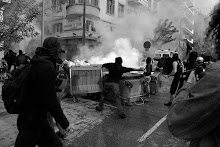
On the appeal trial against the Lecce anarchists
So-called operation Nottetempo (Night Time) started in May 2005 with a massive police deployment that led to the arrests of 5 anarchists in the Lecce province (southern Italy) and to the investigation of another ten for conspiracy. The comrades had actually been actively engaged in the struggle against the Regina Pacis immigration detention centre of San Foca (Lecce) run by the clergy, which closed down before the beginning of the infamous operation Nottetempo. The tenacious struggle of the local anarchists, in fact, had unveiled the atrocities perpetrated in that prison for immigrants to such a point that the operators of the centre could no longer hide their ignominious activity. Some of them were even put on trial and eventually went abroad, where they carried on their dirty business and managed to repair their reputation.
On the contrary, two of the arrested anarchists spent two years in prison while the others were put under house arrest or subjected to various restrictions. The first grade of the trial concluded in July 2008: as it was impossible for the jury to confirm the existence of a subversive association (article 270bis on conspiracy), they turned to article 416 of the Italian penal code and accused four comrades of forming a ‘criminal association’ (organized crime). Three other comrades were accused of specific crimes and the other eight were acquitted.
Anxious about his career and longing for promotion, public prosecutor Lino Giorgio did not resign himself to the fact that his theory of an anarchist clandestine association had been rejected by the jury. For this reason, a few weeks later, he presented an appeal against this sentence in order for another jury to confirm the accusation of conspiracy against the Lecce anarchists.
The sentence of appeal was to be finally pronounced on February 10 2010, but it has once again been postponed following the decision of the jury to examine further ‘evidence’ provided by the public prosecutor. The intention to charge the anarchists
involved in this shameful story of repression with yet more serious charges is evident, and it is also clear how the local powerful are determined to silence the entire matter as well as the violence and the abuse inflicted on immigrants by the
operators of the Regina Pacis concentration camp. If the latter no longer exists, numerous others can be found all over Italy and everywhere else; but the struggle is also alive, the struggle of those who, inside and outside these concentration camps,
believe that the only fate of these places is that of being destroyed along with the fear, hatred, indifference and racism fomented by power in order to create terror and to stir up a war among the exploited.
Solidarity to the Lecce anarchists!
Destroy all prisons!
Sunday, 14 February 2010

Sunday, 7 February 2010
What are anarchists?
Who do anarchists struggle against
- Against the State seen as the centralised organisation of power in all spheres (administrative, financial, political, military, etc.)
- Against government which is the political executive organ of the State and makes all decisions concerning repression, exploitation, control, etc.
-Against Capitalism which can be considered both as the flux of productive relations in course and individual capitalists, their activity, their projects and their complicity in this form
- Against the individual parts that the State and capital are divided into. In other words the police, judiciary, the army, school, newspapers, television, trade unions, the large multinational firms, etc.
- Against the family, which forms the essential nucleus upon which the State structure is based
- Against the world of politics, therefore against political parties (all of them), Parliament which is the expression of bourgeois democracy, and the political ideology which serves to mask real social problems
- Against fascists and all the other instruments of repression used by the State and Capital
- Against religion and the Church which constitute a potent ally to repression
- Against the army which is an armed force that is used against the people
- Against prisons which institutionalise the repression of the poorest of the exploited classes
- Against asylums which repress the different
What false ideas do anarchists struggle against
- Against reformism which wants to set social problems right by using laws, political parties, parliaments, referendums, votes, etc.
- Against efficientism which wants to reduce man to an automat always capable of working and obeying
- Against humanitarianism which calls for peace and safety of an abstract idea of man but does not act concretely to attack class enemies
- Against nonviolence which blocks the just violence of the exploited which is their only arm of liberation
- Against patriotism which feeds the absurd idea of the homeland in preference to other nations, whereas the exploited have no homeland but are brothers of the exploited of the whole world
- Against militarism which justifies the function of armies with the swindle that their role is the defence of the homeland
- Against racism which defines a part of the human race as inferior
- Against male chauvinism which reduces women to sex objects
- Against feminism which closes itself within an asphyxiating inverted male chauvinism
- Against the delegate which separates the exploited from direct action
- Against hierarchy which educates towards social stratification
- Against obedience which represses all individuality
- Against authority which prevents the autonomous development of the individual
- Against progressivism, a modern version of evolutionism which is the ideological covering of reformism
- Against economism which puts the economics at the centre of the history of class exploitation
-Against trade unionism which is the direct product of economism and which means to limit the class struggle to claiming at the level of the workplace. Anarcho-syndicalism, with all its revolutionary declarations does not escape this reformist limitation
What anarchists want
- Abolition of the State, Government, Capitalism, the family, religion, the army, prisons, asylums and every form of power which uses the law to force others to do something. Therefore refusal also of any kind of workers’ or socialist State and of any form of dictatorship of the proletariat
- Elimination of the private property of land, the tools of labour, materials, machines, factories, the land and anything else required for the production of what is necessary in order to live
-Abolition of salaried work and reduction of work to a minimum organised by individual groups federated on the basis of their own aptitudes and sympathies as well as on the basis of their own needs
- Substitution of the traditional family with life in common based on love and reciprocal affinity and on the basis of real sexual equality
- Organisation of life, such as that of production, based on free associations differing according to the problems to be faced, interests to be defended and affinities to be developed. The whole of these organisations federated on a local basis, by groups of communes, then widening the relations to a larger federation until it reaches the maximum possible of the liberated areas of the revolution
- Education free and aimed at an awakening of individual aptitude which in a liberated society will be meaningful only in the limits in which this liberation is realised
- The spreading of atheism and anti-religious propaganda, always necessary because on these problems even the liberation that has come about cannot exercise more than a limited clarification
- Completion of the social revolution until all domination of man over man be abolished.
The means anarchists want to use
- The specific anarchist organisation which is an active minority of conscious individuals who share personal and political affinity and give themselves the aim of calling on the exploited to organise themselves with a view to revolution.
- A federation of different anarchist groups who while changing nothing of their particular specific structure, link with each other with informal, federative pacts in order to better coordinate their own action
- Propaganda to explain through books, pamphlets, newspapers, leaflets, graffiti, etc. what the intentions of the ruling structure are and the dangers facing the exploited. Also to supply indications of the anarchist struggle and show who anarchists are, or to urge the exploited to rebel, denouncing the consequences of obedience and resignation
- The struggle to claim better conditions - Although we are not reformists, the struggle to obtain improvements in one’s immediate situation (wages, habitation, health, education, occupational, etc.) sees anarchists present although they do not see these moments as ends in themselves. They push the exploited towards this form of struggle so that they can develop the elements of self-organisation and refusal of the delegate which are indispensable in order to develop direct action at all other levels
- Violent struggle to realise the social revolution along with the exploited. The attack against the class enemy (State, government, capital, church, etc.) must necessarily be violent, in the case of the contrary it would only be a sterile protest and would determine a reinforcement of class dominion. This attack could be:
a) isolated attacks against individual structures or people who are responsible for repression
b) an insurrectional attack by a specific minority
c) a mass insurrectional attack
d) a mass revolutionary attack
Each of these levels, starting from the first, may or may not create the conditions leading to the successive one to develop. Political and economic analyses can foresee this possibility within certain limits, but cannot give an absolute response: action itself is the only test for action. The moral foundation of violent struggle already exists in the fact of repression as it has been exercised by power for centuries.
from 'Revolution, Violence, anti-authoritarianism', Elephant Editions
- Against the State seen as the centralised organisation of power in all spheres (administrative, financial, political, military, etc.)
- Against government which is the political executive organ of the State and makes all decisions concerning repression, exploitation, control, etc.
-Against Capitalism which can be considered both as the flux of productive relations in course and individual capitalists, their activity, their projects and their complicity in this form
- Against the individual parts that the State and capital are divided into. In other words the police, judiciary, the army, school, newspapers, television, trade unions, the large multinational firms, etc.
- Against the family, which forms the essential nucleus upon which the State structure is based
- Against the world of politics, therefore against political parties (all of them), Parliament which is the expression of bourgeois democracy, and the political ideology which serves to mask real social problems
- Against fascists and all the other instruments of repression used by the State and Capital
- Against religion and the Church which constitute a potent ally to repression
- Against the army which is an armed force that is used against the people
- Against prisons which institutionalise the repression of the poorest of the exploited classes
- Against asylums which repress the different
What false ideas do anarchists struggle against
- Against reformism which wants to set social problems right by using laws, political parties, parliaments, referendums, votes, etc.
- Against efficientism which wants to reduce man to an automat always capable of working and obeying
- Against humanitarianism which calls for peace and safety of an abstract idea of man but does not act concretely to attack class enemies
- Against nonviolence which blocks the just violence of the exploited which is their only arm of liberation
- Against patriotism which feeds the absurd idea of the homeland in preference to other nations, whereas the exploited have no homeland but are brothers of the exploited of the whole world
- Against militarism which justifies the function of armies with the swindle that their role is the defence of the homeland
- Against racism which defines a part of the human race as inferior
- Against male chauvinism which reduces women to sex objects
- Against feminism which closes itself within an asphyxiating inverted male chauvinism
- Against the delegate which separates the exploited from direct action
- Against hierarchy which educates towards social stratification
- Against obedience which represses all individuality
- Against authority which prevents the autonomous development of the individual
- Against progressivism, a modern version of evolutionism which is the ideological covering of reformism
- Against economism which puts the economics at the centre of the history of class exploitation
-Against trade unionism which is the direct product of economism and which means to limit the class struggle to claiming at the level of the workplace. Anarcho-syndicalism, with all its revolutionary declarations does not escape this reformist limitation
What anarchists want
- Abolition of the State, Government, Capitalism, the family, religion, the army, prisons, asylums and every form of power which uses the law to force others to do something. Therefore refusal also of any kind of workers’ or socialist State and of any form of dictatorship of the proletariat
- Elimination of the private property of land, the tools of labour, materials, machines, factories, the land and anything else required for the production of what is necessary in order to live
-Abolition of salaried work and reduction of work to a minimum organised by individual groups federated on the basis of their own aptitudes and sympathies as well as on the basis of their own needs
- Substitution of the traditional family with life in common based on love and reciprocal affinity and on the basis of real sexual equality
- Organisation of life, such as that of production, based on free associations differing according to the problems to be faced, interests to be defended and affinities to be developed. The whole of these organisations federated on a local basis, by groups of communes, then widening the relations to a larger federation until it reaches the maximum possible of the liberated areas of the revolution
- Education free and aimed at an awakening of individual aptitude which in a liberated society will be meaningful only in the limits in which this liberation is realised
- The spreading of atheism and anti-religious propaganda, always necessary because on these problems even the liberation that has come about cannot exercise more than a limited clarification
- Completion of the social revolution until all domination of man over man be abolished.
The means anarchists want to use
- The specific anarchist organisation which is an active minority of conscious individuals who share personal and political affinity and give themselves the aim of calling on the exploited to organise themselves with a view to revolution.
- A federation of different anarchist groups who while changing nothing of their particular specific structure, link with each other with informal, federative pacts in order to better coordinate their own action
- Propaganda to explain through books, pamphlets, newspapers, leaflets, graffiti, etc. what the intentions of the ruling structure are and the dangers facing the exploited. Also to supply indications of the anarchist struggle and show who anarchists are, or to urge the exploited to rebel, denouncing the consequences of obedience and resignation
- The struggle to claim better conditions - Although we are not reformists, the struggle to obtain improvements in one’s immediate situation (wages, habitation, health, education, occupational, etc.) sees anarchists present although they do not see these moments as ends in themselves. They push the exploited towards this form of struggle so that they can develop the elements of self-organisation and refusal of the delegate which are indispensable in order to develop direct action at all other levels
- Violent struggle to realise the social revolution along with the exploited. The attack against the class enemy (State, government, capital, church, etc.) must necessarily be violent, in the case of the contrary it would only be a sterile protest and would determine a reinforcement of class dominion. This attack could be:
a) isolated attacks against individual structures or people who are responsible for repression
b) an insurrectional attack by a specific minority
c) a mass insurrectional attack
d) a mass revolutionary attack
Each of these levels, starting from the first, may or may not create the conditions leading to the successive one to develop. Political and economic analyses can foresee this possibility within certain limits, but cannot give an absolute response: action itself is the only test for action. The moral foundation of violent struggle already exists in the fact of repression as it has been exercised by power for centuries.
from 'Revolution, Violence, anti-authoritarianism', Elephant Editions
Communist guerrilla against drug pushers in Italy 1978
18 June 1978, Rome: A notorious fascist belonging to the infamous Di Luia gang and boss of the heroin trade, is killed with three pistol shots. The action is claimed in a telephone call to Lotta Continua by Movimento proletaria di resistenza offensivo Nucleo Antieroina. (Anti-heroin nucleus of the Movement of Proletarian Resistance). On November
1 in Milan, Proletari Armati claim the killing of Giampiero Grandi, shopkeeper, belonging to an organisation that controls heroin traffic and the exploitation of prostitutes. Bomb at Mental Hygiene Centre in via Pancrazi, and a bar in via Degli Apuli. On November 6, still in Milan a bomb exploded in a bar in via Arsia, centre of heroin traffic in that area. On the 27th in Rome, Guerriglia comnunista ambush two heroin pushers; one is killed, the other wounded.
Here is the communique claiming the action:
WE CLAIM the execution of the heroin pusher and mafioso, Grandi Giampiero, and the bombings at the Centre for Mental Hygiene in via Pancrazi, the pushers’ lair of via Degli Apuli on 1.11.78, and the bar in via Arsia, centre of the heroin traffic in the Quarto Oggiaro area, on 6.11.78.
Communists are not generally against ‘drug addicts’ like the bourgeoisie and the forces of repression: they are against those who speculate on their skins. We know that heroin is an answer, although illusory and disgusting, to a real need for change in the quality of life. Heroin is the most beautiful of the false consumer products that capital has invented to mystify the reality of proletarian needs. To struggle against heroin pushers is for every heroin addict to struggle against those who seem to be giving him the only possibility of life and survival.
It wouldn’t be habit-forming if daily life weren’t shit. State and God, Work and Family, are deviating ideologies that serve to uphold and hide an unnatural, lousy, criminal social order which denies in all its relationships the legitimacy of the natural needs of man, and upsets his relationship with reality. Destruction of nature (Seveso is only a tiny example of capitalist criminality), destruction of man as a natural being.
What capital cannot exploit it destroys.
With the circulation of heroin and psychotropic drugs they are planning the destruction of entire generations. They destroy as the only way to evaluate the desire to live, to be well, to express the creativity which the young proletarians are the carriers of, in terms of profit.
Instead of the forced suicides of the Chilean type, capital is launching voluntary suicide on the market for common use.
Heroin in itself is a false problem: it is a consumer product invented to suffocate the real need to change the quality of life, the real problem is the existence of the capitalist social organisation, because it bends towards death and the destruction of all that is human. The drug addict becomes known and measured for the quantity of heroin he consumes, for the average number of thefts he commits, and not for being a human being who, like others, is trying to affirm his own right to existence. To speak of heroin gratuitously is useless if one doesn’t begin to organise the proletarian strength to destroy the present state of affairs at the same time. The proletarian revolution, the surpassing of the existing social order, is not a project to be defined in abstract, but begins in practice with the destruction of capitalist society.
All those who support the liberalisation of the heroin market without posing the problem of how to change the reality of proletarian life in the capitalist metropoli, are stupid opportunists.
The armed strength of the proletariat must aim to impose itself as a concrete element capable of self-determining social reality in its complexity.
Build proletarian unity in the struggle, establish and develop the political legitimacy of the revolutionaries among the proletariat, extend the space for building the real power of the proletariat armed.
The armed strength of the proletariat in struggle is the only practical instrument of liberation from capitalist dominion.
Heroin pushing, the exploitation of prostitution, the fencing of small thefts, are activities which correspond only to the law of capitalist accumulation. Communists are not against illegal activity that damages the bourgeois strata: they are against all those vile activities of proletarian exploitation. It is right to rob banks, to ransom the bourgeois strata, but enough opportunism! Whoever gets rich through the injury of other proletarians will be considered a vile traitor!
Vile is the pusher who earns his living through the deaths of others. Vile is the pimp who uses womens’ bodies as an instrument for his own profit. Vile is the fence who exploits the sweat labour of young proletarians when they are constrained to steal a stereo or spare tyres. All those, especially at a big level, are friends of the police and the carabinieri and enemies of the proletariat. They buy the freedom to continue their vile activities in exchange for tip-offs and prison for other proletarians. The carabinieri use them as informers and they use the carabinieri to get rid of those who are in their way. So the operations of the drug squad against the pushers are in the end nothing other than operations controlling the market to the benefit of those who really centralise the heroin commerce.
Whoever breaks proletarian unity, exploits and robs from the proletariat themselves, must the considered vile enemy and traitor: no solidarity in their divisions for subversive work among all the proletarians, for the destruction of capitalist society.
Expel the enemies of the proletariat, the spies and traitors, whether they be heroin pushers or trade union bosses, to build the unity of the proletariat in struggle.
Heroin is an instrument of social control that suits power. Alongside the pushers, and the forces of repression there exists another hierarchy of control over the proletariat: the medico-psychiatric one. The sanitary decentralisation, the opening of centres for hygiene and mental health in every area, are the new instruments which capital is using to keep the contradictions of the capitalist metropolis under control, to render stupid and to drug the forces of the proletarian revolution. Whoever goes beyond the rule of State, of Work, of Family, is ‘mad’, can be labelled as deviant from childhood. As such, capital assigns his ghetto; will give him more heroin free, will stuff him with psychotropic drugs from the beginning, so that he doesn’t disturb the regular functioning of the social order.
Doctors and psychiatrists who administer such rubbish, especially to young people and women, are mad criminals, labelling antagonism and proletarian rebellion as ‘social deviance’. Neurotic and psychopathic subjects only because they cannot support the disgust of capitalist society. What does a psychiatrist who has been able to study without lifting a finger until he gets his degree know of proletarian life in the ghettos?
What we are fighting for is the fundamental right to self-determination of the proletariat. It must be the proletariat themselves to decide how, where and why they want to live. The psychiatrists, the criminologists, the priests, the trade union bosses, in their positions as social controllers of the proletariat are enemies, and as such should be struck down.
Attack the forces of repression, carabinieri and police. Expel and strike their friends, the traitors, the informers, the spies, from the factories, from the proletarian areas.
Attack the hierarchy of medico-psychiatric control.
Break up the internal hierarchy of control within the proletariat, the pushers and the shit fences.
Build the power of the armed proletariat.
(Nov. ’78)
from 'Armed Struggle in Italy 1976-78' Elephant Editions
1 in Milan, Proletari Armati claim the killing of Giampiero Grandi, shopkeeper, belonging to an organisation that controls heroin traffic and the exploitation of prostitutes. Bomb at Mental Hygiene Centre in via Pancrazi, and a bar in via Degli Apuli. On November 6, still in Milan a bomb exploded in a bar in via Arsia, centre of heroin traffic in that area. On the 27th in Rome, Guerriglia comnunista ambush two heroin pushers; one is killed, the other wounded.
Here is the communique claiming the action:
WE CLAIM the execution of the heroin pusher and mafioso, Grandi Giampiero, and the bombings at the Centre for Mental Hygiene in via Pancrazi, the pushers’ lair of via Degli Apuli on 1.11.78, and the bar in via Arsia, centre of the heroin traffic in the Quarto Oggiaro area, on 6.11.78.
Communists are not generally against ‘drug addicts’ like the bourgeoisie and the forces of repression: they are against those who speculate on their skins. We know that heroin is an answer, although illusory and disgusting, to a real need for change in the quality of life. Heroin is the most beautiful of the false consumer products that capital has invented to mystify the reality of proletarian needs. To struggle against heroin pushers is for every heroin addict to struggle against those who seem to be giving him the only possibility of life and survival.
It wouldn’t be habit-forming if daily life weren’t shit. State and God, Work and Family, are deviating ideologies that serve to uphold and hide an unnatural, lousy, criminal social order which denies in all its relationships the legitimacy of the natural needs of man, and upsets his relationship with reality. Destruction of nature (Seveso is only a tiny example of capitalist criminality), destruction of man as a natural being.
What capital cannot exploit it destroys.
With the circulation of heroin and psychotropic drugs they are planning the destruction of entire generations. They destroy as the only way to evaluate the desire to live, to be well, to express the creativity which the young proletarians are the carriers of, in terms of profit.
Instead of the forced suicides of the Chilean type, capital is launching voluntary suicide on the market for common use.
Heroin in itself is a false problem: it is a consumer product invented to suffocate the real need to change the quality of life, the real problem is the existence of the capitalist social organisation, because it bends towards death and the destruction of all that is human. The drug addict becomes known and measured for the quantity of heroin he consumes, for the average number of thefts he commits, and not for being a human being who, like others, is trying to affirm his own right to existence. To speak of heroin gratuitously is useless if one doesn’t begin to organise the proletarian strength to destroy the present state of affairs at the same time. The proletarian revolution, the surpassing of the existing social order, is not a project to be defined in abstract, but begins in practice with the destruction of capitalist society.
All those who support the liberalisation of the heroin market without posing the problem of how to change the reality of proletarian life in the capitalist metropoli, are stupid opportunists.
The armed strength of the proletariat must aim to impose itself as a concrete element capable of self-determining social reality in its complexity.
Build proletarian unity in the struggle, establish and develop the political legitimacy of the revolutionaries among the proletariat, extend the space for building the real power of the proletariat armed.
The armed strength of the proletariat in struggle is the only practical instrument of liberation from capitalist dominion.
Heroin pushing, the exploitation of prostitution, the fencing of small thefts, are activities which correspond only to the law of capitalist accumulation. Communists are not against illegal activity that damages the bourgeois strata: they are against all those vile activities of proletarian exploitation. It is right to rob banks, to ransom the bourgeois strata, but enough opportunism! Whoever gets rich through the injury of other proletarians will be considered a vile traitor!
Vile is the pusher who earns his living through the deaths of others. Vile is the pimp who uses womens’ bodies as an instrument for his own profit. Vile is the fence who exploits the sweat labour of young proletarians when they are constrained to steal a stereo or spare tyres. All those, especially at a big level, are friends of the police and the carabinieri and enemies of the proletariat. They buy the freedom to continue their vile activities in exchange for tip-offs and prison for other proletarians. The carabinieri use them as informers and they use the carabinieri to get rid of those who are in their way. So the operations of the drug squad against the pushers are in the end nothing other than operations controlling the market to the benefit of those who really centralise the heroin commerce.
Whoever breaks proletarian unity, exploits and robs from the proletariat themselves, must the considered vile enemy and traitor: no solidarity in their divisions for subversive work among all the proletarians, for the destruction of capitalist society.
Expel the enemies of the proletariat, the spies and traitors, whether they be heroin pushers or trade union bosses, to build the unity of the proletariat in struggle.
Heroin is an instrument of social control that suits power. Alongside the pushers, and the forces of repression there exists another hierarchy of control over the proletariat: the medico-psychiatric one. The sanitary decentralisation, the opening of centres for hygiene and mental health in every area, are the new instruments which capital is using to keep the contradictions of the capitalist metropolis under control, to render stupid and to drug the forces of the proletarian revolution. Whoever goes beyond the rule of State, of Work, of Family, is ‘mad’, can be labelled as deviant from childhood. As such, capital assigns his ghetto; will give him more heroin free, will stuff him with psychotropic drugs from the beginning, so that he doesn’t disturb the regular functioning of the social order.
Doctors and psychiatrists who administer such rubbish, especially to young people and women, are mad criminals, labelling antagonism and proletarian rebellion as ‘social deviance’. Neurotic and psychopathic subjects only because they cannot support the disgust of capitalist society. What does a psychiatrist who has been able to study without lifting a finger until he gets his degree know of proletarian life in the ghettos?
What we are fighting for is the fundamental right to self-determination of the proletariat. It must be the proletariat themselves to decide how, where and why they want to live. The psychiatrists, the criminologists, the priests, the trade union bosses, in their positions as social controllers of the proletariat are enemies, and as such should be struck down.
Attack the forces of repression, carabinieri and police. Expel and strike their friends, the traitors, the informers, the spies, from the factories, from the proletarian areas.
Attack the hierarchy of medico-psychiatric control.
Break up the internal hierarchy of control within the proletariat, the pushers and the shit fences.
Build the power of the armed proletariat.
(Nov. ’78)
from 'Armed Struggle in Italy 1976-78' Elephant Editions
Monday, 11 January 2010
Tarnac 9 and their longstanding rapport with the media
http://cettesemaine.free.fr/spip/article.php3?id_article=2785
Sunday, 27 December 2009
WHAT IS TERRORISM?
original title: Qu'est-ce que le terrorisme?
A Corps Perdu number one, 1 December 2008
http://www.acorpsperdu.net/
In May 1898, king Umberto I, worried about the news
reaching him from Milan where a general strike had
broken out, entrusted general Bava Beccaris with the task of repressing the revolt. The order is given to the soldiers to shoot at sight, and Bava Beccaris opens fire on the town with canon shot. The balance is 80 dead and 450 wounded. Proud of having done his duty, the general telegraphs the king that Milan is now ‘pacified’. The head of the government, the marquis Di Rudini, prohibits over one hundred opposition newspapers, the Bourses de Travail, socialist circles, Mutual Societies, and also at least 70 diocesain committees and 2,500 parish committees. Moreover, the universities of Rome, Naples, Padova and Bologne are closed, while thousands of arrests are made. Umberto I immediately sends a telegramme of congratulations to Bava Beccaris and decorates him with the cross of the Military Order of Savoy ‘for precious services rendered to the institutions and civilisation’. Two years later, on July 29 1800, the anarchist Gaetano Bresci relieves king Umberto I of the weight of his responsibilities by killing him in Monza. The King and the anarchist. Two assassins, their hands stained with blood, that’s undeniable. Yet, can one put them on the same level?I don’t think so, any more than one can consider the motivations and consequences of their acts in the same way.
And so, because they can’t be united in a common execration, which of the two committed an act of terrorism? The king who had the crowd massacred, or the anarchist that slayed the king?
To ask oneself what is terrorism is one of those questions that it would seem pointless to ask, because it is destined to get a univoque answer. In reality - when it is formulated rigorously - it doesn’t fail to give rise to surprising reactions. The answers are actually different and contradictory. ‘Terrorism is the violence of those that fight the State’, some say, ‘Terrorism is the violence of the State’, others answer, ‘but no, terrorism is any act of political violence, no matter where it comes from’, the last point out. And all the debates that open up in the face of the distinctions that can then be made on the subject: for example, terrorism is only violence against people or can also be against things? Must it necessarily have a political motivation or is it only characterised by the panic is seminates?
The multiplicity of meanings assigned to this term is suspect. The sensation here is not of finding oneself in the presence of the usual malcomprehensions linked to the incapacity of words to express a reality whose complexity goes beyond the symbols that would like to represent it. On the contrary, one gets the impression that one is face to face with deliberate confusion, a relativism of interpretations created artificially with the intention of emptying ideas of their meaning, or neutralising practical strength, banalising the whole question by reducing all reflection that one might carry out on the subject to chatter.
All the same, this nine-letter word must have an origin, a history, from which it would be possible to deduct a meaning capable of dissipating at least a good part of the ambiguities that its use generates today. And that is in fact so.
The first definition that is given of this term by most dictionaries is of an historical character: ‘the government of terror in France’. One thereby discovers the precise origin of the word. Terrorism corresponds to the period of the French Revolution that goes from April 1793 to July 1794, when the Committe of public health led by Robespierre and Saint-Just ordered a huge number of capital executions. The terror was therefore represented by the guillotine whose blade cut the head off thousands of people who, one presumes, constituted a threat for the security of the new State in formation. Starting off from this base, the same dictionaries add by extension a more general definition of terrorism: ‘all methods of government based on terror’.
At the present time this interpretation of the concept of terrorism is extremely clear. First of all, it highlights the narrow line that exists between terrorism and the State. Terrorism is born with the State, is exercised by the State, is precisely a ‘method of government’ that the State uses against its enemies to guarantee its own conservation. ‘The guillotine - said Victor Hugo - is the concretisation of law’. Only the State can promulgate laws. And law, far from being the expression of this social contract garantor of harmonious cohabitation among humans, represents the barbed wire with which power protects its privileges.Whoever dares to go beyond it will have to pass through the hands of the hangman. In fact, before the month of April 1793, some so-called common law criminals and some insurgents had already climbed the scaffold.
Whatever one might think, the guillotine is not actually an invention of monsieur Guillotin. In France this instrument of capital execution already had a history, but nobody had talked about Terror yet.It is only when the authority of the State, then in the hands of the jacobins, is threatened by a revolutionary wave, when it is no longer a question of simple outlaws or isolated insurgents, but a huge social movement capable of overthrowing it, only then does repressive violence come to be called terror’.
But, apart from its institutional character, another characteristic distinguishes terrorism: anyone can become a victim of it. During the period of the Terror there were no fewer than 4,000 executions in Paris alone. Louis Blanc found the identity of 2,750 guillotined people, discovering that only 650 of them belonged to the wealthy classes. That means that the State machine of the guillotine did not make many distinctions, decapitating anyone it considered a nuisance or suspect. It was not only noblemen, military men and priests that lost their heads these days - as the most conservative and traditional propaganda would have it - but above all simple artisans, peasants, poor people. Terrorism is such because it strikes blindly, hence the feeling of collective panic it inspires. The indiscriminate use of the guillotine, systemised thanks to the simplification of judicial procedures consented by the law of Prairial, created the ineluctable effect of chain operations, annuling the individual differences between all the decapitated. This practise of amalgam has a precise political sense: regrouping into one single seance the people suspected of ‘crimes’ of a nature or identity that were completely different. Terror aims at eliminating individual differences to create popular consensus, and to destroy ‘the abjection of the personal me’ (Robespierre), given that there must only exist one single entity into which to melt individuals: the State. Terrorism is therefore born as an institutional and indiscriminate instrument. These two aspects also retentissent in current expressions, as for example ‘terrorising bombardments’. Not only does bombardment take place during wars carried out by States, it seminates death and desolation among the whole population. One could say the same thing concerning the psychological terrorism considered ‘a form of intimidation or blackmail’ in order to manipulate public opinion, effectuated above all through the means of communication, by the exaggeration of the dangers of certain situations or even inventing them, in order to induce the masses to behave in a certain way in political, social and economic projects. One can see clearly how only those who hold power are able to manipulate the great means of communication and, through them, the ‘masses’, in order to reach their aim.
Terrorism is therefore the blind violence of the State, as the origin of the term shows clearly. But language is never a neutral expression. Far from being merely descriptive, language is above all a code. The meaning of words always points to the side on which the balance of power is leaning. He who holds power also possesses the meaning of words. That explains how it is that, over time, the concept of terrorism has taken on a new meaning that completely contradicts its historical origins but corresponds to the needs of power. Today, this concept is defined ‘a method of political struggle based on intimidatory violence (murder, sabotage, explosive attacks, etc.) generally used by revolutionary groups or subversives (left or right)’. As we can see, this interpretation, which began to spread at the end of the 19th century, is in complete opposition to what has been said until now.In the initial acceptation of the word, it is the State that has recourse to terrorism against its enemies; in the second, it is its enemies that use terrorism against the State.The upturning of meaning could not be more explicit. The usefulness of such an operation for the Reason of State is only too clthe Terror in France was the work of a state born from the Revolution.To justifythe present meaning of the concept of terrorism, the dominant ideology has had to intervertire its subjects and attribute to the Revolution the responsibility that in reality belongs to the State. Ainsi, we are taught today that Terror is the work of the Revolution which, in this far off historical context, took the form of the State. Terror is therefore synonymous with revolutionary violence. An acrobatic jump in logic that continues to enchant the parterres of spectators the world over, who don’t seem to realise de l’arnaque more than obvious.
In reality, one cannot attribute Terror to the Revolution, the insurgent people, because it is only when the Revolution becomes a state that the Terror has appeared. It is an enormous ideological lie and a gross historical error to make Terror the very expression of ‘massacrante’ revolutionary violence, that in the streets, ythe days on the barricades, of popular vengeance. Before April 17 1793 (day of the foundatio of the revolutionarytribunal), the violence exercised against power, even that which was particularly cruel, had never recouvert the name of terrorism. Neither the bloody Jacqueries of the XIV century, nor the excesses that deroule during the Great Revolution (such as for example the demonstratio of the women of Marseille who carried a la ronde, on top of a pike, the visceres of Major De Beausset to the sound of ‘who’s for tripe?’) were ever considered as acts of terrorism.This term indicates only the repressive violence of the State apparutus at the moment in which it has to defend itself - for the first time in history - from a revolutionary assault. En somme, the historic aspect of the term shows how terrorism is violence of power that defends itself from the Revolution, not Revolution attacking power.
What a social monstruosity, what chef d’oeuvre of Machiavelism is this revolutionary government! For any being that reasons, government and revolution are incompatible.
Jean Varlet, Gare l’explosion, 15 vendemaire an III.
It should be said a ce propos that the persistence of this ambiguity has been encouraged for a long time by the revolutionaries themselves, who have accepted this qualificativ de bon gres, without realising that in so doing they were helping the propaganda of the very State that they wanted to strike. And if the concept of terrorism can legitimately find its place in an authoritarian concept of revolution (as Lenin and Stalin demonstrated in Russia), it is absolutely devoid of sense, not to say abhorrant, in an anti-authoritarian perspective of liberation. It is not by chance thast it is precisely the anarchists to have in first revu the improper use of this term, perhaps pushed by events. In 1921 the tragic attentat took place against the cinema-theatre Diana in Milan, causing the death and wounding of numerous spectators, although it had the objective the town prefect who was responsible for the imprisonment of some well-known anarchists. In spite of the authors’ intentions, it was an act of terrorism. As one can imagine, this act has led to many arguments within the anarchist movement. Ainsi, in the face of the condemnation of the gesture by many anarchists, both the revue Anarchisme of Pisa, undoubtedly the most widely distributed publication of autonomous anarchism in Italy, continued to defend ‘this cardinal anarchist truth, of knowing the impossibility of separating terrorism from insurrectionalism’, it began on the other hand to esquisser the first critical reflections on the concept of terrorism: ‘why name and tax with ‘catastrophic terror’ - which is the propre of the State - the act of individual revolt? The State is terrorist, the revolutionary who insurges, never!’ Half a century later, within a context of strong social tension, this critique was to be taken up again and developed by those who did not intend to accept the accusation of terrorism launched by the state against its enemies.
[insert]
Words have always been subject to an evolution in meaning. It is not surprising that the meaning of the term terrorism has also been modified. It is all the same unacceptable that it contradict each one of its original characteristics, which are those of the institutional and indiscriminate aspectof violence. This violence can be exercised against people or against things, it can be physical or psychological, but in order to be able to speak of terrorism, there must be at least one of these two characteristics remains. For example, one has rightly spoken of terrorism to indicate actions carried out by death squads of the Spanish State against the militants of ETA. These actions were directed against a precise objective, but it was all the same a question of a form of institutional violence against a threat considered as revolutionary. In the same way terrorism can not always be carried out by institutions. But in order for us to consider it such, its manifestations must then strike in an indiscriminate way. A bomb in a station or an open supermarket or on a crowded beach can rightly be defined terrorist. Even when it is fruit of the delirium of a ‘madman’ or when it is claimed by a revolutionary orga nisation, the result of such an action is to seminate panic in the population.
When on the other hand violence is neither institutional nor indiscriminate, it is a non-sense to speak of terrorism. An individual that exterminates his family in prey of a crisis of madness is not a terrorist. Any more than a revolutionary or a subversive organisation that choses its objectives with care. Of course there is violence, revolutionary violence, but not terrorism. It is aimed neither a defending the State nor at seminating terror in the population. If, during such attacks, the media talk of ‘collective psychosis’ or ‘whole nations trembling in fear’, it is merely in reference to the old lie that wants to identify a whole country with its representatives, in order to better justify the pursuit of the private interests of some in the name and at the cost of the social interests of all the others. If someone were to start to kill politicians, industrialists and magistrates, that would merely seminate terror among politicians, industrialists and magistrates. Nobody else would be materially touched. But if someone were to put a bomb in a train, anyone could be a victim, without exclusion: the politician just like the enemy of politics, the industrialist just like the worker, the magistrate just like the repris de justice. In the first case we are faced with an example of revolutionary violence, in the second it is a question of terrorism on the other hand. And in spite of all objections, critiques and perplexities that the first form of violence can raise, one certainly cannot compare it to the second.
That said, we come back to the initial question. Between the king who has the crowd massacred and the anarchist that shoots the king, who is the terrorist?
Mare Almani
A Corps Perdu number one, 1 December 2008
http://www.acorpsperdu.net/
In May 1898, king Umberto I, worried about the news
reaching him from Milan where a general strike had
broken out, entrusted general Bava Beccaris with the task of repressing the revolt. The order is given to the soldiers to shoot at sight, and Bava Beccaris opens fire on the town with canon shot. The balance is 80 dead and 450 wounded. Proud of having done his duty, the general telegraphs the king that Milan is now ‘pacified’. The head of the government, the marquis Di Rudini, prohibits over one hundred opposition newspapers, the Bourses de Travail, socialist circles, Mutual Societies, and also at least 70 diocesain committees and 2,500 parish committees. Moreover, the universities of Rome, Naples, Padova and Bologne are closed, while thousands of arrests are made. Umberto I immediately sends a telegramme of congratulations to Bava Beccaris and decorates him with the cross of the Military Order of Savoy ‘for precious services rendered to the institutions and civilisation’. Two years later, on July 29 1800, the anarchist Gaetano Bresci relieves king Umberto I of the weight of his responsibilities by killing him in Monza. The King and the anarchist. Two assassins, their hands stained with blood, that’s undeniable. Yet, can one put them on the same level?I don’t think so, any more than one can consider the motivations and consequences of their acts in the same way.
And so, because they can’t be united in a common execration, which of the two committed an act of terrorism? The king who had the crowd massacred, or the anarchist that slayed the king?
To ask oneself what is terrorism is one of those questions that it would seem pointless to ask, because it is destined to get a univoque answer. In reality - when it is formulated rigorously - it doesn’t fail to give rise to surprising reactions. The answers are actually different and contradictory. ‘Terrorism is the violence of those that fight the State’, some say, ‘Terrorism is the violence of the State’, others answer, ‘but no, terrorism is any act of political violence, no matter where it comes from’, the last point out. And all the debates that open up in the face of the distinctions that can then be made on the subject: for example, terrorism is only violence against people or can also be against things? Must it necessarily have a political motivation or is it only characterised by the panic is seminates?
The multiplicity of meanings assigned to this term is suspect. The sensation here is not of finding oneself in the presence of the usual malcomprehensions linked to the incapacity of words to express a reality whose complexity goes beyond the symbols that would like to represent it. On the contrary, one gets the impression that one is face to face with deliberate confusion, a relativism of interpretations created artificially with the intention of emptying ideas of their meaning, or neutralising practical strength, banalising the whole question by reducing all reflection that one might carry out on the subject to chatter.
All the same, this nine-letter word must have an origin, a history, from which it would be possible to deduct a meaning capable of dissipating at least a good part of the ambiguities that its use generates today. And that is in fact so.
The first definition that is given of this term by most dictionaries is of an historical character: ‘the government of terror in France’. One thereby discovers the precise origin of the word. Terrorism corresponds to the period of the French Revolution that goes from April 1793 to July 1794, when the Committe of public health led by Robespierre and Saint-Just ordered a huge number of capital executions. The terror was therefore represented by the guillotine whose blade cut the head off thousands of people who, one presumes, constituted a threat for the security of the new State in formation. Starting off from this base, the same dictionaries add by extension a more general definition of terrorism: ‘all methods of government based on terror’.
At the present time this interpretation of the concept of terrorism is extremely clear. First of all, it highlights the narrow line that exists between terrorism and the State. Terrorism is born with the State, is exercised by the State, is precisely a ‘method of government’ that the State uses against its enemies to guarantee its own conservation. ‘The guillotine - said Victor Hugo - is the concretisation of law’. Only the State can promulgate laws. And law, far from being the expression of this social contract garantor of harmonious cohabitation among humans, represents the barbed wire with which power protects its privileges.Whoever dares to go beyond it will have to pass through the hands of the hangman. In fact, before the month of April 1793, some so-called common law criminals and some insurgents had already climbed the scaffold.
Whatever one might think, the guillotine is not actually an invention of monsieur Guillotin. In France this instrument of capital execution already had a history, but nobody had talked about Terror yet.It is only when the authority of the State, then in the hands of the jacobins, is threatened by a revolutionary wave, when it is no longer a question of simple outlaws or isolated insurgents, but a huge social movement capable of overthrowing it, only then does repressive violence come to be called terror’.
But, apart from its institutional character, another characteristic distinguishes terrorism: anyone can become a victim of it. During the period of the Terror there were no fewer than 4,000 executions in Paris alone. Louis Blanc found the identity of 2,750 guillotined people, discovering that only 650 of them belonged to the wealthy classes. That means that the State machine of the guillotine did not make many distinctions, decapitating anyone it considered a nuisance or suspect. It was not only noblemen, military men and priests that lost their heads these days - as the most conservative and traditional propaganda would have it - but above all simple artisans, peasants, poor people. Terrorism is such because it strikes blindly, hence the feeling of collective panic it inspires. The indiscriminate use of the guillotine, systemised thanks to the simplification of judicial procedures consented by the law of Prairial, created the ineluctable effect of chain operations, annuling the individual differences between all the decapitated. This practise of amalgam has a precise political sense: regrouping into one single seance the people suspected of ‘crimes’ of a nature or identity that were completely different. Terror aims at eliminating individual differences to create popular consensus, and to destroy ‘the abjection of the personal me’ (Robespierre), given that there must only exist one single entity into which to melt individuals: the State. Terrorism is therefore born as an institutional and indiscriminate instrument. These two aspects also retentissent in current expressions, as for example ‘terrorising bombardments’. Not only does bombardment take place during wars carried out by States, it seminates death and desolation among the whole population. One could say the same thing concerning the psychological terrorism considered ‘a form of intimidation or blackmail’ in order to manipulate public opinion, effectuated above all through the means of communication, by the exaggeration of the dangers of certain situations or even inventing them, in order to induce the masses to behave in a certain way in political, social and economic projects. One can see clearly how only those who hold power are able to manipulate the great means of communication and, through them, the ‘masses’, in order to reach their aim.
Terrorism is therefore the blind violence of the State, as the origin of the term shows clearly. But language is never a neutral expression. Far from being merely descriptive, language is above all a code. The meaning of words always points to the side on which the balance of power is leaning. He who holds power also possesses the meaning of words. That explains how it is that, over time, the concept of terrorism has taken on a new meaning that completely contradicts its historical origins but corresponds to the needs of power. Today, this concept is defined ‘a method of political struggle based on intimidatory violence (murder, sabotage, explosive attacks, etc.) generally used by revolutionary groups or subversives (left or right)’. As we can see, this interpretation, which began to spread at the end of the 19th century, is in complete opposition to what has been said until now.In the initial acceptation of the word, it is the State that has recourse to terrorism against its enemies; in the second, it is its enemies that use terrorism against the State.The upturning of meaning could not be more explicit. The usefulness of such an operation for the Reason of State is only too clthe Terror in France was the work of a state born from the Revolution.To justifythe present meaning of the concept of terrorism, the dominant ideology has had to intervertire its subjects and attribute to the Revolution the responsibility that in reality belongs to the State. Ainsi, we are taught today that Terror is the work of the Revolution which, in this far off historical context, took the form of the State. Terror is therefore synonymous with revolutionary violence. An acrobatic jump in logic that continues to enchant the parterres of spectators the world over, who don’t seem to realise de l’arnaque more than obvious.
In reality, one cannot attribute Terror to the Revolution, the insurgent people, because it is only when the Revolution becomes a state that the Terror has appeared. It is an enormous ideological lie and a gross historical error to make Terror the very expression of ‘massacrante’ revolutionary violence, that in the streets, ythe days on the barricades, of popular vengeance. Before April 17 1793 (day of the foundatio of the revolutionarytribunal), the violence exercised against power, even that which was particularly cruel, had never recouvert the name of terrorism. Neither the bloody Jacqueries of the XIV century, nor the excesses that deroule during the Great Revolution (such as for example the demonstratio of the women of Marseille who carried a la ronde, on top of a pike, the visceres of Major De Beausset to the sound of ‘who’s for tripe?’) were ever considered as acts of terrorism.This term indicates only the repressive violence of the State apparutus at the moment in which it has to defend itself - for the first time in history - from a revolutionary assault. En somme, the historic aspect of the term shows how terrorism is violence of power that defends itself from the Revolution, not Revolution attacking power.
What a social monstruosity, what chef d’oeuvre of Machiavelism is this revolutionary government! For any being that reasons, government and revolution are incompatible.
Jean Varlet, Gare l’explosion, 15 vendemaire an III.
It should be said a ce propos that the persistence of this ambiguity has been encouraged for a long time by the revolutionaries themselves, who have accepted this qualificativ de bon gres, without realising that in so doing they were helping the propaganda of the very State that they wanted to strike. And if the concept of terrorism can legitimately find its place in an authoritarian concept of revolution (as Lenin and Stalin demonstrated in Russia), it is absolutely devoid of sense, not to say abhorrant, in an anti-authoritarian perspective of liberation. It is not by chance thast it is precisely the anarchists to have in first revu the improper use of this term, perhaps pushed by events. In 1921 the tragic attentat took place against the cinema-theatre Diana in Milan, causing the death and wounding of numerous spectators, although it had the objective the town prefect who was responsible for the imprisonment of some well-known anarchists. In spite of the authors’ intentions, it was an act of terrorism. As one can imagine, this act has led to many arguments within the anarchist movement. Ainsi, in the face of the condemnation of the gesture by many anarchists, both the revue Anarchisme of Pisa, undoubtedly the most widely distributed publication of autonomous anarchism in Italy, continued to defend ‘this cardinal anarchist truth, of knowing the impossibility of separating terrorism from insurrectionalism’, it began on the other hand to esquisser the first critical reflections on the concept of terrorism: ‘why name and tax with ‘catastrophic terror’ - which is the propre of the State - the act of individual revolt? The State is terrorist, the revolutionary who insurges, never!’ Half a century later, within a context of strong social tension, this critique was to be taken up again and developed by those who did not intend to accept the accusation of terrorism launched by the state against its enemies.
[insert]
Words have always been subject to an evolution in meaning. It is not surprising that the meaning of the term terrorism has also been modified. It is all the same unacceptable that it contradict each one of its original characteristics, which are those of the institutional and indiscriminate aspectof violence. This violence can be exercised against people or against things, it can be physical or psychological, but in order to be able to speak of terrorism, there must be at least one of these two characteristics remains. For example, one has rightly spoken of terrorism to indicate actions carried out by death squads of the Spanish State against the militants of ETA. These actions were directed against a precise objective, but it was all the same a question of a form of institutional violence against a threat considered as revolutionary. In the same way terrorism can not always be carried out by institutions. But in order for us to consider it such, its manifestations must then strike in an indiscriminate way. A bomb in a station or an open supermarket or on a crowded beach can rightly be defined terrorist. Even when it is fruit of the delirium of a ‘madman’ or when it is claimed by a revolutionary orga nisation, the result of such an action is to seminate panic in the population.
When on the other hand violence is neither institutional nor indiscriminate, it is a non-sense to speak of terrorism. An individual that exterminates his family in prey of a crisis of madness is not a terrorist. Any more than a revolutionary or a subversive organisation that choses its objectives with care. Of course there is violence, revolutionary violence, but not terrorism. It is aimed neither a defending the State nor at seminating terror in the population. If, during such attacks, the media talk of ‘collective psychosis’ or ‘whole nations trembling in fear’, it is merely in reference to the old lie that wants to identify a whole country with its representatives, in order to better justify the pursuit of the private interests of some in the name and at the cost of the social interests of all the others. If someone were to start to kill politicians, industrialists and magistrates, that would merely seminate terror among politicians, industrialists and magistrates. Nobody else would be materially touched. But if someone were to put a bomb in a train, anyone could be a victim, without exclusion: the politician just like the enemy of politics, the industrialist just like the worker, the magistrate just like the repris de justice. In the first case we are faced with an example of revolutionary violence, in the second it is a question of terrorism on the other hand. And in spite of all objections, critiques and perplexities that the first form of violence can raise, one certainly cannot compare it to the second.
That said, we come back to the initial question. Between the king who has the crowd massacred and the anarchist that shoots the king, who is the terrorist?
Mare Almani
Critique of 'Call' 2
This critique of “Call”was written because it is being talked about among comrades, sometimes not too critically. For the sake of the article’s size, I will refer only to some crucial points that I see as the basis of their proposal.
According to Call, the main problem is capitalism. The State is a mere accessory that we can ignore, put in parenthesis. So, don’t expect to find anything in this text pointing to suggestions for an attack on the State. And don’t even bother looking for an analysis of any other structures and institutions of domination; in fact, for the Call the latter are desirable and even necessary. So long as they are managed by the “political force” they call “the party”, of course – “What would be of a political force, under empire, that didn’t have its farms, its schools, its arms, its medicines, its collective houses, its editing desks, its printers, its covered trucks and its bridgeheads in the metropolis?” (pg. 67). We realise on reading the whole of Call that a critique of production, technology, industrialization, the submission of the individual will to the collective will, militarization, politics, etc… is totally absent from the interests of its authors.
But, what about capitalism? What is the analysis and proposal of the Call?
According to the authors of Call, the objective and method of capitalism is “to ruin all community” (pg 30). And we’re given some examples of communities persecuted by capitalism: sects, revolutionary parties, secret societies… If we had already recognized the individual misery existent wherever the reproduction of a group feeds on the theft of the individual’s capacity to decide over his/her own life for some time now, the authors of Call seem to see a problem precisely in the disappearance of alternative societies. What they don’t seem to understand is that those alternative societies reproduce the same individual domination existent in mainstream society: only the form changes. Everything is about an image of radicality. But perhaps they are not concerned about this: their analysis doesn’t come from the individual. The autonomy they’re sorry about having lost is the autonomy of communities.
Obviously, for those for whom capitalism isn’t the reproduction of forced social relations not chosen by the individuals who reproduce them, but rather a formality where it seems to be sufficient to cast aside a symbol (the capitalists) for everything to be alright, that which is reproduced will be ok, if those who reproduce it are seen as the revolutionary subjects of the modern times. “[…] communisation means depriving only the agents of the empire from it” (pg. 69).
So, if the problem is the disaggregation of all community, the solution will logically be the aggregation and constitution of new communities. And this is the way that, in opposition to capitalism, the Call proposes communism. But what is Call’s conception of communism? “So, communism starts from the experience of sharing. […] The practice of communism, as we live it, we call “the Party” (pgs. 64/65). And, somewhere else: “[…] everyone has access to a certain amount of resources and knowledge made available by the simple fact of living in these lands of the old world; and can communize them.” (pg. 33). What is proposed is the sharing of that which we have and generate; the goal is the sharing of structures and resources, and the flux of experiences, knowledge and emotions of the “worlds” involved in those structures (pg. 66). And this is their communism. Along with “In a way it is existential liberalism itself that pushes us to communism, by the very excess of its triumph.” (pg. 63), you can see Marxism is just around the corner; even if they explicitly discard Marx. As in the past, dialectical materialism will find a way…
What the authors of the call intend is to live in communism in the midst of capitalism, “to start from the situation and not dismiss it. To take sides within it.” (pg. 9). Therefore, their project is one of building and managing infra-structures which, they hope, will aggregate “the deserters” and let them survive outside capitalism. But it seems to me that there are some things its authors don’t recognize: in this world, there is nowhere outside capitalism. If, instead of being destroyed, the technological and productive resources of this social order were to be occupied/taken/shared and managed without the intervention of capitalists, the exploitation and domination of individuals would continue the same as now, but without the intervention of capitalists.
If at some point one can read in the Call that “those who pretend to split material autonomy from the sabotage of the imperial machine show that they want neither” (pg 70), it seems to me that those who claim to build an autonomous community in the midst of this society are simply perpetuating the reproduction of this society. After all, if their desires are met through the sharing of existent infra-structures, why should they preoccupy themselves with organizing the attack on and destruction of those same infra-structures? That attack would be an attack on the very things they are proposing.
An example as to how something like the Call’s “party” would look like are the Black Panthers. A Marxist-Leninist armed party, hierarchical, authoritarian, vanguardist. The goal was to set up the conditions for a future rising up of the black community. In the meantime, they served 10 thousand lunches (?breakfasts?) daily, among other services provided. One could be a militant or a “client”. Or both! Working for the organization and depending of it were perpetuated with each singular act the organization did. Rebellion was strongly discouraged, and the value of “individuals” was measured by how much they could give to the organization, or how much they needed to receive from it. Because sometimes the State isn’t the most effective structure to control people. “Until the time is ripe”, of course! Maybe it’s this that the authors of the Call mean when they write “That it might take a generation to build a victorious revolutionary movement in all its breadth does not cause us to waver. We envisage this with serenity.” (pg. 25) Maybe this is the communism they want to live, but for sure it isn’t anarchy.
Some years ago a comrade said that our goal should not be the defense of interests, but the attack on interests. Also, from my own experience, and from other comrades’, I feel that “in order to be strong at the points of attack, it is almost indispensable to be weak at those you are defending”. It’s not an ideological matter, but a logical one: if you’re preoccupied with building and defending, it’s illogical to be occupied with attacking and destroying. To this goal of building “the party”, this material community, the Call provides something new, an appealing justification: in this context it is possible to live communism. And it’s in this way that you give a positive project a revolutionary appearance.
Here we can see why is that that the only time they speak of insurrection is to say that “insurrection itself is just an accelerator” (pg. 66). Like it’s more of the same: defense, certainty, community, construction, agglomeration.
But an alternative built in this world doesn’t need to come from activists or militants to be a limitation on the desires of the rebels; it only needs to be an alternative built in this world. And I think that here we can make a connection with one other fundamental point of Call: it considers that the individual was built by existential liberalism (and, consequently, that the individual is bad and the collective is good). On this conception they rest their premise that everything must start from the collective. This totally ideological position, based upon collectivist conceptions, reduces the individual to the liberal “individual”. “Liberalism may have invented the individual, but it was born mutilated.” (pg. 38).
The individual wasn’t “created” by any one, or by any system; the individual has always existed! Even if this simple fact surprises or embarrasses the collectivists and the Marxists. If civilization has always based itself on the theft of the capacity of each person to decide how and with whom to live her life, wherever there are rebels fighting against that theft there are individuals taking back their individuality.
But it seems that the individual is an obstacle for the goals of the authors of Call. The material community they want is reached “when affects and thoughts are no longer ascribable to one or the other, when a circulation seems to be restored in which affects, ideas, impressions and emotions transmit indifferently among individuals.” (pg. 45). I’m sorry, but for me it seems that it is individuals that have ideas, affections and emotions, and I don’t feel it is desirable that these start flowing independently of the individuals who feel, develop or discard them. It sounds as though we should be getting rid of something that afflicts us and at the same time that we want to “circulate” the good things it produces/communizes…
The authors of Call, intentionally and ideologically, turn the individual into something he never was (the so-called liberal individual), and attack her on the basis of that transformation. But the critique of a caricature is the caricature of a critique… It’s not hard to see that every revolt, large or small, known or not, has started and starts from the action of individuals and groups of individuals rising up against a specific aspect of their lives.
But precisely because rebel individuals are something that those who want the creation of an alternative society would prefer not to hear about, they imagine things right from the start in such a way that they don’t have to think about them again. After all, rebellion is intrinsically related to destruction; and I don’t think that is what they want.
For those who recognize as enemies not only capitalism, but every structure of exploitation, oppression and dominion, our critique is directed against all of them; and far from proposing the autonomous self-management of those structures, we propose their destruction in an autonomous and informal way of individual and collective struggle.
For those who see the necessary characteristic of capitalism to be not the ruining of communities, but the theft of the individual’s vital activity, the logical consequence is not the constitution of communities (nor of one big community), but the attack on what robs us of our lives. Instead of an autonomous community, we desire individual autonomy.
For those who see and desire communism as nothing less than complete access to the conditions of our existence, a conception that immediately puts us in confrontation with all the structures and institutions that prevent that access, insurrection is not an accelerator, it is the physical and necessary step that can give everyone involved an opportunity to go elsewhere, to live as each one desires. The insurrectionary act breaks the present context and creates new ones, offering no certainties at all.
For those who want to live anarchy now, who struggle for individual autonomy and freedom to live as we want with those we want, the autonomous community/party that the Call claims to create is as limiting and oppressive as the existing society, which in many ways possesses autonomous characteristics!
Even if that is not what its authors intend, it seems to me that all Call is offering are new limits disguised as radicality, expressed in a sea of confusing and ambiguous words; and this is not different from what others that we know well already tried to do before.
According to Call, the main problem is capitalism. The State is a mere accessory that we can ignore, put in parenthesis. So, don’t expect to find anything in this text pointing to suggestions for an attack on the State. And don’t even bother looking for an analysis of any other structures and institutions of domination; in fact, for the Call the latter are desirable and even necessary. So long as they are managed by the “political force” they call “the party”, of course – “What would be of a political force, under empire, that didn’t have its farms, its schools, its arms, its medicines, its collective houses, its editing desks, its printers, its covered trucks and its bridgeheads in the metropolis?” (pg. 67). We realise on reading the whole of Call that a critique of production, technology, industrialization, the submission of the individual will to the collective will, militarization, politics, etc… is totally absent from the interests of its authors.
But, what about capitalism? What is the analysis and proposal of the Call?
According to the authors of Call, the objective and method of capitalism is “to ruin all community” (pg 30). And we’re given some examples of communities persecuted by capitalism: sects, revolutionary parties, secret societies… If we had already recognized the individual misery existent wherever the reproduction of a group feeds on the theft of the individual’s capacity to decide over his/her own life for some time now, the authors of Call seem to see a problem precisely in the disappearance of alternative societies. What they don’t seem to understand is that those alternative societies reproduce the same individual domination existent in mainstream society: only the form changes. Everything is about an image of radicality. But perhaps they are not concerned about this: their analysis doesn’t come from the individual. The autonomy they’re sorry about having lost is the autonomy of communities.
Obviously, for those for whom capitalism isn’t the reproduction of forced social relations not chosen by the individuals who reproduce them, but rather a formality where it seems to be sufficient to cast aside a symbol (the capitalists) for everything to be alright, that which is reproduced will be ok, if those who reproduce it are seen as the revolutionary subjects of the modern times. “[…] communisation means depriving only the agents of the empire from it” (pg. 69).
So, if the problem is the disaggregation of all community, the solution will logically be the aggregation and constitution of new communities. And this is the way that, in opposition to capitalism, the Call proposes communism. But what is Call’s conception of communism? “So, communism starts from the experience of sharing. […] The practice of communism, as we live it, we call “the Party” (pgs. 64/65). And, somewhere else: “[…] everyone has access to a certain amount of resources and knowledge made available by the simple fact of living in these lands of the old world; and can communize them.” (pg. 33). What is proposed is the sharing of that which we have and generate; the goal is the sharing of structures and resources, and the flux of experiences, knowledge and emotions of the “worlds” involved in those structures (pg. 66). And this is their communism. Along with “In a way it is existential liberalism itself that pushes us to communism, by the very excess of its triumph.” (pg. 63), you can see Marxism is just around the corner; even if they explicitly discard Marx. As in the past, dialectical materialism will find a way…
What the authors of the call intend is to live in communism in the midst of capitalism, “to start from the situation and not dismiss it. To take sides within it.” (pg. 9). Therefore, their project is one of building and managing infra-structures which, they hope, will aggregate “the deserters” and let them survive outside capitalism. But it seems to me that there are some things its authors don’t recognize: in this world, there is nowhere outside capitalism. If, instead of being destroyed, the technological and productive resources of this social order were to be occupied/taken/shared and managed without the intervention of capitalists, the exploitation and domination of individuals would continue the same as now, but without the intervention of capitalists.
If at some point one can read in the Call that “those who pretend to split material autonomy from the sabotage of the imperial machine show that they want neither” (pg 70), it seems to me that those who claim to build an autonomous community in the midst of this society are simply perpetuating the reproduction of this society. After all, if their desires are met through the sharing of existent infra-structures, why should they preoccupy themselves with organizing the attack on and destruction of those same infra-structures? That attack would be an attack on the very things they are proposing.
An example as to how something like the Call’s “party” would look like are the Black Panthers. A Marxist-Leninist armed party, hierarchical, authoritarian, vanguardist. The goal was to set up the conditions for a future rising up of the black community. In the meantime, they served 10 thousand lunches (?breakfasts?) daily, among other services provided. One could be a militant or a “client”. Or both! Working for the organization and depending of it were perpetuated with each singular act the organization did. Rebellion was strongly discouraged, and the value of “individuals” was measured by how much they could give to the organization, or how much they needed to receive from it. Because sometimes the State isn’t the most effective structure to control people. “Until the time is ripe”, of course! Maybe it’s this that the authors of the Call mean when they write “That it might take a generation to build a victorious revolutionary movement in all its breadth does not cause us to waver. We envisage this with serenity.” (pg. 25) Maybe this is the communism they want to live, but for sure it isn’t anarchy.
Some years ago a comrade said that our goal should not be the defense of interests, but the attack on interests. Also, from my own experience, and from other comrades’, I feel that “in order to be strong at the points of attack, it is almost indispensable to be weak at those you are defending”. It’s not an ideological matter, but a logical one: if you’re preoccupied with building and defending, it’s illogical to be occupied with attacking and destroying. To this goal of building “the party”, this material community, the Call provides something new, an appealing justification: in this context it is possible to live communism. And it’s in this way that you give a positive project a revolutionary appearance.
Here we can see why is that that the only time they speak of insurrection is to say that “insurrection itself is just an accelerator” (pg. 66). Like it’s more of the same: defense, certainty, community, construction, agglomeration.
But an alternative built in this world doesn’t need to come from activists or militants to be a limitation on the desires of the rebels; it only needs to be an alternative built in this world. And I think that here we can make a connection with one other fundamental point of Call: it considers that the individual was built by existential liberalism (and, consequently, that the individual is bad and the collective is good). On this conception they rest their premise that everything must start from the collective. This totally ideological position, based upon collectivist conceptions, reduces the individual to the liberal “individual”. “Liberalism may have invented the individual, but it was born mutilated.” (pg. 38).
The individual wasn’t “created” by any one, or by any system; the individual has always existed! Even if this simple fact surprises or embarrasses the collectivists and the Marxists. If civilization has always based itself on the theft of the capacity of each person to decide how and with whom to live her life, wherever there are rebels fighting against that theft there are individuals taking back their individuality.
But it seems that the individual is an obstacle for the goals of the authors of Call. The material community they want is reached “when affects and thoughts are no longer ascribable to one or the other, when a circulation seems to be restored in which affects, ideas, impressions and emotions transmit indifferently among individuals.” (pg. 45). I’m sorry, but for me it seems that it is individuals that have ideas, affections and emotions, and I don’t feel it is desirable that these start flowing independently of the individuals who feel, develop or discard them. It sounds as though we should be getting rid of something that afflicts us and at the same time that we want to “circulate” the good things it produces/communizes…
The authors of Call, intentionally and ideologically, turn the individual into something he never was (the so-called liberal individual), and attack her on the basis of that transformation. But the critique of a caricature is the caricature of a critique… It’s not hard to see that every revolt, large or small, known or not, has started and starts from the action of individuals and groups of individuals rising up against a specific aspect of their lives.
But precisely because rebel individuals are something that those who want the creation of an alternative society would prefer not to hear about, they imagine things right from the start in such a way that they don’t have to think about them again. After all, rebellion is intrinsically related to destruction; and I don’t think that is what they want.
For those who recognize as enemies not only capitalism, but every structure of exploitation, oppression and dominion, our critique is directed against all of them; and far from proposing the autonomous self-management of those structures, we propose their destruction in an autonomous and informal way of individual and collective struggle.
For those who see the necessary characteristic of capitalism to be not the ruining of communities, but the theft of the individual’s vital activity, the logical consequence is not the constitution of communities (nor of one big community), but the attack on what robs us of our lives. Instead of an autonomous community, we desire individual autonomy.
For those who see and desire communism as nothing less than complete access to the conditions of our existence, a conception that immediately puts us in confrontation with all the structures and institutions that prevent that access, insurrection is not an accelerator, it is the physical and necessary step that can give everyone involved an opportunity to go elsewhere, to live as each one desires. The insurrectionary act breaks the present context and creates new ones, offering no certainties at all.
For those who want to live anarchy now, who struggle for individual autonomy and freedom to live as we want with those we want, the autonomous community/party that the Call claims to create is as limiting and oppressive as the existing society, which in many ways possesses autonomous characteristics!
Even if that is not what its authors intend, it seems to me that all Call is offering are new limits disguised as radicality, expressed in a sea of confusing and ambiguous words; and this is not different from what others that we know well already tried to do before.
Notes on 'Breakfast' - Understanding Ketamine Hydrochloride.
What is it?
Have you ever been to a party and seen someone passed out in the corner with white powder crystallised all around their nose and wondered what the hell they were on? Chances are they're probably in a K-hole – the highest 'plateau' high of the narcotic ketamine. Also called 'Special K'; 'horse'; 'tranq'; 'wonky'; 'donkey dust'; 'Rodney' (only fools and horses!); and by a certain tabloid newspaper; 'techno smack', ketamine use is undoubtedly on the increase, yet it is a substance surrounded by myths and confusion. In this article we will try to raise awareness of the issues surrounding ketamine, whilst addressing some of those common myths. It is meant to neither glamorise nor demonise the drug, but we are circulating this article because there is a big situation with this substance in the UK underground and we know it has spread into Europe. The text is written by a user.
Until recently Ketamine was only really known to the underground scene. Yet recently the front pages of tabloids have been pasted with pictures of 'Ketamine Kate' [Moss] and Brighton's Big Brother Pete allegedly snorting lines of the increasingly popular narcotic, the drug has become somewhat more 'mainstream' and many of us will know someone who has tried the drug if not having experienced the K-hole first hand.
Everyone has their own view on K – some think it is only used by dirty-hippy type squatters – but this view is not too dissimilar from the small-minded view that only middle-class professionals use cocaine. C'mon – lets get real and approach this subject objectively! We live in a society where we're surrounded by all sorts of substances with curious names made up of an amalgamation of letters and numbers. 2CB; MDMA; 5-meo-DMT; 2C-T7; LSD; K; CK1; GHB – this list goes on and on and is only growing, and people from all walks of life 'experiment' with all of the above. Yet how much do we really know about the substances we (or 'they' if you prefer) are putting into our body? Like how it was developed, what does it do and, ultimately, can I get anything constructive out of putting an extremely potent alkaline hydrochloride salt in my body?
Ketamine was invented by Calvin Stevens and patented in Belgium in 1963. It is a derivative of Phencyclidine (PCP) which is less potent with a shorter duration of action. It does not induce sleep but instead a state of apparent catatonia where patients seemed dissociated from the environment without classical unconsciousness.
It was termed a dissociative anaesthetic and was marketed as a rapidly acting anaesthetic with few side effects. However, dissociative and hallucinogenic symptoms were quickly reported. Despite these problems, the drug was the most widely used battlefield anaesthetic in the Vietnam War. This in turn led to an osmosis/trickle like effect of population exposure to the psychedelic effects of the drug caused by 'turned on' returning GI's which may have contributed to the rise of ketamine and phencyclidine misuse in the 1970's. Street use of ketamine hydrochloride was first noted in 1971, although it is likely that it was misused soon after its discovery.
Current UK Legal Situation
Legally ketamine is considered class c, although it has only just been recently made illegal and classified. The authorities are aware of its existence but have not yet developed the systemic tools to deal with it. They know that it is available and are of the opinion that ketamine supply represents low risk and high gains to organised criminals. It seems as though it is not a priority for them as users are unlikely to commit crime in order to get their fix, plus the loss of autonomy produces a much more docile creature for them- easier to control.
There appear to have been a couple of reasons for the classification of K. Firstly the UK police forces reported to the Home Office that there was an increase of use and seizures. However, what is less reported is that it was classified to close a legal loophole. In 2002 Her Majesties Customs and Excise noticed that large amounts of rosewater were being imported from Goa, India(j). Furthermore, all of these bottles of rosewater appeared identical, which raised suspicions. Upon testing the rosewater they realised that it was in fact ketamine hydrochloride (liquid K). In its natural form K comes as an injectable liquid. To turn it into the snortable powder the liquid is heated or 'cooked' until the hydrochloride solution evaporates.
As mentioned above, K previously fell under the Medicines Act, which states that it is illegal to import a prescription only medicine without a license. However, interpretation of this legislation concluded that the import of the rosewater solution [as opposed to medicinal vials] did not constitute a 'medicine', which consequently meant the importation was not illegal5. Unspecified (presumably vast) amounts of liquid K were being imported in the country through a legal loophole, which the government rushed to close. I say 'rushed' as I believe the Home Office's decision to make K only Class C was made in haste. Many believe that if the primary reason for classification were to control the drug, then K would be more at 'home' as a Class B drug. However this merely underlines the flaws of our drug classification system; the class of a substance doesn't reflect the harmfulness, dangers or social impact of the drug.
Composition and Basic Effects
Ketamine Hydrochloride can come either as a crystal, a powder or as a liquid. The crystals are usually small, thin and long (not unlike hundreds and thousands), although sometimes shorter variants can be found; but, as with all crystals, they can come in any size and shape dependent upon how they have been formed. If, for example, the ketamine has been suspended in liquid (usually water) then it can form quite large irregular crystals, given enough time.
+Ketamine is a very strange and a very potent drug whose effects are difficult to explain as they happen on so many different levels dependent upon the consumption and tolerance to the substance of the user. It is usually snort-ed, sometimes injected, and infrequently is used in pills. Tolerance is acquired rather quickly and has enormous influence on the quality of the psychedelic experience .
When snorted for the first time a very small line, 1cm long say (or even less), will give a feeling of exhilaration, invulnerability and slight detachment from reality- 'the wobbly effect', a bit like that old advert for mints- 'Mr. Soft'. However larger doses will draw the user into the dissociative realm.
Dissociation allows the user to become totally detached from reality without becoming unconscious and enter a realm of pure thought, unhindered by distraction from physical reality- this effect is colloquially known as the 'k-hole'.
The K-hole can be extremely scary and daunting at first as your brain does not recognise what is happening to it, but it becomes more manageable as time goes on. This however is the flip side to tolerance. Indeed entering the k-hole is almost as crazy as the thing itself.
Tolerance is the other problem. Whilst first time users can get very, very high from small doses of less than 50 milligrams (one twentieth of a gram), long-term users can tolerate doses of up to 500 milligrams (half a gram) and still feel less intoxicated than the first-time user. Considering the effects of ketamine only last around 20-30 minutes, what is regarded as a relatively cheap drug can turn into quite an expensive habit. Even though the street price of the drug has halved in some cities over the last five years or so to £10 a gram, those who are tolerant to the drug have no problem getting through up to five grams in a session, which can become more costly than heroin addiction. I'm often asked why the price has come down so much – and the answer lies in mere economic theory – supply-and-demand.
K-Hole
After you take the ketamine it can take up to 20 minutes for the first effects to start (this can be much quicker if injected IM or instantaneous if injected IV- not recommended!). The first effects are rather strange. To begin with there can be intense spatial distortion: if you are in a room or night club the room can seem to grow suddenly to many times its real size which can be extremely disorientating. The type of music playing is very important and if you are not used to this I would suggest surroundings, company and music with which you are familiar, although an unfamiliar environment can lead to a more intense experience.
Then suddenly it is almost as if the life in front of you becomes a film reel, or rather a series of snapshots of people and situations which pass before you very quickly, too quickly to perceive any single one on its own in its entirety. Instead you experience a feeling that these snapshots embody reality/existence and you experience a feeling of destiny, of this is how things are meant to be, that all events are connected for a reason too big for you to comprehend. This can be disturbing. The images then start to appear faster and faster and you get the feeling of falling into a hole. You see this hole rush up towards you faster and faster and can experience vertigo until suddenly you hit it and all panic seems to stop and you seem to become at one with the universe. This is often accompanied by a feeling of serenity and a constant quite high pitched note which reinforces the feelings of being calm, safe and at one with everything.
One possible, novel explanation of this effect is that normally each living conciousness is represented as a single point in the universe, the position where the organic vessel containing that conciousness resides. This point has a barrier around it, keeping the conciousness in one place so that it can concentrate on dealing with "reality". Then, when you take ketamine the barrier dissolves and your conciousness expands faster and faster- the snapshots being 'true' events which your mind 'sees' as it expands. Your mind continues expanding/ de-territorialising until it no longer inhabits a single point in space time, but encompasses a network of points of recognition within "universe/the whole of space time", or in 'scientific' words it achieves "quantum non-locality" or you have an "out of body experience". The effect is intrinsic to the ketamine experience. It can most easily and loosely be described as being in one place and every other place at the same time. In other words consciousness appears to escape the confines of the nervous system completely and operate independently of it, that is it separates itself from its local, corporeal embodiment and becomes non-local in time and in space.
After this experience then the hallucinations/visions begin. At first it is hard to comprehend these or to remember anything when you come back round. But as you become accustomed then all matter of visions can happen. It must be stressed that these visions are not like normal hallucinations on LSD or other hallucinogens. Whilst you are in this state the visions that you experience are as real as concious reality itself. You can also cause yourself harm because you are not aware of the environment around you. Let me give you some anecdotal examples:
1) I was on a small travellers site, two trailers, two trucks, next to Devil's Dyke just outside Brighton. I took a big line of K, went through the process outlined above and then suddenly found myself running down a street in some town I didn't recognise. I didn't like this and can remember telling myself so. Suddenly I was on a beach next to the edge of a lake. I looked around me to discover that it was in fact a desert. Behind me was my trailer- the one from reality along with two others that I didn't recognise. I had a ponounced feeling of extreme calm and serenity. A girl I didn't know came out and we sat down, drank tea from a camp fire and talked, although I can't remember what about. Then my reality changed again suddenly, but I can't remember where to. I was so astounded by my transportation to the beach and the peace that I felt that I brought back the memory of this intact. The change between these events is strange, like an abrupt temporal shift: your sense of identity and of being in the present are acute, but your surroundings and their context shift almost instantaneously.
2)Another time I was on a site at a huge squat in Ris d'Orangis in Paris. After I went into the K hole I found myself wandering around the site and talking with people that I lived there with, with no recollection of having taken any K. it seemed as though I was walking round for 20 minutes- half an hour when I suddenly turned a corner that was not there previously to be confronted by a blue triple decker bus- like a London Routemaster but blue and with 3 decks. I thought nothing of this and climbed aboard and ascended to the top deck where I sat on a bean bag and conversed with the people there for what seemed like ages. I then remember coming round quite quickly and finding myself exactly where I was before I took the ketamine. I remember this occasion vividly because I refused to believe that I hadn't moved and had to be repeatedly told by my friends that this was the case. It was only the encounter with the triple decker that finally convinced me, otherwise the encounter was so real as to almost be like astral planing.
3) The amount of injuries I've sustained whilst on K is uncanny. My favourite incident was falling down the bank of grass outside a pub on my birthday. I'd been dancing on the bank, stumbled, and rolled down the hill cracking my head on the concrete bin-store. When I came around there was a bar supervisor there with a member of the security team bandaging up another injury on my arm. I was so off my head I thought I was watching an episode of Blue Peter (starring myself) and they were giving a first-aid demonstration on what to do if your friend [me] fell down a bank and hurt themselves!
4) And then there was the time I borrowed my mates BMX to get home after a session. I got some nice speed coming down a rather steep hill, then I'm not sure exactly what happened, but I came around sitting in my bath with my housemate holding the shower nozzle over my head. I'd somehow come off the bike and again smacked my head on the pavement, causing a not-so-sexy inch-long gash on my forehead. After cleaning the wound, I just wanted to go to bed, but my flatmate was determined to call an ambulance. Five stitches later and I'm scarred for life. It does look kind of cool though…
Another thing with ketamine is that if you concentrate on something enough you can confidently analyse it piece by piece until you come up with a solution or understanding as to how it works. This is because the mind can detach itself and work independently, focussing upon a single matter. In this respect it is a powerful analytical tool, however it could also be seen as poisoned fodder for the inquisitive and brain hungry.
Once your tolerance builds however, you will find that you can no longer reach the point where you enter the k-hole and instead you remain in reality all the time. But you still enter a sort of trance as you are still disassociated in the fact that your mind and body are still separated. Your thought process and your reactions slow down meaning that it is difficult to socialise or get things done, even though you think you are acting normally. This can be extremely dangerous if you attempt to drive, ride a bike or operate machinery (as the prescription warning goes).
Psychologically speaking, ketamine seems to feeds your death instinct, this is one of the dangers of ketamine. It allows it to come to the fore, making you selfish, only concerned about immediate personal satisfaction. You forget about other priorities, you become a shell, refraining from socialising as your focus turns slowly inward onto yourself. After a while you may find yourself being able to move in and out of the conciousness/awareness trance at will, which is a very strange and disturbing thing at first, as you realise that no longer does the drug have such control over you. This is also potentially dangerous as it may lead you to believe that you are in control, whereas in fact the addiction gains greater control instead.
Ketamine also comes, however, with plenty of other negative consequences. It is not too bad if you are an occasional user, but if you are a habitual user (of any drug), in the sense that you use drugs as a mask to take you away from contemporary reality, then ketamine is not for you, as there is a strong chance that you will become addicted with all the psychological and physical problems that entails. It is often said that there are no withdrawals from ketamine, but this view is mistaken.
There may be no visible signs of physical withdrawal like those from heroin and other opiates, but there is a marked psychological withdrawal which entices you back to using. One becomes so accustomed to experiencing the world in this altered mental state that the brain finds it difficult to latch onto reality as the default mode. This can cause quite severe psychological withdrawals as the brain panders after the artificial interpretation of reality that ketamine offers. This, combined with the loss of autonomy that is a by-product of ketamine abuse, can make it extremely difficult to stop- especially if ketamine is freely available.
Further consequences of ketamine abuse are increased anxiety, irrational social fear and self-enforced solitude. It can best be described as being similar to voluntarily incarcerating yourself within a psychological prison. This has the effect of destroying your autonomy while offering insights and speculative scenarios, effectively removing you, psychically, from human community. At the time these insights are extremely enticing. The brain latches onto what it sees as the objective benefits of these experiences whilst at the same time remaining unaware of the negative consequences which are the inevitable result. The worst of these side effects is arguably the loss of autonomy.
Your autonomy is destroyed as a consequence of the quantum non-locality effect. The quantum non-locality effect offers the belief that you are part of a larger thing than just yourself, because it allows you to be where you are and everywhere else at once. A vast emptiness and a very lonely one. When this is combined with the reptilian impulses of the id then a model which favours self gratification and selfishness occurs. This model causes a loss in the ability to choose secondary options which are not so necessary for basic survival and thus a sense of autonomy.
Another way of putting this is to say that Ketamine retards the forward mental advancement procedure of your brain. As it entices you to live in the now, the here, the instant, it also prevents you from seeing the immediacy of any potential possibilities in the immediate future. This is how it slows you down, as you become trapped in the moment, unable to quite grasp the next moment of reality. In effect, you stagnate, mentally, in your connection to the real, everyday world. There is a loss of connection which means that even the most basic chores, like cleaning up and doing the washing up, become even bigger impossibilities, problems and nightmares than they were before.
D.M. Turner, a self-confessed addict, (who drowned in the bath after taking K) explains these problems in yet another way as "a reduction in ambition; a reduction in healthy mortal fears, such as the fear of death; as well as a reluctance to confront fears or difficult tasks and situations directly. Frequent use of Ketamine can lure one as an escape since a blissful and fantastic state of fearless, disembodied consciousness is so easily available".
Ketamine can, if used wisely and not abused, be advantageous when administering chemical assistance in order to modify/self-program your consciousness. It can be useful in helping to determine how individuals might de-program themselves and cause deep changes to the psyche. This can be demonstrated by a reference to the eight circuit theoretical model as first described by Dr. Timothy Leary and then by Robert Anton Wilson in his book PROMETHEUS RISING, (Falcon Press 1983).
This theoretical model of human consciousness employs metaphors termed bio-circuits. As far as we're concerned we only need one of the circuits at the moment. Therefore we will be concentrating on the eighth bio-circuit, which is feature of everyone's nervous system just waiting to be unlocked at any moment!- anybody interested in circuits five to seven should refer to PROMETHEUS RISING by Robert Anton Wilson.
When one takes a 'journey' down the K-hole then the Circuit Eight or 'The Quantum Non-Local Circuit' is triggered. Also called the Metaphysiological Circuit, this type of consciousness involves disassociative and out-of-body experiences (OOBE's), consciousness appears to escape the confines of the nervous system completely and operate independently of it, that is it separates from its local, corporeal embodiment and becomes non-local. This OOBE – appears to be triggered by ketamine, as well as very large doses of LSD or various yogic practices and shamanic techniques and is one of many liberation-of-consciousness phenomena which point ultimately to the type of experience variously known as union with all consciousness, communion with the Cosmic Consciousness, One, AUM etc.
Here is where the quantum non-local effect comes into play. Since Circuit Eight is non-local in time as well as in space, such time-bridging abilities as precognition and retrocognition come into play. Often, precognition is a matter of trusting your own perceptions more than anything else, rather than dismissing them as "only" imagination or fantasy. Indeed, neither the future nor the past can be described as fixed, since each person's reality differs so widely, and many possibilities in the running may or may not materialize at any given point. With activation of this circuit, comes the increasing awareness that various realities are more or less arbitrary and equally valid depending on the framework being used, a logical progression from the metaprogramming discoveries of Circuit Seven. Finally, the most obvious indicator of Circuit Eight in operation is an expansive, "cosmic" feeling that defies description but feels utterly marvellous.
Ketamine boosts the ego. The focus upon the self produces a huge egotistical monster which can happily boom laughingly down the street and into any social situation without realising that its presence is blatantly, obviously apparent. This is like the loss of all social mores in the way that you don't care what people think. Thus develops a mindset perfectly suited for today's society—one which favours self gratification and selfishness within a vast empty and lonely social structure.
In any case, these encounters of the Ultimate kind seem practically beyond description. As is usually experienced with ketamine, words appear completely inadequate to describe or even understand the experience; only repeated trips by the ketamine psychonaut seem to offer a way of understanding and keeping hold of any meaningful context. However, as repeated elsewhere in the essay this method is fraught with danger to the individual psyche, so if one really would like to navigate this level of conciousness and aim for actual transformation of reality, we would recommend other less narcotic methods, like wide-spread rebellion against the ruling order and the immediate total liberation of every aspect of our lives. Unfortunately these take more work and more time to achieve- but the satisfaction is surely worth it.
Physical Effects
If you allow it to become habitual then Ketamine can take an extremely heavy toll on you physically. It is a corrosive alkaline hydrochloride salt so your nose will slowly disintegrate from the inside out, and a good wake up call is if you blow your nose and big lumps of flat snot come out—it's not snot, it's your nasal lining! This is caused by the fact that when you snort it (in large amounts) it sits around waiting to be absorbed into the bloodstream, but while it there it is eating away at the soft tissue inside your head from the inside.
It also has a huge detrimental effect on your urinary/renal system, causing an extremely painful form of cystitis where you will suddenly need to urinate very badly, with strong burning pains in your bladder. however when you attempt to urinate you will find that you are unable to immediately and will have to wait, whilst in the meantime it can be painful to walk. Once it does come you will feel like you are not be able to hold it in, but it will still not come out for a few minutes. When it does it can burn intensely. It is very important to drink lots and lots of water in order to flush the alkaline through your system as all the time it is burning and eating at your kidneys and bladder and can lead to infection in both.
In fact it attacks your whole water system as your body recognizes it for the poison that it is. Your nose also runs and your spit glands go into overdrive. It is extremely important to spit when you feel like it. Although this is not socially polite, if you swallow the spit you may find yourself with k-cramps as the alkaline burns your stomach lining—this is excruciatingly painful and can leave you doubled up in agony. It is important to make sure that you always have food in your stomach.
Excessive intake when ketamine is snorted can cause a build up of salts in the renal system leading to high blood pressure and hypertension. This causes anxiety and is detrimental to eyesight function.
The level of ph is affected by ketamine as your blood becomes more astringent. This causes itches and rashes but is also highly dangerous as you have an alkaline coursing through your body destroying the cell walls. In effect you are burning your body from the inside out, corrosively degenerating your kidneys, liver, heart etc.
You almost feel as if your entire body is becoming alkaline and astringent, you can taste it in your saliva and you feel like you are becoming like the properties of an alkaline-astringent, sharp, edgy, tetchy, agitated: corrosive
Conclusion
Ketamine is a seriously dehabilitating drug that causes psychological dependence resulting in a loss of autonomy which is antithetical to the survival of the human spirit. If you really want insights into the human condition or just want a drug to use recreationally to escape the pressures of modern life then I would suggest you look elsewhere.
It is a perfect dumb down drug for the modern generation for all that ultimately does is distract you from reality
Ketamine offers a lot but produces nothing. It offers a vision of perfection but removes the tools with which you would need to get there.
Ultimately ketamine is a death drug: it kills your body, it kills your spirit and reduces your autonomy for the sake of a perceived artificial reality which only contributes to the social disintegration which is an endemic symptom of post-industrial, post-modern society.
Have you ever been to a party and seen someone passed out in the corner with white powder crystallised all around their nose and wondered what the hell they were on? Chances are they're probably in a K-hole – the highest 'plateau' high of the narcotic ketamine. Also called 'Special K'; 'horse'; 'tranq'; 'wonky'; 'donkey dust'; 'Rodney' (only fools and horses!); and by a certain tabloid newspaper; 'techno smack', ketamine use is undoubtedly on the increase, yet it is a substance surrounded by myths and confusion. In this article we will try to raise awareness of the issues surrounding ketamine, whilst addressing some of those common myths. It is meant to neither glamorise nor demonise the drug, but we are circulating this article because there is a big situation with this substance in the UK underground and we know it has spread into Europe. The text is written by a user.
Until recently Ketamine was only really known to the underground scene. Yet recently the front pages of tabloids have been pasted with pictures of 'Ketamine Kate' [Moss] and Brighton's Big Brother Pete allegedly snorting lines of the increasingly popular narcotic, the drug has become somewhat more 'mainstream' and many of us will know someone who has tried the drug if not having experienced the K-hole first hand.
Everyone has their own view on K – some think it is only used by dirty-hippy type squatters – but this view is not too dissimilar from the small-minded view that only middle-class professionals use cocaine. C'mon – lets get real and approach this subject objectively! We live in a society where we're surrounded by all sorts of substances with curious names made up of an amalgamation of letters and numbers. 2CB; MDMA; 5-meo-DMT; 2C-T7; LSD; K; CK1; GHB – this list goes on and on and is only growing, and people from all walks of life 'experiment' with all of the above. Yet how much do we really know about the substances we (or 'they' if you prefer) are putting into our body? Like how it was developed, what does it do and, ultimately, can I get anything constructive out of putting an extremely potent alkaline hydrochloride salt in my body?
Ketamine was invented by Calvin Stevens and patented in Belgium in 1963. It is a derivative of Phencyclidine (PCP) which is less potent with a shorter duration of action. It does not induce sleep but instead a state of apparent catatonia where patients seemed dissociated from the environment without classical unconsciousness.
It was termed a dissociative anaesthetic and was marketed as a rapidly acting anaesthetic with few side effects. However, dissociative and hallucinogenic symptoms were quickly reported. Despite these problems, the drug was the most widely used battlefield anaesthetic in the Vietnam War. This in turn led to an osmosis/trickle like effect of population exposure to the psychedelic effects of the drug caused by 'turned on' returning GI's which may have contributed to the rise of ketamine and phencyclidine misuse in the 1970's. Street use of ketamine hydrochloride was first noted in 1971, although it is likely that it was misused soon after its discovery.
Current UK Legal Situation
Legally ketamine is considered class c, although it has only just been recently made illegal and classified. The authorities are aware of its existence but have not yet developed the systemic tools to deal with it. They know that it is available and are of the opinion that ketamine supply represents low risk and high gains to organised criminals. It seems as though it is not a priority for them as users are unlikely to commit crime in order to get their fix, plus the loss of autonomy produces a much more docile creature for them- easier to control.
There appear to have been a couple of reasons for the classification of K. Firstly the UK police forces reported to the Home Office that there was an increase of use and seizures. However, what is less reported is that it was classified to close a legal loophole. In 2002 Her Majesties Customs and Excise noticed that large amounts of rosewater were being imported from Goa, India(j). Furthermore, all of these bottles of rosewater appeared identical, which raised suspicions. Upon testing the rosewater they realised that it was in fact ketamine hydrochloride (liquid K). In its natural form K comes as an injectable liquid. To turn it into the snortable powder the liquid is heated or 'cooked' until the hydrochloride solution evaporates.
As mentioned above, K previously fell under the Medicines Act, which states that it is illegal to import a prescription only medicine without a license. However, interpretation of this legislation concluded that the import of the rosewater solution [as opposed to medicinal vials] did not constitute a 'medicine', which consequently meant the importation was not illegal5. Unspecified (presumably vast) amounts of liquid K were being imported in the country through a legal loophole, which the government rushed to close. I say 'rushed' as I believe the Home Office's decision to make K only Class C was made in haste. Many believe that if the primary reason for classification were to control the drug, then K would be more at 'home' as a Class B drug. However this merely underlines the flaws of our drug classification system; the class of a substance doesn't reflect the harmfulness, dangers or social impact of the drug.
Composition and Basic Effects
Ketamine Hydrochloride can come either as a crystal, a powder or as a liquid. The crystals are usually small, thin and long (not unlike hundreds and thousands), although sometimes shorter variants can be found; but, as with all crystals, they can come in any size and shape dependent upon how they have been formed. If, for example, the ketamine has been suspended in liquid (usually water) then it can form quite large irregular crystals, given enough time.
+Ketamine is a very strange and a very potent drug whose effects are difficult to explain as they happen on so many different levels dependent upon the consumption and tolerance to the substance of the user. It is usually snort-ed, sometimes injected, and infrequently is used in pills. Tolerance is acquired rather quickly and has enormous influence on the quality of the psychedelic experience .
When snorted for the first time a very small line, 1cm long say (or even less), will give a feeling of exhilaration, invulnerability and slight detachment from reality- 'the wobbly effect', a bit like that old advert for mints- 'Mr. Soft'. However larger doses will draw the user into the dissociative realm.
Dissociation allows the user to become totally detached from reality without becoming unconscious and enter a realm of pure thought, unhindered by distraction from physical reality- this effect is colloquially known as the 'k-hole'.
The K-hole can be extremely scary and daunting at first as your brain does not recognise what is happening to it, but it becomes more manageable as time goes on. This however is the flip side to tolerance. Indeed entering the k-hole is almost as crazy as the thing itself.
Tolerance is the other problem. Whilst first time users can get very, very high from small doses of less than 50 milligrams (one twentieth of a gram), long-term users can tolerate doses of up to 500 milligrams (half a gram) and still feel less intoxicated than the first-time user. Considering the effects of ketamine only last around 20-30 minutes, what is regarded as a relatively cheap drug can turn into quite an expensive habit. Even though the street price of the drug has halved in some cities over the last five years or so to £10 a gram, those who are tolerant to the drug have no problem getting through up to five grams in a session, which can become more costly than heroin addiction. I'm often asked why the price has come down so much – and the answer lies in mere economic theory – supply-and-demand.
K-Hole
After you take the ketamine it can take up to 20 minutes for the first effects to start (this can be much quicker if injected IM or instantaneous if injected IV- not recommended!). The first effects are rather strange. To begin with there can be intense spatial distortion: if you are in a room or night club the room can seem to grow suddenly to many times its real size which can be extremely disorientating. The type of music playing is very important and if you are not used to this I would suggest surroundings, company and music with which you are familiar, although an unfamiliar environment can lead to a more intense experience.
Then suddenly it is almost as if the life in front of you becomes a film reel, or rather a series of snapshots of people and situations which pass before you very quickly, too quickly to perceive any single one on its own in its entirety. Instead you experience a feeling that these snapshots embody reality/existence and you experience a feeling of destiny, of this is how things are meant to be, that all events are connected for a reason too big for you to comprehend. This can be disturbing. The images then start to appear faster and faster and you get the feeling of falling into a hole. You see this hole rush up towards you faster and faster and can experience vertigo until suddenly you hit it and all panic seems to stop and you seem to become at one with the universe. This is often accompanied by a feeling of serenity and a constant quite high pitched note which reinforces the feelings of being calm, safe and at one with everything.
One possible, novel explanation of this effect is that normally each living conciousness is represented as a single point in the universe, the position where the organic vessel containing that conciousness resides. This point has a barrier around it, keeping the conciousness in one place so that it can concentrate on dealing with "reality". Then, when you take ketamine the barrier dissolves and your conciousness expands faster and faster- the snapshots being 'true' events which your mind 'sees' as it expands. Your mind continues expanding/ de-territorialising until it no longer inhabits a single point in space time, but encompasses a network of points of recognition within "universe/the whole of space time", or in 'scientific' words it achieves "quantum non-locality" or you have an "out of body experience". The effect is intrinsic to the ketamine experience. It can most easily and loosely be described as being in one place and every other place at the same time. In other words consciousness appears to escape the confines of the nervous system completely and operate independently of it, that is it separates itself from its local, corporeal embodiment and becomes non-local in time and in space.
After this experience then the hallucinations/visions begin. At first it is hard to comprehend these or to remember anything when you come back round. But as you become accustomed then all matter of visions can happen. It must be stressed that these visions are not like normal hallucinations on LSD or other hallucinogens. Whilst you are in this state the visions that you experience are as real as concious reality itself. You can also cause yourself harm because you are not aware of the environment around you. Let me give you some anecdotal examples:
1) I was on a small travellers site, two trailers, two trucks, next to Devil's Dyke just outside Brighton. I took a big line of K, went through the process outlined above and then suddenly found myself running down a street in some town I didn't recognise. I didn't like this and can remember telling myself so. Suddenly I was on a beach next to the edge of a lake. I looked around me to discover that it was in fact a desert. Behind me was my trailer- the one from reality along with two others that I didn't recognise. I had a ponounced feeling of extreme calm and serenity. A girl I didn't know came out and we sat down, drank tea from a camp fire and talked, although I can't remember what about. Then my reality changed again suddenly, but I can't remember where to. I was so astounded by my transportation to the beach and the peace that I felt that I brought back the memory of this intact. The change between these events is strange, like an abrupt temporal shift: your sense of identity and of being in the present are acute, but your surroundings and their context shift almost instantaneously.
2)Another time I was on a site at a huge squat in Ris d'Orangis in Paris. After I went into the K hole I found myself wandering around the site and talking with people that I lived there with, with no recollection of having taken any K. it seemed as though I was walking round for 20 minutes- half an hour when I suddenly turned a corner that was not there previously to be confronted by a blue triple decker bus- like a London Routemaster but blue and with 3 decks. I thought nothing of this and climbed aboard and ascended to the top deck where I sat on a bean bag and conversed with the people there for what seemed like ages. I then remember coming round quite quickly and finding myself exactly where I was before I took the ketamine. I remember this occasion vividly because I refused to believe that I hadn't moved and had to be repeatedly told by my friends that this was the case. It was only the encounter with the triple decker that finally convinced me, otherwise the encounter was so real as to almost be like astral planing.
3) The amount of injuries I've sustained whilst on K is uncanny. My favourite incident was falling down the bank of grass outside a pub on my birthday. I'd been dancing on the bank, stumbled, and rolled down the hill cracking my head on the concrete bin-store. When I came around there was a bar supervisor there with a member of the security team bandaging up another injury on my arm. I was so off my head I thought I was watching an episode of Blue Peter (starring myself) and they were giving a first-aid demonstration on what to do if your friend [me] fell down a bank and hurt themselves!
4) And then there was the time I borrowed my mates BMX to get home after a session. I got some nice speed coming down a rather steep hill, then I'm not sure exactly what happened, but I came around sitting in my bath with my housemate holding the shower nozzle over my head. I'd somehow come off the bike and again smacked my head on the pavement, causing a not-so-sexy inch-long gash on my forehead. After cleaning the wound, I just wanted to go to bed, but my flatmate was determined to call an ambulance. Five stitches later and I'm scarred for life. It does look kind of cool though…
Another thing with ketamine is that if you concentrate on something enough you can confidently analyse it piece by piece until you come up with a solution or understanding as to how it works. This is because the mind can detach itself and work independently, focussing upon a single matter. In this respect it is a powerful analytical tool, however it could also be seen as poisoned fodder for the inquisitive and brain hungry.
Once your tolerance builds however, you will find that you can no longer reach the point where you enter the k-hole and instead you remain in reality all the time. But you still enter a sort of trance as you are still disassociated in the fact that your mind and body are still separated. Your thought process and your reactions slow down meaning that it is difficult to socialise or get things done, even though you think you are acting normally. This can be extremely dangerous if you attempt to drive, ride a bike or operate machinery (as the prescription warning goes).
Psychologically speaking, ketamine seems to feeds your death instinct, this is one of the dangers of ketamine. It allows it to come to the fore, making you selfish, only concerned about immediate personal satisfaction. You forget about other priorities, you become a shell, refraining from socialising as your focus turns slowly inward onto yourself. After a while you may find yourself being able to move in and out of the conciousness/awareness trance at will, which is a very strange and disturbing thing at first, as you realise that no longer does the drug have such control over you. This is also potentially dangerous as it may lead you to believe that you are in control, whereas in fact the addiction gains greater control instead.
Ketamine also comes, however, with plenty of other negative consequences. It is not too bad if you are an occasional user, but if you are a habitual user (of any drug), in the sense that you use drugs as a mask to take you away from contemporary reality, then ketamine is not for you, as there is a strong chance that you will become addicted with all the psychological and physical problems that entails. It is often said that there are no withdrawals from ketamine, but this view is mistaken.
There may be no visible signs of physical withdrawal like those from heroin and other opiates, but there is a marked psychological withdrawal which entices you back to using. One becomes so accustomed to experiencing the world in this altered mental state that the brain finds it difficult to latch onto reality as the default mode. This can cause quite severe psychological withdrawals as the brain panders after the artificial interpretation of reality that ketamine offers. This, combined with the loss of autonomy that is a by-product of ketamine abuse, can make it extremely difficult to stop- especially if ketamine is freely available.
Further consequences of ketamine abuse are increased anxiety, irrational social fear and self-enforced solitude. It can best be described as being similar to voluntarily incarcerating yourself within a psychological prison. This has the effect of destroying your autonomy while offering insights and speculative scenarios, effectively removing you, psychically, from human community. At the time these insights are extremely enticing. The brain latches onto what it sees as the objective benefits of these experiences whilst at the same time remaining unaware of the negative consequences which are the inevitable result. The worst of these side effects is arguably the loss of autonomy.
Your autonomy is destroyed as a consequence of the quantum non-locality effect. The quantum non-locality effect offers the belief that you are part of a larger thing than just yourself, because it allows you to be where you are and everywhere else at once. A vast emptiness and a very lonely one. When this is combined with the reptilian impulses of the id then a model which favours self gratification and selfishness occurs. This model causes a loss in the ability to choose secondary options which are not so necessary for basic survival and thus a sense of autonomy.
Another way of putting this is to say that Ketamine retards the forward mental advancement procedure of your brain. As it entices you to live in the now, the here, the instant, it also prevents you from seeing the immediacy of any potential possibilities in the immediate future. This is how it slows you down, as you become trapped in the moment, unable to quite grasp the next moment of reality. In effect, you stagnate, mentally, in your connection to the real, everyday world. There is a loss of connection which means that even the most basic chores, like cleaning up and doing the washing up, become even bigger impossibilities, problems and nightmares than they were before.
D.M. Turner, a self-confessed addict, (who drowned in the bath after taking K) explains these problems in yet another way as "a reduction in ambition; a reduction in healthy mortal fears, such as the fear of death; as well as a reluctance to confront fears or difficult tasks and situations directly. Frequent use of Ketamine can lure one as an escape since a blissful and fantastic state of fearless, disembodied consciousness is so easily available".
Ketamine can, if used wisely and not abused, be advantageous when administering chemical assistance in order to modify/self-program your consciousness. It can be useful in helping to determine how individuals might de-program themselves and cause deep changes to the psyche. This can be demonstrated by a reference to the eight circuit theoretical model as first described by Dr. Timothy Leary and then by Robert Anton Wilson in his book PROMETHEUS RISING, (Falcon Press 1983).
This theoretical model of human consciousness employs metaphors termed bio-circuits. As far as we're concerned we only need one of the circuits at the moment. Therefore we will be concentrating on the eighth bio-circuit, which is feature of everyone's nervous system just waiting to be unlocked at any moment!- anybody interested in circuits five to seven should refer to PROMETHEUS RISING by Robert Anton Wilson.
When one takes a 'journey' down the K-hole then the Circuit Eight or 'The Quantum Non-Local Circuit' is triggered. Also called the Metaphysiological Circuit, this type of consciousness involves disassociative and out-of-body experiences (OOBE's), consciousness appears to escape the confines of the nervous system completely and operate independently of it, that is it separates from its local, corporeal embodiment and becomes non-local. This OOBE – appears to be triggered by ketamine, as well as very large doses of LSD or various yogic practices and shamanic techniques and is one of many liberation-of-consciousness phenomena which point ultimately to the type of experience variously known as union with all consciousness, communion with the Cosmic Consciousness, One, AUM etc.
Here is where the quantum non-local effect comes into play. Since Circuit Eight is non-local in time as well as in space, such time-bridging abilities as precognition and retrocognition come into play. Often, precognition is a matter of trusting your own perceptions more than anything else, rather than dismissing them as "only" imagination or fantasy. Indeed, neither the future nor the past can be described as fixed, since each person's reality differs so widely, and many possibilities in the running may or may not materialize at any given point. With activation of this circuit, comes the increasing awareness that various realities are more or less arbitrary and equally valid depending on the framework being used, a logical progression from the metaprogramming discoveries of Circuit Seven. Finally, the most obvious indicator of Circuit Eight in operation is an expansive, "cosmic" feeling that defies description but feels utterly marvellous.
Ketamine boosts the ego. The focus upon the self produces a huge egotistical monster which can happily boom laughingly down the street and into any social situation without realising that its presence is blatantly, obviously apparent. This is like the loss of all social mores in the way that you don't care what people think. Thus develops a mindset perfectly suited for today's society—one which favours self gratification and selfishness within a vast empty and lonely social structure.
In any case, these encounters of the Ultimate kind seem practically beyond description. As is usually experienced with ketamine, words appear completely inadequate to describe or even understand the experience; only repeated trips by the ketamine psychonaut seem to offer a way of understanding and keeping hold of any meaningful context. However, as repeated elsewhere in the essay this method is fraught with danger to the individual psyche, so if one really would like to navigate this level of conciousness and aim for actual transformation of reality, we would recommend other less narcotic methods, like wide-spread rebellion against the ruling order and the immediate total liberation of every aspect of our lives. Unfortunately these take more work and more time to achieve- but the satisfaction is surely worth it.
Physical Effects
If you allow it to become habitual then Ketamine can take an extremely heavy toll on you physically. It is a corrosive alkaline hydrochloride salt so your nose will slowly disintegrate from the inside out, and a good wake up call is if you blow your nose and big lumps of flat snot come out—it's not snot, it's your nasal lining! This is caused by the fact that when you snort it (in large amounts) it sits around waiting to be absorbed into the bloodstream, but while it there it is eating away at the soft tissue inside your head from the inside.
It also has a huge detrimental effect on your urinary/renal system, causing an extremely painful form of cystitis where you will suddenly need to urinate very badly, with strong burning pains in your bladder. however when you attempt to urinate you will find that you are unable to immediately and will have to wait, whilst in the meantime it can be painful to walk. Once it does come you will feel like you are not be able to hold it in, but it will still not come out for a few minutes. When it does it can burn intensely. It is very important to drink lots and lots of water in order to flush the alkaline through your system as all the time it is burning and eating at your kidneys and bladder and can lead to infection in both.
In fact it attacks your whole water system as your body recognizes it for the poison that it is. Your nose also runs and your spit glands go into overdrive. It is extremely important to spit when you feel like it. Although this is not socially polite, if you swallow the spit you may find yourself with k-cramps as the alkaline burns your stomach lining—this is excruciatingly painful and can leave you doubled up in agony. It is important to make sure that you always have food in your stomach.
Excessive intake when ketamine is snorted can cause a build up of salts in the renal system leading to high blood pressure and hypertension. This causes anxiety and is detrimental to eyesight function.
The level of ph is affected by ketamine as your blood becomes more astringent. This causes itches and rashes but is also highly dangerous as you have an alkaline coursing through your body destroying the cell walls. In effect you are burning your body from the inside out, corrosively degenerating your kidneys, liver, heart etc.
You almost feel as if your entire body is becoming alkaline and astringent, you can taste it in your saliva and you feel like you are becoming like the properties of an alkaline-astringent, sharp, edgy, tetchy, agitated: corrosive
Conclusion
Ketamine is a seriously dehabilitating drug that causes psychological dependence resulting in a loss of autonomy which is antithetical to the survival of the human spirit. If you really want insights into the human condition or just want a drug to use recreationally to escape the pressures of modern life then I would suggest you look elsewhere.
It is a perfect dumb down drug for the modern generation for all that ultimately does is distract you from reality
Ketamine offers a lot but produces nothing. It offers a vision of perfection but removes the tools with which you would need to get there.
Ultimately ketamine is a death drug: it kills your body, it kills your spirit and reduces your autonomy for the sake of a perceived artificial reality which only contributes to the social disintegration which is an endemic symptom of post-industrial, post-modern society.
Subscribe to:
Posts (Atom)