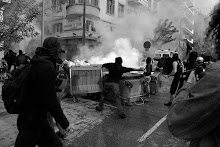
Police lack sense of humour
An anti-religion demonstration took place in the centre of Lecce [southern Italy] on April 30, 2010 with an exhibition, leaflets, megaphone and discussions on sexuality, abortion, personal freedoms, obscurantism. All these questions are obsessively brandished by the Church, as it tries to intrude its tentacles in the intimacy of everyone.
Nothing strange so far, except that the terrible demonstrators, just for fun, were offering desecrated wafers, wine of the Madonna and sweets of free love to passer-bys. Funny games were also being played to cheer the sunny afternoon of the very bigoted and bourgeois city of Lecce. But, as everybody knows, the pigs in uniform don’t like having fun except when they massacre those who end up in their barracks and police stations. So the pigs showed off their contempt: defamation, defamation, this is public defamation! First a few Digos officers tried to film passers-by and demonstrators intent at playing darts with a picture of Ratzinger [the current pope], but were soon driven away. Then they came back in greater number in anti-riot gear in order to seize the vituperated picture. Meantime dozens of people strolling in the piazza realized how the police, headed by chief Digos officer Raffaele Attanasi, were acting violently in their attempt to apply censorship. Not yet satisfied with creating such a chaos, Mr Attanasi threatened to kill an anarchist comrade if the latter dared touch him: ‘I’m going to chase you and kill you’, said the officer. Needless to say, the mess created by the police (but shouldn’t they guarantee public order?) attracted the attention of many passer-bys and onlookers, who stopped to watch the exhibition and to take leaflets. More police and carabinieri arriving on the spot were compelled to step back in front of the demonstrators denouncing them publicly through the megaphone.
Anarchists from Lecce
Text of the leaflet distributed during the initiative:
In a different way
To claim that violence and sexual abuse of minors are consequences of being homosexual [as an Italian high prelate recently did] is a proper terrorist act. It means to deny free sexual choice by considering it as a disease to be eradicated in order to avoid the most disgusting crimes that can be imagined. This is what high prelates of the Italian church felt obliged to say in the middle of so-called ‘paedophilia scandal’ that involves priests all over the world with the cover-up of the Vatican – including the pope. Besides suppressing all possibilities of auto-determination, this affirmation aims at banning the ‘diverse’ and legitimises, on a social and cultural level, the persecution against them. The more and more frequent aggressions against homosexuals are a clear example of this.
The stabbing of a homosexual is never mentioned whereas much is said against the abortion pill in the name of the defence of the ‘non-born’. Similarly, the murder of a pro-abortion doctor by a catholic fundamentalist is also silenced. Obviously not all lives are considered equal and worth being lived in the same way. After all, this reflects the entire history of discrimination characterising the catholic church and all the religions in the world.
If, on the one hand, the Vatican tries to divert the attention from the infamy committed by its representatives, on the other, relying on a particularly favourable socio-political climate, it tries to condition the life of everyone through practises of control on bodies and minds by pursuing its millennial aim: the submission and obedience of the masses through obscurantism.
Interfering with women's wombs and spying under people's sheets are practises aimed at social control: in this respect the Church and the State have always worked together in order to survive and reproduce themselves. Not by chance the campaign against the abortion pill can count on the support of the most conservative and reactionary politicians. This is an obvious example of the new form of collaboration between the State and the Church, which has seen the leaders of the Veneto and Piedmont regions backing the ban of the abortive pill in their local hospitals. Furthermore, when cardinal Bertone argued that it is homosexuality that leads to sexual violence on minors, there was total silence on the part of all [Italian] political representatives.
To talk about collaboration between the State and the Church might sound strange to some, but it is sufficient to look back in history to realize how the authority of these two institutions has always been the same.
Because of this collaboration, the revolutionaries shot priests and burnt churches during the Spanish civil war. If this had happened everywhere, maybe we wouldn’t be talking about all this now…
Friday, 7 May 2010

Oktoberfest
Oktoberfest
from “Insurrezione” October 1977
translated from 'Parafulmine e controfigure', ed. Anarchismo
1. The intolerable sensation that each one of us felt at the news of the killing of Baader, Ensslin and Raspe and the attempted elimination of Moeller, is the piercing stab in that part of us that recognises itself in these women and men, and recognises and admires in them individuals who, in the immediate, can no longer tolerate the present state of affairs. On the other hand, the claim of the Rote Armee Fraktion to educate the masses by example and organise their revolutonary struggle as a vanguard, has always rendered their perspective quite extraneous and absolutely opposed to ours.
2. The indignation that we shouted in the streets against the demented butchers that unleashed their fury on Gudrun, Jan Carl, Andreas and Irmgard is new fuel for the fires that are burning and will burn inside and around us. It means greater determination and energy in our struggle of all times against capital: the only specific help that we can give the German comrades, as to the South African or Ecuadorian, is that of struggling all the more resolutely against Italian capitalism and its specific democratic forms of power.
3. The killing of the members of the RAF in the prison of Stammheim tells us nothing that was not clear from the day that UIrike Meinhof was assassinated: the protest of intellectuals and democrats (among whom reactionaries such as Trombadori) simply reveal the bad faith of who, waving the scarecrows of Germany and Germanisation, want to cover up the shame of their own house. Without too much scandal, for a long time in Italy “terrorists” are finished off at their place of capture; the “State born from the resistence” thus avoids processual or custodial complications and mistakes such as that which saved the life of Irmgard Moeller.
But, Italian democracy is also in the vanguard in suicides: Pinelli flew down from the window of Milan police headquarters shouting “Anarchy is finished!” already eight years before left-handed Baader contrived his “left-handed shooting” against the German State, shooting himself with a shot in the nape of the neck with a pistol eighteen centimetres long held in his right hand.
4. The inextinguishable hatred that we swear against the State assassins and the even deeper, if possible, disgust that we feel for their democratic opposers, be they Italian or German, does not prevent us however from criticising and rejecting the perspectives and logic of the RAF and groups like it, because it is useless and extraneous to the revolutionary process in course. The RAF showed they believe in the spectacle of hierarchy when they kidnapped Schleyer, head of the German industrialists; they think they are striking the maximum holder of real power, and even believe the gross lie of democratic humanitarianism when they hijack a plane, as though a hundred or so human lives counted anything for the machine-capital and its servants. The Monster-automata of Marx is just as indifferent to the sort of its followers as it is to that of its enemies. Before the propagandistic tempest made possible by the long negotiations for the exchange of Schleyer with the RAF prisoners, the death of the hostages of Mogadiscio would have been a real tocsan for humanitarian German democracy. Reflexes of the image of revolution that capital itself projects, “revolutionary” terrorism stages a series of armed conflicts between human beings, individuals and organisations, reproducing, under the appearance of the class struggle, the permanent concorrential war between the fractions of capital.
This mystification reaches the point of realizing the smear that capital is opposing to the revolution when it depicts it as the war of small groups against the whole of civil and democratic society.
The real war, the real class struggle, remains elusive for the actors of the guerrilla war between terrorist groups and special forces. Clandestine to the spectacle, the communist proletariat combats, anonimously, the Monster-automa, impersonal and anonymous concretization of death that devours life to the point of destructively opposing itself to the human species as a whole.
5. In Italy clandestine organisations such as the Brigate Rosse are revealing their substantial estraneity to the class struggle in act, and their incomprehension of the real terms of the questions, also military, that the subversive movement must today pose itself, repeating, in a now demential way, the scene of the laming of the servants of capital (chosen from the ranks of the right hostile to the P.C.I. and often among those that occupy the lowest steps in the hierarchies of the spectacle) and criticise, as “adventurists” and “spontaneists”, the manifestations and organisational forms, still in embrion, of the nascent revolutionary movement. Considering more or less openly to have been the instigators, the clandestine groups do not recognise the most relevant characteristics of the subversive movement that exists today in Italy: its profound antireformist character and the mass dimension of its illegal and violent practices. In this way the armed organisations do not even grasp the terms of the strictly military questions that the revolutionary movement is posing itself today, organising its own forms of self-defence and attack on a territorial basis and on a mass scale. It is not a question of forming commandos capable of rivaling the secret services in efficiency or of kidnapping the president of the industrialists, but of contributing to acting in such a way that all those who are involved in the revolutionary process know how to express, as autonomous subjects, their own destructive power.
6. The massacre of the militants of the RAF also provoked the hypocritical protestations of reformist groups such as Lotta Continua, Democrazia Proletaria and Movimento Lavoratori per il Socialismo, long involved in repressive brutality and systematic snitching against revolutionaries and militants of clandestine or armed organisations. Suddenly ousted from their positions of power by the winds of February (apart from situations such as that of Milan where a group like Movimento Lavoratori per il Socialismo can still carry on with its odious aggressions undisturbed) these zombies have, like Democrazia Proletaria, either become clandestine to the situations of struggle, or, those with a better sense of timing, have “disbanded” into the so-called movement, like Lotta Continua. The only “political” argument that they have left against revolutionary insurgence is their personal fear of repression or the violence of the State apparatus (cfr.the attempt of Lotta Continua and Radio Città Futura to sabotage the Rome demonstration against the German embassy). In order to condemn revolutionary violence these wretches are trying today to appropriate the oddments of radical critique of armed struggle; ex-revolutionaries who, poisoned by their scepticism or cynism, are supplying consciously, i.e. in bad faith, arms to recuperate revolutionary theory, we know that with them we will be particularly severe. Just as reality in movement has been severe when it cancelled the mao-dadaista “creative autonomia” (A/traverso e derivati) when, at the Bologna meeting against repression, it was unable to conceal its complicity with Lotta Continua, to which the P.C.I. had, following open negotiations, entrusted the control of the city during the three days of the encounter. But the fear that the modernists and the re-established militants of Lotta Continua and Democrazia Proletaria are complaining about cheers us up. It is easy to recognise: it is the fear of revolutionary insurgency, the fear that gives the real approach of the revolution to those who believed they could continue indefinitely to trifle away their time with its image in the chaste and spotless manner of ideology.
from “Insurrezione” October 1977
translated from 'Parafulmine e controfigure', ed. Anarchismo
1. The intolerable sensation that each one of us felt at the news of the killing of Baader, Ensslin and Raspe and the attempted elimination of Moeller, is the piercing stab in that part of us that recognises itself in these women and men, and recognises and admires in them individuals who, in the immediate, can no longer tolerate the present state of affairs. On the other hand, the claim of the Rote Armee Fraktion to educate the masses by example and organise their revolutonary struggle as a vanguard, has always rendered their perspective quite extraneous and absolutely opposed to ours.
2. The indignation that we shouted in the streets against the demented butchers that unleashed their fury on Gudrun, Jan Carl, Andreas and Irmgard is new fuel for the fires that are burning and will burn inside and around us. It means greater determination and energy in our struggle of all times against capital: the only specific help that we can give the German comrades, as to the South African or Ecuadorian, is that of struggling all the more resolutely against Italian capitalism and its specific democratic forms of power.
3. The killing of the members of the RAF in the prison of Stammheim tells us nothing that was not clear from the day that UIrike Meinhof was assassinated: the protest of intellectuals and democrats (among whom reactionaries such as Trombadori) simply reveal the bad faith of who, waving the scarecrows of Germany and Germanisation, want to cover up the shame of their own house. Without too much scandal, for a long time in Italy “terrorists” are finished off at their place of capture; the “State born from the resistence” thus avoids processual or custodial complications and mistakes such as that which saved the life of Irmgard Moeller.
But, Italian democracy is also in the vanguard in suicides: Pinelli flew down from the window of Milan police headquarters shouting “Anarchy is finished!” already eight years before left-handed Baader contrived his “left-handed shooting” against the German State, shooting himself with a shot in the nape of the neck with a pistol eighteen centimetres long held in his right hand.
4. The inextinguishable hatred that we swear against the State assassins and the even deeper, if possible, disgust that we feel for their democratic opposers, be they Italian or German, does not prevent us however from criticising and rejecting the perspectives and logic of the RAF and groups like it, because it is useless and extraneous to the revolutionary process in course. The RAF showed they believe in the spectacle of hierarchy when they kidnapped Schleyer, head of the German industrialists; they think they are striking the maximum holder of real power, and even believe the gross lie of democratic humanitarianism when they hijack a plane, as though a hundred or so human lives counted anything for the machine-capital and its servants. The Monster-automata of Marx is just as indifferent to the sort of its followers as it is to that of its enemies. Before the propagandistic tempest made possible by the long negotiations for the exchange of Schleyer with the RAF prisoners, the death of the hostages of Mogadiscio would have been a real tocsan for humanitarian German democracy. Reflexes of the image of revolution that capital itself projects, “revolutionary” terrorism stages a series of armed conflicts between human beings, individuals and organisations, reproducing, under the appearance of the class struggle, the permanent concorrential war between the fractions of capital.
This mystification reaches the point of realizing the smear that capital is opposing to the revolution when it depicts it as the war of small groups against the whole of civil and democratic society.
The real war, the real class struggle, remains elusive for the actors of the guerrilla war between terrorist groups and special forces. Clandestine to the spectacle, the communist proletariat combats, anonimously, the Monster-automa, impersonal and anonymous concretization of death that devours life to the point of destructively opposing itself to the human species as a whole.
5. In Italy clandestine organisations such as the Brigate Rosse are revealing their substantial estraneity to the class struggle in act, and their incomprehension of the real terms of the questions, also military, that the subversive movement must today pose itself, repeating, in a now demential way, the scene of the laming of the servants of capital (chosen from the ranks of the right hostile to the P.C.I. and often among those that occupy the lowest steps in the hierarchies of the spectacle) and criticise, as “adventurists” and “spontaneists”, the manifestations and organisational forms, still in embrion, of the nascent revolutionary movement. Considering more or less openly to have been the instigators, the clandestine groups do not recognise the most relevant characteristics of the subversive movement that exists today in Italy: its profound antireformist character and the mass dimension of its illegal and violent practices. In this way the armed organisations do not even grasp the terms of the strictly military questions that the revolutionary movement is posing itself today, organising its own forms of self-defence and attack on a territorial basis and on a mass scale. It is not a question of forming commandos capable of rivaling the secret services in efficiency or of kidnapping the president of the industrialists, but of contributing to acting in such a way that all those who are involved in the revolutionary process know how to express, as autonomous subjects, their own destructive power.
6. The massacre of the militants of the RAF also provoked the hypocritical protestations of reformist groups such as Lotta Continua, Democrazia Proletaria and Movimento Lavoratori per il Socialismo, long involved in repressive brutality and systematic snitching against revolutionaries and militants of clandestine or armed organisations. Suddenly ousted from their positions of power by the winds of February (apart from situations such as that of Milan where a group like Movimento Lavoratori per il Socialismo can still carry on with its odious aggressions undisturbed) these zombies have, like Democrazia Proletaria, either become clandestine to the situations of struggle, or, those with a better sense of timing, have “disbanded” into the so-called movement, like Lotta Continua. The only “political” argument that they have left against revolutionary insurgence is their personal fear of repression or the violence of the State apparatus (cfr.the attempt of Lotta Continua and Radio Città Futura to sabotage the Rome demonstration against the German embassy). In order to condemn revolutionary violence these wretches are trying today to appropriate the oddments of radical critique of armed struggle; ex-revolutionaries who, poisoned by their scepticism or cynism, are supplying consciously, i.e. in bad faith, arms to recuperate revolutionary theory, we know that with them we will be particularly severe. Just as reality in movement has been severe when it cancelled the mao-dadaista “creative autonomia” (A/traverso e derivati) when, at the Bologna meeting against repression, it was unable to conceal its complicity with Lotta Continua, to which the P.C.I. had, following open negotiations, entrusted the control of the city during the three days of the encounter. But the fear that the modernists and the re-established militants of Lotta Continua and Democrazia Proletaria are complaining about cheers us up. It is easy to recognise: it is the fear of revolutionary insurgency, the fear that gives the real approach of the revolution to those who believed they could continue indefinitely to trifle away their time with its image in the chaste and spotless manner of ideology.
Italy 1977: an assault on the heavens
from Italian review “Insurrezione” – novembre 1977,
translated from 'Parafulmine e controfigure', ed. Anarchismo
If we undoubtedly claim the wealth of violent and armed expressions of the movement (generalised theft and expropriation as critique of waged work, radicalisation of clashes in the streets, sabotage, etc.), we are convinced, on the other hand, that the field of violence cannot in itself constitute a qualifying moment, a moment, in other words, that characterises the new revolutionaries as such. «The impatience to use weapons at all costs today in reality is delaying the moment in which the proletariat as a whole will have recourse to arms, because it anticipates repression. Those who congratulate themselves in the stupid use of arms are not the revolutionary movement, but the rearguard of its theoretical and strategic conscience». (Manifesto handed out in Bologna 23 settembre 1977, signed: Ass. For the Epidemic of Contagious Rage).
In our opinion, it is precisely social decomposition to push towards totalizing choices – armed struggle as a specialistic and separate dimension – which, by reducing the complexity of the clash to a feud between gangs, remains in a field that capital can always manage for its own benefit. If, concerning the BR [Brigate Rossi] for example, we cannot prevent ourselves from feeling a feeling of sympathy for the measure in which they sometimes manage to ridiculise and beat the State in its own field, we don’t forget that their neostalinist program is full of militaristic ideology and has nothing to do with the project of the proletarian revolution.
And on the basis of the failure of the movement of ‘68 it is possible to understand the present wave of terrorism. When, at the beginning of the 70s, the perspective of a total revolution seemed to be moving away, a few groups considered it possible to destroy the State in a military clash. The incapacity to understand how no armed volontarism or other can take the place of the pace of the real movement, led to to a curious ideology that puts together elements of a naive rebellious tendency and ultrabolshevist traits, in a horrible pot-pourri. In the beginning, the armed groups at least obtained the aim of showing up the vulnerability of the State, all the same the rapid rationalisation of the police apparatus immediately rendered the repression more effective and, soon, their practice trasformed itself into a personal war, autonomised by a real struggle. Moreover, the typical slogan “strike the heart of the State”, hides the real objective, capital, which the State is only the phenominal manifestation of. Actually, the armed groups have become an obstacle to the development of the movement that they (BR) criticise as spontaneist and adventurist (!). These criticisms recall the lamentations of the official left, which these people only constitute the radical wing of. Independently of intentions and the revolutionary ardour of single individuals, we grasp in this kind of armed struggle the seeds of recuperation. Not only and not so much in the sense of the police-like cannibalisation, but in the reduction, the repetition, absolutely functional to power, of the revolution to a simple military question. To that we are opposing real war, war that crosses the whole social totality and does not let itself simply be reduced to the armed clash. It is true that the groups of the autonomia do not identify with the BR, but it is just as true that their acritical pushing towards the militarisation of the movement presents the same problems.
The State is clearly trying to push a large number of people into clandestinity.That reaches the objective of reducing the movement to its military dimensions, where power can still win, at least in this phase. Groups such as the Brigate Rosse believe they have found confirmation of their strategy. And it is significant that the recent period characterised by growing confusion and a kind of return to traditional militarism has been marked by the most stupid terrorism (Casalegno and Acca Laurentia).
It is obvious that the clandestine groups are now playing on the ambiguity between crises and revolution; between neostalinist management and radical transformation in the communist.
translated from 'Parafulmine e controfigure', ed. Anarchismo
If we undoubtedly claim the wealth of violent and armed expressions of the movement (generalised theft and expropriation as critique of waged work, radicalisation of clashes in the streets, sabotage, etc.), we are convinced, on the other hand, that the field of violence cannot in itself constitute a qualifying moment, a moment, in other words, that characterises the new revolutionaries as such. «The impatience to use weapons at all costs today in reality is delaying the moment in which the proletariat as a whole will have recourse to arms, because it anticipates repression. Those who congratulate themselves in the stupid use of arms are not the revolutionary movement, but the rearguard of its theoretical and strategic conscience». (Manifesto handed out in Bologna 23 settembre 1977, signed: Ass. For the Epidemic of Contagious Rage).
In our opinion, it is precisely social decomposition to push towards totalizing choices – armed struggle as a specialistic and separate dimension – which, by reducing the complexity of the clash to a feud between gangs, remains in a field that capital can always manage for its own benefit. If, concerning the BR [Brigate Rossi] for example, we cannot prevent ourselves from feeling a feeling of sympathy for the measure in which they sometimes manage to ridiculise and beat the State in its own field, we don’t forget that their neostalinist program is full of militaristic ideology and has nothing to do with the project of the proletarian revolution.
And on the basis of the failure of the movement of ‘68 it is possible to understand the present wave of terrorism. When, at the beginning of the 70s, the perspective of a total revolution seemed to be moving away, a few groups considered it possible to destroy the State in a military clash. The incapacity to understand how no armed volontarism or other can take the place of the pace of the real movement, led to to a curious ideology that puts together elements of a naive rebellious tendency and ultrabolshevist traits, in a horrible pot-pourri. In the beginning, the armed groups at least obtained the aim of showing up the vulnerability of the State, all the same the rapid rationalisation of the police apparatus immediately rendered the repression more effective and, soon, their practice trasformed itself into a personal war, autonomised by a real struggle. Moreover, the typical slogan “strike the heart of the State”, hides the real objective, capital, which the State is only the phenominal manifestation of. Actually, the armed groups have become an obstacle to the development of the movement that they (BR) criticise as spontaneist and adventurist (!). These criticisms recall the lamentations of the official left, which these people only constitute the radical wing of. Independently of intentions and the revolutionary ardour of single individuals, we grasp in this kind of armed struggle the seeds of recuperation. Not only and not so much in the sense of the police-like cannibalisation, but in the reduction, the repetition, absolutely functional to power, of the revolution to a simple military question. To that we are opposing real war, war that crosses the whole social totality and does not let itself simply be reduced to the armed clash. It is true that the groups of the autonomia do not identify with the BR, but it is just as true that their acritical pushing towards the militarisation of the movement presents the same problems.
The State is clearly trying to push a large number of people into clandestinity.That reaches the objective of reducing the movement to its military dimensions, where power can still win, at least in this phase. Groups such as the Brigate Rosse believe they have found confirmation of their strategy. And it is significant that the recent period characterised by growing confusion and a kind of return to traditional militarism has been marked by the most stupid terrorism (Casalegno and Acca Laurentia).
It is obvious that the clandestine groups are now playing on the ambiguity between crises and revolution; between neostalinist management and radical transformation in the communist.
To the immigrants
translated from guerra sociale
We asked for labour power, men came.
Max Frisch
No one emigrates from their country for pleasure – this is a simple truth that many want to hide. If someone leaves their land and loved ones peacefully, we don’t define them as migrants, but simply as travellers or tourists. Migration is a coercive form of moving, a roaming in search of better living conditions.
At the moment there are 150 million ‘foreigners’ around the world due to wars, ecological disasters, famine, or simply the management of industrial production (the destruction of countryside and forests, mass lay-offs, and so on). All these aspects form a mosaic of oppression and misery in which the effects of exploitation become more or less direct causes of suffering and uprooting in a never ending spiral that makes any distinction between “displaced”, “migrants”, asylum seekers, refugees, survivors, hypocritical. Just think how social so called ecological emergencies (lack of water, growing desertification, field sterility) are: the explosion of an oil refinery, together with the destruction of every local autonomy on which it rested, can sometimes change the fate of an entire population.
Contrary to what racist propaganda would have us believe, only 17% of immigration concerns the rich North, it involves all continents (the African and Asian ones in particular); that means that for every poor country there is an even poorer one which immigrants are running away from. The total mobilization imposed by economy and States is a planetary symptom, an undeclared civil war that crosses every national border: millions of exploited people roam through the hell of the commercial heaven, jolted from border to border, forced into refugee camps, surrounded by police and army, handled by so-called charity organisations – partners in tragedies whose causes they don’t denounce for the mere purpose of exploiting the consequences – piled up in “waiting zones” in airports or stadiums (macabre circenses for those who don’t even have bread), locked up in Lagers called “detention centres” and, finally, packaged and expelled in the most total indifference. For many reasons we could say that the face of these unwelcome people is the face of our time – and that’s also why we’re so afraid of them. Immigrants scare us because in their misery we can see the reflection of our own, because in their wanderings we recognise our daily condition: the condition of persons who feel more and more like strangers both to this world and to themselves.
Uprooting is the most widespread condition in our present society – we might call it its centre – not a threat coming from a terrifying and mysterious elsewhere. Only by directing our gaze at our daily lives can we understand what gets all of us into the condition of immigrants. First though we must define a fundamental concept: that of clandestinity.
The creation of the clandestine, the creation of the enemy
[…] what are you? […]
You are not of this castle, you are not of this village, you are nothing.
But you are something too, unfortunately, you are a foreigner, someone that is always
inopportune and in the way, one that brings a lot of troubles, […]
whose intentions no one knows.
F. Kafka
An alien is simply someone who doesn’t have regular papers. And this is certainly not due to the pure pleasure of risk or illegality, but rather because in the majority of cases, in order to own such papers he or she would have to give certain guarantees the possession of which wouldn’t have made them aliens in the first place, but simply tourists or foreign students. If the same standards were forced on everybody, millions would have been thrown overboard. Which unemploy-ed Italian, for instance, could give the guarantee of a legal wage? What about all the precarious people here who work for temporary job agencies, whose contracts are not even worth a visa for immigrants? And by the way, are there as many Italians living in a 60 squares metres flat with no more than two other people? If we read all these decrees (from both the left and the right wing) about immigration, it will be clear that clandestinization is a precise project of States. Why?
An illegal immigrant is easier to blackmail, to make accept, under the threat of expulsion, even more hateful conditions of work and existence (precariousness, endless wandering, makeshift accommo-dation, and so on). With the threat of the police, bosses obtain tame wage slaves, or rather real forced labour workers. Even the most reactionary and xenophobic right wing parties are perfectly aware that hermetically closed borders are not only technically impossible, but are not even profitable. According to the United Nations, in order to keep the present “balance between active and inactive population”, from here to 2025, Italy should “take” inside its borders a quantity of immigrants five times the present yearly fixed amount. Confindustria, in fact, continuously suggest doubling the quantity fixed so far.
The granting or rejection of year-long or season-long permits contributes to creating a specific social hierarchy among the poor. The same distinction between immediate forced repatriation and expulsion (or the obligation, for an irregular immigrant, who shows up at the borders to be sent back home) allows them to choose who to make clandestine or to expel right away – a choice based on ethnic principles, economical-political agreement with the governments of the countries the immigrant comes from and the needs of the labour market. In fact, the authorities are perfectly aware that no one will ever spontaneously show up at the border to be expelled; surely not people who have spent all that they owned – sometimes even more – to pay for their trip here. Businessmen define the features of the goods they buy (immigrants are goods, like everything else after all), the State records data, police carry out orders.
The warnings of politicians and mass media, anti-immigration claims build up imaginary enemies to drive the exploited from here to lay on an easy scapegoat the growing social tension and reassure them, letting them admire the show of poor and even more precarious and blackmailed people than themselves, and let them feel part of a ghost called Nation. Making of “irregularity” – that same irregularity that they create – synonymous with crime and danger, States justify police control and the criminalisation of class conflict that is getting more and more seditious. In this context, for instance, should be seen the manipulation of consensus after September 11, summed up in the despicable slogan “clandestine=terrorist” which combines, if read in both senses, racist paranoia with the demand for repression against the enemy within (rebels, subversives).
They shout out, from the right as well as the left, against the Mafia that organises the journeys for clandestine people (described by the media as an invasion, a scourge, the advance of an army), when it’s by their very laws that they are promoted. They shout out against “organised crime” exploiting so many immigrants (which is true but only partially), when it’s they who supply it with desperate and ready-for-everything resources. In their historical symbiosis, State and Mafia stand united by the same liberal principle: business is business.
Racism, a means for economic and political necessity, finds room to spread in a context of generalised standardisation and isolation, when insecurity creates fears that can be opportunely manipulated. A moral or cultural condemnation of racism is of little use, since it is not an opinion or an argument, but psychological misery, an “emotional plague”. It’s in the present social conditions that the reason of its spreading ought to be sought and also, at the same time, the power to fight it.
The welcome of a lager
To call the detention camps for immigrants waiting for expulsion Lagers– centres introduced in Italy in 1998 by the left wing government by mean of the Turco-Napolitano law – is not rhetorical emphasis, as most of those who use this formula think. It is a strict definition. Nazi Lagers were concentration camps where people thought by the police to be dangerous for State security were locked up, even in the absence of criminally indictable behaviour. This precautionary measure – defined as “protective detention” – consisted in taking all civil and political rights away from certain citizens. Whether they were refugees, Jewish, gypsy, homosexuals or subversives, it was up to the police, after months or years, to decide what to do about them. So Lagers were not jails in which to expiate some crime, nor an extension of criminal law. They were camps where the Rule set its exception; in short terms, a legal suspension of legality. Therefore a Lager is not a consequence of the number of internees or of the number of murders (between 1935 and 1937, before the start of Jewish deportations, in Germany internees numbered 7500), but rather of its political and juridical nature.
Immigrants nowadays end up in the Centres regardless of possible crimes, without any criminal trial whatsoever: their internment, ordered by the police superintendents, are a simple police measure. Just as happened in 1940 under the Vichy government, when prefects could lock up all the individuals considered a “danger for national defence and public security” or (mind this) “foreigners in respect to the national economy”. We can refer to administrative detention in French Algeria, to the South Africa of apartheid or to the present ghettos for Palestinians created by the State of Israel.
It is not a coincidence if, with regard to the infamous conditions of the detention centres, the good democrats don’t appeal to the respect of any law at all, but to the respect of human rights – the last mask in front of women and men to whom nothing remains but belonging to the human species. It’s not possible to integrate them as citizens, so they are falsely integrated as Human Beings. The abstract equality of principles hides real inequalities everywhere.
A new eradication
Immigrants that for the
first time landed on Battery Park soon
realized that what they had been
told about the marvelous America
wasn’t true at all:
maybe land belonged to everybody,
but the first come
had largely served themselves already,
and to them there was nothing left
than to crowd together in tens in windowless
hovels
of the Lower East Side and work fifteen hours
a day. Turkeys didn’t fall roasted
straight in the dishes and the streets of New York
weren’t paved in gold.
Yet, most of the times, they weren’t
paved at all. And then they realised that
it was just to get them to pave these streets that they
were allowed to come. And to dig tunnels
and canals, to build up streets, bridges, big
embankments, railroads, to clear forests, to exploit
mines and caves, to make cars and cigars,/
carabines and clothes, shoes, chewing gum,
corned-beef and soap, and to build
skyscrapers higher
than the ones that they discovered when they first arrived.
Georges Perec
If we go a few steps back, it will become clear that eradication is a crucial moment in the expansion of the State and capitalistic domination. At its dawn, industrial production drew the exploited away from country and villages to gather them into the city. The ancient skills of farm workers and artisans were thereby substituted with the forced and repetitive activity of the factory – an activity impossible to control, in its means and its finalities, by the new proletarians. So the first children of industrialization lost both their ancient spaces of life and their ancient knowledge, that which had allowed them to autonomously provide for the most part of their means of subsistence. On the other hand, forcing millions of men and women to similar living conditions (same places, same problems, same knowledge), capitalism unified their struggles, got them to find new brothers and sisters to fight against that same unbearable life. The 20th century marked the apex of this productive and State gathering, whose symbols had been the factory-neighbourhood and the Lager, and at the same time the apex of the more radical social struggles for its destruction. In the last twenty years, due to technological innovation, capital has substituted the old factory with new productive cores ever smaller and more widely distributed throughout the territory, also breaking up the fabric of the society within which those fights had grown, thereby creating a new eradication.
There’s more. Technological reorganisation has made trade faster and easier, opening the whole world to the most ferocious competition, overthrowing the economies and the ways of life of entire Countries. So there is, in Africa, in Asia, in South America, the closure of many factories, mass lay offs. All this, within a social context that has been destroyed by colonisation from the deportation of inhabitants from their villages to the shantytowns, from their fields to the assembly lines, produced a crowd of poor people who became useless to their masters, of unwanted children of capitalism. Add to this the fall of self-styled communist Countries and the debt racket initiated by the International Monetary Fund and the World Bank and we will get quite a faithful cartography of migration, of ethnical and religious wars.
What we now call “flexibility” and “precariousness” is the consequence of all this: a further progress in the submission to the machines, fiercer competition, a worsening of material conditions (deals, health, etcetera). We’ve seen the reason why: capitalism has dismantled the community that it created. Anyway it would be partial to see precariousness in an economic sense alone, as the lack of a steady work place and the old pride for professionalism. It is isolation inside standardisation, or a fanatical conformity with lack of common spaces. In the distressing void of meaning and perspectives, mystified, the unfulfilled need of community returns, giving birth to new nationalistic, ethnical or religious counterpositions, a tragic re-proposition of collective identities just where any real communality among individuals has diminished. And it’s exactly within this void that the fundamentalist argument finds its place, false promise of a redeemed community.
Civil war
All this leads to a scenario that is more and more that of an ongoing civil war, with no distinction between “time of peace” and “time of war”. Conflicts are no longer declared – as the military intervention in the Balkans has shown –, but simply administrated to grant the establishment of the World Order. This endless fight goes through the entire society and the very individuals. Common spaces for dialogue and struggles are substituted by adherence to similar commercial models. The poor go to war against each other for a fashionable sweater or a hat, since the possession or not of particular goods creates the illusion of a social or clan-like hierarchy. Individuals feel more and more irrelevant, so ready to sacrifice themselves to the first nationalist blunderbuss or for whatever flag. Abused daily by the State, here they come defending zealously any Padania (desolated and polluted, with factories and mall everywhere – is this the “land of the forefathers”?). Tied to that mirage of property that is left to them, they are scared to face themselves for what they really are: interchangeable gears of the Megamachine, in need of psychotropic drugs to get to the end of the day, always more envious towards everyone who looks even just happier than themselves. To an always colder, more abstract and more calculating rationality, correspond increasingly brutal and untold drives. So, what better than someone different by colour of the skin or religion to throw their grudge upon? As a man from Mozambique said, “people have taken war inside them”. A few external conditions can be enough for all this to explode, just like in Bosnia. And these conditions are being carefully prepared. To capitalist Universalism is opposed, in a tragic game of mirrors, ethnic particularism. Under institutional order, with increasingly anonymous and controlled places, lies concealed the implosion of human relationships. It all looks like the same quicksand from whence in the 30’s totalitarian man arose.
Two possible ways out
Why have we talked so much about immigration and racism, as we are not directly touched by problems of wandering and expulsion? Dictated by some of its peculiarities such as precariousness and the impossibility to decide for our present, this same capitalism is joining our lives more and more: that’s why we feel like brothers, in deed, with the all the exploited who land on the shores of this Country.
In the face of the despoliation of millions of individuals towards a commercial imperialism that is forcing everybody to dream the same lifeless dream, there can be no appeal to dialogue or to democratic integration. Whatever the legalistic anti-racists might say, it’s too late for hypocritical civic education classes. When the fields in which misery is confined – from the shantytowns of Caracas to the suburbs of Paris, from the Palestinian territories to centres and stadia where aliens are locked up–are growing everywhere; when the state of exception – or the juridical suspension of every right – becomes the rule; when millions of human beings are literally left rotting into the reserves of the capitalist heaven; when entire neighbourhoods are getting militarised and armed (Genova doesn’t tell you anything?), to talk of immigration becomes a despicable joke. There are only two ways out from these conditions of desperation and fear, from this planetary civil war: the fraticidal clash (religious and clannish in all its manifestations), or the social tempest of class war.
Racism is the grave of every exploited individual’s fight against the exploiters, it’s the last trick – the dirtiest – played by those who would like to see ourselves killing one another. It can only evaporate in moments of common revolt, when we recognise our real enemies – the exploiters and their servants – and we recognise ourselves as exploited individuals that no longer want to be like that. The social fight that took place in Italy during the 60’s and 70’s – when the young workers immigrated from the South met those from the North in the field of sabotage, wild strikes and absolute disloyalty to the firm – has shown. The disappearance of the revolutionary struggles after the 70’s (from Nicaragua to Italy, from Portugal to Germany, from Poland to Iran) has crumbled the foundation of concrete solidarity among the dispossessed of the World. This solidarity will only be conquered again in the revolt, and not in the powerless words of the new Thirdworlders or the democratic anti-racists.
So, or religious and clannish massacre, or class war. And at the end of this we can only catch a glimpse of a world free from State and money in which there’ll be no need for money to live and no visa required to travel.
A machine that can be broken
A slogan in the 80’s said: “It’s not the noise of boot that should scared us today, but the silence of the slipper”. Now they’re both coming back. With a holy war speech (the police as “army of good” protecting citizens from the “army of evil”, as the Prime Minister said recently), day after day the State has put up curtains at the expense of immigrants. Their homes are devastated, aliens are rounded up in the streets, locked up in Lagers and expelled in total indifference. New detention camps are already under construction in many cities. The State, wants to limit the number of visas according to the exact length of the work contract, blacklist all immigrants, make being clandestine a crime and strengthen expulsion. The democratic mechanism of rights and citizenship, wide as that might be, will always presuppose the existence of excluded people. To criticise and try to prevent expulsions signifies realising a critique of racism and nationalism in act; it means creating a common space for revolt against the capitalist uprooting that affects us all; it means obstructing a hateful as it is important repressive mechanism; it means breaking the silence and indifference of the civilized ones who stand looking on; lastly, it means confronting the very concept of law dictated by the principle “we are all aliens”. Finally, it signifies an attack on one of the pillars of the State and class society: competition between the poor, the increasingly seditious substitution of social war with ethnic or religious wars.
In order to function the expulsion framework requires the collaboration of many public and private structures (from the Red Cross which cooperates in the management of Lagers, to companies which supply services, to airline companies which deport aliens, to the airports that put up waiting zones, to self-styled charity associations which operate in collaboration with the police). All those responsible can easily be seen and attacked. From actions against detention camps (as happened a couple of years ago in Belgium and a few months ago in Australia, when demonstrations ended up with the liberation of some clandestine immigrants) to those against “waiting zones” (as in France, against the Ibis hotels chain that supplies the police with rooms) or obstructing the flights of infamy (in Frankfurt, the sabotage of optic fibre cables some years ago put all the computers of an airport out of order for a couple of days) there are thousands of activities that a movement against expulsion can carry out.
Today like never before it’s in the street that it’s possible to rebuild class solidarity. In the complicity against police raids; in the struggle against military occupation of neighbourhoods; in the restless rejection of every division that the masters of society want to impose on us (nationals and foreigners, legal immigrants and aliens); aware that every outrage suffered by any dispossessed on Earth is an outrage to everyone – only in this way will the exploited people from a thousand countries recognise themselves.
We asked for labour power, men came.
Max Frisch
No one emigrates from their country for pleasure – this is a simple truth that many want to hide. If someone leaves their land and loved ones peacefully, we don’t define them as migrants, but simply as travellers or tourists. Migration is a coercive form of moving, a roaming in search of better living conditions.
At the moment there are 150 million ‘foreigners’ around the world due to wars, ecological disasters, famine, or simply the management of industrial production (the destruction of countryside and forests, mass lay-offs, and so on). All these aspects form a mosaic of oppression and misery in which the effects of exploitation become more or less direct causes of suffering and uprooting in a never ending spiral that makes any distinction between “displaced”, “migrants”, asylum seekers, refugees, survivors, hypocritical. Just think how social so called ecological emergencies (lack of water, growing desertification, field sterility) are: the explosion of an oil refinery, together with the destruction of every local autonomy on which it rested, can sometimes change the fate of an entire population.
Contrary to what racist propaganda would have us believe, only 17% of immigration concerns the rich North, it involves all continents (the African and Asian ones in particular); that means that for every poor country there is an even poorer one which immigrants are running away from. The total mobilization imposed by economy and States is a planetary symptom, an undeclared civil war that crosses every national border: millions of exploited people roam through the hell of the commercial heaven, jolted from border to border, forced into refugee camps, surrounded by police and army, handled by so-called charity organisations – partners in tragedies whose causes they don’t denounce for the mere purpose of exploiting the consequences – piled up in “waiting zones” in airports or stadiums (macabre circenses for those who don’t even have bread), locked up in Lagers called “detention centres” and, finally, packaged and expelled in the most total indifference. For many reasons we could say that the face of these unwelcome people is the face of our time – and that’s also why we’re so afraid of them. Immigrants scare us because in their misery we can see the reflection of our own, because in their wanderings we recognise our daily condition: the condition of persons who feel more and more like strangers both to this world and to themselves.
Uprooting is the most widespread condition in our present society – we might call it its centre – not a threat coming from a terrifying and mysterious elsewhere. Only by directing our gaze at our daily lives can we understand what gets all of us into the condition of immigrants. First though we must define a fundamental concept: that of clandestinity.
The creation of the clandestine, the creation of the enemy
[…] what are you? […]
You are not of this castle, you are not of this village, you are nothing.
But you are something too, unfortunately, you are a foreigner, someone that is always
inopportune and in the way, one that brings a lot of troubles, […]
whose intentions no one knows.
F. Kafka
An alien is simply someone who doesn’t have regular papers. And this is certainly not due to the pure pleasure of risk or illegality, but rather because in the majority of cases, in order to own such papers he or she would have to give certain guarantees the possession of which wouldn’t have made them aliens in the first place, but simply tourists or foreign students. If the same standards were forced on everybody, millions would have been thrown overboard. Which unemploy-ed Italian, for instance, could give the guarantee of a legal wage? What about all the precarious people here who work for temporary job agencies, whose contracts are not even worth a visa for immigrants? And by the way, are there as many Italians living in a 60 squares metres flat with no more than two other people? If we read all these decrees (from both the left and the right wing) about immigration, it will be clear that clandestinization is a precise project of States. Why?
An illegal immigrant is easier to blackmail, to make accept, under the threat of expulsion, even more hateful conditions of work and existence (precariousness, endless wandering, makeshift accommo-dation, and so on). With the threat of the police, bosses obtain tame wage slaves, or rather real forced labour workers. Even the most reactionary and xenophobic right wing parties are perfectly aware that hermetically closed borders are not only technically impossible, but are not even profitable. According to the United Nations, in order to keep the present “balance between active and inactive population”, from here to 2025, Italy should “take” inside its borders a quantity of immigrants five times the present yearly fixed amount. Confindustria, in fact, continuously suggest doubling the quantity fixed so far.
The granting or rejection of year-long or season-long permits contributes to creating a specific social hierarchy among the poor. The same distinction between immediate forced repatriation and expulsion (or the obligation, for an irregular immigrant, who shows up at the borders to be sent back home) allows them to choose who to make clandestine or to expel right away – a choice based on ethnic principles, economical-political agreement with the governments of the countries the immigrant comes from and the needs of the labour market. In fact, the authorities are perfectly aware that no one will ever spontaneously show up at the border to be expelled; surely not people who have spent all that they owned – sometimes even more – to pay for their trip here. Businessmen define the features of the goods they buy (immigrants are goods, like everything else after all), the State records data, police carry out orders.
The warnings of politicians and mass media, anti-immigration claims build up imaginary enemies to drive the exploited from here to lay on an easy scapegoat the growing social tension and reassure them, letting them admire the show of poor and even more precarious and blackmailed people than themselves, and let them feel part of a ghost called Nation. Making of “irregularity” – that same irregularity that they create – synonymous with crime and danger, States justify police control and the criminalisation of class conflict that is getting more and more seditious. In this context, for instance, should be seen the manipulation of consensus after September 11, summed up in the despicable slogan “clandestine=terrorist” which combines, if read in both senses, racist paranoia with the demand for repression against the enemy within (rebels, subversives).
They shout out, from the right as well as the left, against the Mafia that organises the journeys for clandestine people (described by the media as an invasion, a scourge, the advance of an army), when it’s by their very laws that they are promoted. They shout out against “organised crime” exploiting so many immigrants (which is true but only partially), when it’s they who supply it with desperate and ready-for-everything resources. In their historical symbiosis, State and Mafia stand united by the same liberal principle: business is business.
Racism, a means for economic and political necessity, finds room to spread in a context of generalised standardisation and isolation, when insecurity creates fears that can be opportunely manipulated. A moral or cultural condemnation of racism is of little use, since it is not an opinion or an argument, but psychological misery, an “emotional plague”. It’s in the present social conditions that the reason of its spreading ought to be sought and also, at the same time, the power to fight it.
The welcome of a lager
To call the detention camps for immigrants waiting for expulsion Lagers– centres introduced in Italy in 1998 by the left wing government by mean of the Turco-Napolitano law – is not rhetorical emphasis, as most of those who use this formula think. It is a strict definition. Nazi Lagers were concentration camps where people thought by the police to be dangerous for State security were locked up, even in the absence of criminally indictable behaviour. This precautionary measure – defined as “protective detention” – consisted in taking all civil and political rights away from certain citizens. Whether they were refugees, Jewish, gypsy, homosexuals or subversives, it was up to the police, after months or years, to decide what to do about them. So Lagers were not jails in which to expiate some crime, nor an extension of criminal law. They were camps where the Rule set its exception; in short terms, a legal suspension of legality. Therefore a Lager is not a consequence of the number of internees or of the number of murders (between 1935 and 1937, before the start of Jewish deportations, in Germany internees numbered 7500), but rather of its political and juridical nature.
Immigrants nowadays end up in the Centres regardless of possible crimes, without any criminal trial whatsoever: their internment, ordered by the police superintendents, are a simple police measure. Just as happened in 1940 under the Vichy government, when prefects could lock up all the individuals considered a “danger for national defence and public security” or (mind this) “foreigners in respect to the national economy”. We can refer to administrative detention in French Algeria, to the South Africa of apartheid or to the present ghettos for Palestinians created by the State of Israel.
It is not a coincidence if, with regard to the infamous conditions of the detention centres, the good democrats don’t appeal to the respect of any law at all, but to the respect of human rights – the last mask in front of women and men to whom nothing remains but belonging to the human species. It’s not possible to integrate them as citizens, so they are falsely integrated as Human Beings. The abstract equality of principles hides real inequalities everywhere.
A new eradication
Immigrants that for the
first time landed on Battery Park soon
realized that what they had been
told about the marvelous America
wasn’t true at all:
maybe land belonged to everybody,
but the first come
had largely served themselves already,
and to them there was nothing left
than to crowd together in tens in windowless
hovels
of the Lower East Side and work fifteen hours
a day. Turkeys didn’t fall roasted
straight in the dishes and the streets of New York
weren’t paved in gold.
Yet, most of the times, they weren’t
paved at all. And then they realised that
it was just to get them to pave these streets that they
were allowed to come. And to dig tunnels
and canals, to build up streets, bridges, big
embankments, railroads, to clear forests, to exploit
mines and caves, to make cars and cigars,/
carabines and clothes, shoes, chewing gum,
corned-beef and soap, and to build
skyscrapers higher
than the ones that they discovered when they first arrived.
Georges Perec
If we go a few steps back, it will become clear that eradication is a crucial moment in the expansion of the State and capitalistic domination. At its dawn, industrial production drew the exploited away from country and villages to gather them into the city. The ancient skills of farm workers and artisans were thereby substituted with the forced and repetitive activity of the factory – an activity impossible to control, in its means and its finalities, by the new proletarians. So the first children of industrialization lost both their ancient spaces of life and their ancient knowledge, that which had allowed them to autonomously provide for the most part of their means of subsistence. On the other hand, forcing millions of men and women to similar living conditions (same places, same problems, same knowledge), capitalism unified their struggles, got them to find new brothers and sisters to fight against that same unbearable life. The 20th century marked the apex of this productive and State gathering, whose symbols had been the factory-neighbourhood and the Lager, and at the same time the apex of the more radical social struggles for its destruction. In the last twenty years, due to technological innovation, capital has substituted the old factory with new productive cores ever smaller and more widely distributed throughout the territory, also breaking up the fabric of the society within which those fights had grown, thereby creating a new eradication.
There’s more. Technological reorganisation has made trade faster and easier, opening the whole world to the most ferocious competition, overthrowing the economies and the ways of life of entire Countries. So there is, in Africa, in Asia, in South America, the closure of many factories, mass lay offs. All this, within a social context that has been destroyed by colonisation from the deportation of inhabitants from their villages to the shantytowns, from their fields to the assembly lines, produced a crowd of poor people who became useless to their masters, of unwanted children of capitalism. Add to this the fall of self-styled communist Countries and the debt racket initiated by the International Monetary Fund and the World Bank and we will get quite a faithful cartography of migration, of ethnical and religious wars.
What we now call “flexibility” and “precariousness” is the consequence of all this: a further progress in the submission to the machines, fiercer competition, a worsening of material conditions (deals, health, etcetera). We’ve seen the reason why: capitalism has dismantled the community that it created. Anyway it would be partial to see precariousness in an economic sense alone, as the lack of a steady work place and the old pride for professionalism. It is isolation inside standardisation, or a fanatical conformity with lack of common spaces. In the distressing void of meaning and perspectives, mystified, the unfulfilled need of community returns, giving birth to new nationalistic, ethnical or religious counterpositions, a tragic re-proposition of collective identities just where any real communality among individuals has diminished. And it’s exactly within this void that the fundamentalist argument finds its place, false promise of a redeemed community.
Civil war
All this leads to a scenario that is more and more that of an ongoing civil war, with no distinction between “time of peace” and “time of war”. Conflicts are no longer declared – as the military intervention in the Balkans has shown –, but simply administrated to grant the establishment of the World Order. This endless fight goes through the entire society and the very individuals. Common spaces for dialogue and struggles are substituted by adherence to similar commercial models. The poor go to war against each other for a fashionable sweater or a hat, since the possession or not of particular goods creates the illusion of a social or clan-like hierarchy. Individuals feel more and more irrelevant, so ready to sacrifice themselves to the first nationalist blunderbuss or for whatever flag. Abused daily by the State, here they come defending zealously any Padania (desolated and polluted, with factories and mall everywhere – is this the “land of the forefathers”?). Tied to that mirage of property that is left to them, they are scared to face themselves for what they really are: interchangeable gears of the Megamachine, in need of psychotropic drugs to get to the end of the day, always more envious towards everyone who looks even just happier than themselves. To an always colder, more abstract and more calculating rationality, correspond increasingly brutal and untold drives. So, what better than someone different by colour of the skin or religion to throw their grudge upon? As a man from Mozambique said, “people have taken war inside them”. A few external conditions can be enough for all this to explode, just like in Bosnia. And these conditions are being carefully prepared. To capitalist Universalism is opposed, in a tragic game of mirrors, ethnic particularism. Under institutional order, with increasingly anonymous and controlled places, lies concealed the implosion of human relationships. It all looks like the same quicksand from whence in the 30’s totalitarian man arose.
Two possible ways out
Why have we talked so much about immigration and racism, as we are not directly touched by problems of wandering and expulsion? Dictated by some of its peculiarities such as precariousness and the impossibility to decide for our present, this same capitalism is joining our lives more and more: that’s why we feel like brothers, in deed, with the all the exploited who land on the shores of this Country.
In the face of the despoliation of millions of individuals towards a commercial imperialism that is forcing everybody to dream the same lifeless dream, there can be no appeal to dialogue or to democratic integration. Whatever the legalistic anti-racists might say, it’s too late for hypocritical civic education classes. When the fields in which misery is confined – from the shantytowns of Caracas to the suburbs of Paris, from the Palestinian territories to centres and stadia where aliens are locked up–are growing everywhere; when the state of exception – or the juridical suspension of every right – becomes the rule; when millions of human beings are literally left rotting into the reserves of the capitalist heaven; when entire neighbourhoods are getting militarised and armed (Genova doesn’t tell you anything?), to talk of immigration becomes a despicable joke. There are only two ways out from these conditions of desperation and fear, from this planetary civil war: the fraticidal clash (religious and clannish in all its manifestations), or the social tempest of class war.
Racism is the grave of every exploited individual’s fight against the exploiters, it’s the last trick – the dirtiest – played by those who would like to see ourselves killing one another. It can only evaporate in moments of common revolt, when we recognise our real enemies – the exploiters and their servants – and we recognise ourselves as exploited individuals that no longer want to be like that. The social fight that took place in Italy during the 60’s and 70’s – when the young workers immigrated from the South met those from the North in the field of sabotage, wild strikes and absolute disloyalty to the firm – has shown. The disappearance of the revolutionary struggles after the 70’s (from Nicaragua to Italy, from Portugal to Germany, from Poland to Iran) has crumbled the foundation of concrete solidarity among the dispossessed of the World. This solidarity will only be conquered again in the revolt, and not in the powerless words of the new Thirdworlders or the democratic anti-racists.
So, or religious and clannish massacre, or class war. And at the end of this we can only catch a glimpse of a world free from State and money in which there’ll be no need for money to live and no visa required to travel.
A machine that can be broken
A slogan in the 80’s said: “It’s not the noise of boot that should scared us today, but the silence of the slipper”. Now they’re both coming back. With a holy war speech (the police as “army of good” protecting citizens from the “army of evil”, as the Prime Minister said recently), day after day the State has put up curtains at the expense of immigrants. Their homes are devastated, aliens are rounded up in the streets, locked up in Lagers and expelled in total indifference. New detention camps are already under construction in many cities. The State, wants to limit the number of visas according to the exact length of the work contract, blacklist all immigrants, make being clandestine a crime and strengthen expulsion. The democratic mechanism of rights and citizenship, wide as that might be, will always presuppose the existence of excluded people. To criticise and try to prevent expulsions signifies realising a critique of racism and nationalism in act; it means creating a common space for revolt against the capitalist uprooting that affects us all; it means obstructing a hateful as it is important repressive mechanism; it means breaking the silence and indifference of the civilized ones who stand looking on; lastly, it means confronting the very concept of law dictated by the principle “we are all aliens”. Finally, it signifies an attack on one of the pillars of the State and class society: competition between the poor, the increasingly seditious substitution of social war with ethnic or religious wars.
In order to function the expulsion framework requires the collaboration of many public and private structures (from the Red Cross which cooperates in the management of Lagers, to companies which supply services, to airline companies which deport aliens, to the airports that put up waiting zones, to self-styled charity associations which operate in collaboration with the police). All those responsible can easily be seen and attacked. From actions against detention camps (as happened a couple of years ago in Belgium and a few months ago in Australia, when demonstrations ended up with the liberation of some clandestine immigrants) to those against “waiting zones” (as in France, against the Ibis hotels chain that supplies the police with rooms) or obstructing the flights of infamy (in Frankfurt, the sabotage of optic fibre cables some years ago put all the computers of an airport out of order for a couple of days) there are thousands of activities that a movement against expulsion can carry out.
Today like never before it’s in the street that it’s possible to rebuild class solidarity. In the complicity against police raids; in the struggle against military occupation of neighbourhoods; in the restless rejection of every division that the masters of society want to impose on us (nationals and foreigners, legal immigrants and aliens); aware that every outrage suffered by any dispossessed on Earth is an outrage to everyone – only in this way will the exploited people from a thousand countries recognise themselves.
Opinion
The democratic ideal of participation finds expression in the widespread voicing of opinion. Everyone must have an opinion, a pre-masticated mishmash which remains separate from the will and consequently the decision or capacity to act on one’s life. You can find one on any street corner, shrink-wrapped and readily available from a number of well-established suppliers. Distribution is taken care of by the media, the source of the animated pub talk that jumps from the current war to the next football match or latest serial killer in the time it takes to down a pint. From the cubital headings of the tabloids to the more discreet forms of the ‘serious’ dailies, from the ‘informative’ TV channels to the repetitive condensations from the satellite dishes, just enough significant information is supplied to keep people chattering and, if not turning up to vote at the next elections, at least remaining within the paradigms of the democratic management of dominion.
At the other end of the spectrum there is the ever-widening area of the politically correct, those who inform themselves from well-documented sources and have become an indispensable pole as the moral upholders of the right to express an opinion that is different—so long as it does not go beyond that. In this semantic desert, relationships based on knowledge of each other are impossible. Differences (the basis for affinity) are veiled within the great circus of identities. The most profound relationship one can reach is a kind of camaraderie in the generic affirmation of the right to exist and not be harrassed or offended. Thought is replaced by a carefully codified verbal exchange mined with inbuilt inhibitory factors which reduce it to the lowest common denominator where the only concrete prospect beyond the chatter is of things staying as they are.
In this compendium of trivia an idea is an unwelcome intruder. It cannot slip unobtrusively into the grammar of tolerance, does not fit into the binary logic of data, is not immediately comprehensible and above all is not politically correct. Taking root in the turmoil of reality far from the desert of the ready-made, it does not hold other people’s territory in timorous respect, but is the expression of individuals in search of affinity in their desire to act expansively and passionately in the world.
At the other end of the spectrum there is the ever-widening area of the politically correct, those who inform themselves from well-documented sources and have become an indispensable pole as the moral upholders of the right to express an opinion that is different—so long as it does not go beyond that. In this semantic desert, relationships based on knowledge of each other are impossible. Differences (the basis for affinity) are veiled within the great circus of identities. The most profound relationship one can reach is a kind of camaraderie in the generic affirmation of the right to exist and not be harrassed or offended. Thought is replaced by a carefully codified verbal exchange mined with inbuilt inhibitory factors which reduce it to the lowest common denominator where the only concrete prospect beyond the chatter is of things staying as they are.
In this compendium of trivia an idea is an unwelcome intruder. It cannot slip unobtrusively into the grammar of tolerance, does not fit into the binary logic of data, is not immediately comprehensible and above all is not politically correct. Taking root in the turmoil of reality far from the desert of the ready-made, it does not hold other people’s territory in timorous respect, but is the expression of individuals in search of affinity in their desire to act expansively and passionately in the world.
Thursday, 6 May 2010
Some notes about the movement in Italy
In spite of their common boundaries, European countries are traditionally separate from each other and this separation and reciprocal lack of knowledge also applies to the revolutionary movement in struggle against individual States. The names that come to mind when one thinks of the Italy of years gone by tend to go no further than Lotta Continua, Prima Linea and the Red Brigades and, today, Autonomia and the Cobas.
In order to grasp what is happening now concerning a part of the Italian anarchist movement it is necessary to take a brief glimpse of the struggle in that country from the early seventies up until the present time.
Following the great insurrectional explosions of ’68, the next intensification of social struggle was to culminate in 1977 in the so-called ‘lead years’ folkloristically symbolised by the media through the P38. The Metropolitan Indians, mass demos and clashes with police, attacks on trade unionists, the looting of supermarkets, the spread of small acts of sabotage on various structures of exploitation were the order of the day. Hard demonstrations in the streets, tear gas and police bullets to disperse them. Comrades killed. Fights to the death between fascist youth and young communists.
Various extraparliamentarian organisations emerged during that period: Lotta continua, Potere Operaio, Potere Rosso in the communist milieu, and at a certain point clandestinity became the next step for many young comrades and was extended considerably as a result of intensive recruiting from within the organisations themselves. Not only the Red Brigades with their columns in many parts of the country, but numerous other communist tendencies went underground in the conviction that the time was ripe to attack the heart of the State, to overthrow a corrupt political and economic system and set themselves up in its place.
Such a discourse was naturally far from the intentions of the anarchists who, although present in the social struggles, attacks, sabotage, debate and various other initiatives, maintained a critique of the armed party in word and deed. Within the anarchist movement itself a heated debate was also taking place. This was centred around a critique of the ‘organisation of synthesis’ such as anarcho-syndicalism and the anarchist federation, and incorporated further debate concerning the use of revolutionary violence, i.e. the need to attack power in all its forms but using methods that were idoneous to the aims of anarchists, that is the destruction of power in all its forms through mass self-managed rebellion and insurrection leading to a social revolution that started deep within each individual, finally to become protagonists of their own life.
An attempt was made to form a libertarian clandestine structure, Azione Rivoluzionaria, and the latter carried out a considerable number of attacks (see Insurrection no 1). This also led to fierce debate within the anarchist movement: is it possible for such a structure to evolve the way anarchists want, or does it not simply turn out to be an ideological mystification of the usual closed specialist structure, albeit anti-stalinist in outlook?
Many meetings took place but the voice of anarchist critique often fell on deaf ears. Debates also proceeded on the pages of some of the publications of the time. The anarchist review Anarchismo in particular carried a progressively articulate methodolical critique and, drawing inspiration from the wide range of anonymous acts of sabotage all over the country, small actions which required not hierarchical specialisation but individual decision far from the heavy vindicative atmosphere of the stalinist ideology aimed at striking the heart of the State. In fact the social and economic set up was eveolving in such a way that now more than ever before was spreading over the whole country and no longer confined to the big industrial cities as it had been in the fifties and sixties. The question of number ‘let’s get a big organisation together then we’ll see’ came to be seen in another light, that of politics, far from the reality of revolutionary effectiveness.
Naturally this development was taking place parallel to developments in science and technology, now definitively being applied to all spheres of life.
Now we also saw a wide refusal of militarism, in particular military service at individual level. The anarchists were clear on this point. Against war, against militarism (no matter what colour) but not against arms in themselves which, although not of central importance in the way that they are for the armed parties (the armed wing of the proletariat), they are nevertheless also necessary for the attack on the exploiting enemy. Actions in this field go from total objection against military service, to desertion, to bomb attacks on army barracks, the desacration of military iconography, etc.
The years passed. The armed attack on the State in terms of centrality had come to an end and many of the 5,000 arrested in the early eighties began negotiating with the State in order to get out of a prospect of decades of prison meted out in multiple life sentences. Tactics went from outright delation (and it is here that the strategy of the pentiti, the ‘repentant terrorist’, took root. Captured militants underwent levels of torture which until then only proletarians had been submitted to as the norm and that, or fear of a prospect of long imprisonment (also a consequence of recruiting as opposed to mature choice in the class war), led to this breaking up of a situation which, had it remained solid, would have forced the State to find a solution itself, for its own reasons and because of relations with neighbouring States which were moving closer together in economic collaboration through a sanitisation of struggles of the past. 5,000 would have been too great a number to hide under the carpet. Instead, special prisons were built and special emergency laws were decreed. The prison reality gradually devolved from rebellion, mass escape attempts and rioting to the insertion in re-educative programmes of repentant ex-militants who had signed their definitice renunciation of armed struggle.
In order to grasp what is happening now concerning a part of the Italian anarchist movement it is necessary to take a brief glimpse of the struggle in that country from the early seventies up until the present time.
Following the great insurrectional explosions of ’68, the next intensification of social struggle was to culminate in 1977 in the so-called ‘lead years’ folkloristically symbolised by the media through the P38. The Metropolitan Indians, mass demos and clashes with police, attacks on trade unionists, the looting of supermarkets, the spread of small acts of sabotage on various structures of exploitation were the order of the day. Hard demonstrations in the streets, tear gas and police bullets to disperse them. Comrades killed. Fights to the death between fascist youth and young communists.
Various extraparliamentarian organisations emerged during that period: Lotta continua, Potere Operaio, Potere Rosso in the communist milieu, and at a certain point clandestinity became the next step for many young comrades and was extended considerably as a result of intensive recruiting from within the organisations themselves. Not only the Red Brigades with their columns in many parts of the country, but numerous other communist tendencies went underground in the conviction that the time was ripe to attack the heart of the State, to overthrow a corrupt political and economic system and set themselves up in its place.
Such a discourse was naturally far from the intentions of the anarchists who, although present in the social struggles, attacks, sabotage, debate and various other initiatives, maintained a critique of the armed party in word and deed. Within the anarchist movement itself a heated debate was also taking place. This was centred around a critique of the ‘organisation of synthesis’ such as anarcho-syndicalism and the anarchist federation, and incorporated further debate concerning the use of revolutionary violence, i.e. the need to attack power in all its forms but using methods that were idoneous to the aims of anarchists, that is the destruction of power in all its forms through mass self-managed rebellion and insurrection leading to a social revolution that started deep within each individual, finally to become protagonists of their own life.
An attempt was made to form a libertarian clandestine structure, Azione Rivoluzionaria, and the latter carried out a considerable number of attacks (see Insurrection no 1). This also led to fierce debate within the anarchist movement: is it possible for such a structure to evolve the way anarchists want, or does it not simply turn out to be an ideological mystification of the usual closed specialist structure, albeit anti-stalinist in outlook?
Many meetings took place but the voice of anarchist critique often fell on deaf ears. Debates also proceeded on the pages of some of the publications of the time. The anarchist review Anarchismo in particular carried a progressively articulate methodolical critique and, drawing inspiration from the wide range of anonymous acts of sabotage all over the country, small actions which required not hierarchical specialisation but individual decision far from the heavy vindicative atmosphere of the stalinist ideology aimed at striking the heart of the State. In fact the social and economic set up was eveolving in such a way that now more than ever before was spreading over the whole country and no longer confined to the big industrial cities as it had been in the fifties and sixties. The question of number ‘let’s get a big organisation together then we’ll see’ came to be seen in another light, that of politics, far from the reality of revolutionary effectiveness.
Naturally this development was taking place parallel to developments in science and technology, now definitively being applied to all spheres of life.
Now we also saw a wide refusal of militarism, in particular military service at individual level. The anarchists were clear on this point. Against war, against militarism (no matter what colour) but not against arms in themselves which, although not of central importance in the way that they are for the armed parties (the armed wing of the proletariat), they are nevertheless also necessary for the attack on the exploiting enemy. Actions in this field go from total objection against military service, to desertion, to bomb attacks on army barracks, the desacration of military iconography, etc.
The years passed. The armed attack on the State in terms of centrality had come to an end and many of the 5,000 arrested in the early eighties began negotiating with the State in order to get out of a prospect of decades of prison meted out in multiple life sentences. Tactics went from outright delation (and it is here that the strategy of the pentiti, the ‘repentant terrorist’, took root. Captured militants underwent levels of torture which until then only proletarians had been submitted to as the norm and that, or fear of a prospect of long imprisonment (also a consequence of recruiting as opposed to mature choice in the class war), led to this breaking up of a situation which, had it remained solid, would have forced the State to find a solution itself, for its own reasons and because of relations with neighbouring States which were moving closer together in economic collaboration through a sanitisation of struggles of the past. 5,000 would have been too great a number to hide under the carpet. Instead, special prisons were built and special emergency laws were decreed. The prison reality gradually devolved from rebellion, mass escape attempts and rioting to the insertion in re-educative programmes of repentant ex-militants who had signed their definitice renunciation of armed struggle.
Touching the heart – about the blackmail concerning the immigrants
Over the past 10 years many comrades in various countries have been involved in struggles around the question of migration, be it people without documents wanting to get regularized, struggles for housing in poor neighbourhoods, against raids in the streets and on public transport or against detention centres. They have often ended up in dead ends or powerlessness concerning concerning possible interventions.
We have no recipe, but we feel it is necessary to break with cetain militant mechanisms that have seen us struggle on an activist basis with no perspective, or agitate under the guidelines of authoritarian groups. These reflections simply want to evaluate experiences of struggle and work out some possible tracks for the development of a subversive projectuality around migration and its management that we can call our own.
Beyond the illusion of the ‘immigrant’
A classical approach in the attempt to understand social conflicts in order to intervene is to take a closer look at the protagonists of the conflict and submit them to more or less militant sociological analyses. As well as focusing on finding the answer to the mysterious question “who are they?” instead of examining what we want ourselves, it is also based upon some doctrines that affect our critical reflection. Alongside the usual leftist racketeers desperately in search of no matter what political subject to can put them at the head of resistance, there are also many sincere people to be found alongside illegal immigrants. But since they consider the specific situation of those without papers as something external to themselves, they tend to be driven more by outrage than a desire to struggle alongside those that share a common (although not exactly the same) condition: exploitation, police control on the streets or on public transport, housing in the outskirts or in neighbourhoods that are being upgraded, illegal activities that are part of the art of survival. Both often reproduce all the divisions that play into the hands of power. To create a new general image of the immigrant-victim-in-struggle is tantamount to introducing a sociological mystification that not only hinders every struggle in common but also strengthens the State’s grip on all of us.
Libertarian or radical activists (who nonetheless have a certain intuition about what could be possible common ground) are often not adverse to swallowing this pill in their need for collectivity or in the name of autonomy of the struggle, as though the struggle was started by some sort of homogeneous block instead of by individuals, potential accomplices at least against a specific form of oppression. As far as the people without documentsre concerned, all of a sudden the methods of struggle (self-organisation, refusal of institutional mediation, direct action) became way more relative. Some good Samaritan will always appear to explain, using a few classical arguments pulled out of the militant tirade, that breaking the windows of an airline company that deports people during a demonstration will expose the paperless ‘to danger’ (they who nonetheless face up to the police day by day); that the struggle against fascists (e.g. the members of the Turkish Grey Wolves), nationalists (e.g. certain refugees who came here after the disintegration of former Yugoslavia) or priests (e.g. the priest who ‘gives refuge’ to the paperless in ‘his’ church to later kick them out, the Christian associations that take up the vile task of the State such as Cimade, Caritas International or the Red Cross) ends at the doorstep of the ‘undocumented’ collectives; that you can spit in the face of a French or Belgian ambassador but not in the face of a Malian one that comes to mediate a struggle that is threatening to radicalise (idem the leftist politicians who are generally considered unacceptable but are tolerated in the name of a false unity demanded by some chief of a collective of people without papers).
Everybody knows that a struggle always starts from the existent and that initial particularities often differ a lot (e.g. the relation to the trade unions in most of the struggles concerned with exploitation), but in our opinion it’s all about going beyond the latter in a subversive dynamic. We will certainly not succeed in this by accepting the variety of authoritarian straitjackets – the goal is already there in the means you acquire. Moreover, because this relativism doesn’t lead to confrontation in the struggle but to some sort of reverse colonialism that turns the immigrant yet again into an object with a supposedly different-being (“they” would be like this). In that case misery is not intended to scare off but to excuse all renunciation.
The “innocent immigrant”, the eternal passive victim that is being exploited, arrested, locked up and deported is one of the most prominent characters of this ideological stricture. As a reaction to the usual racist propaganda aimed at giving the immigrant the role of the social enemy, source of all evil (from unemployment to a safety threat and terrorism), a lot of people de facto deny the immigrant any criminal capacity at all. They aim at presenting immigrants as servile, begging for integration with all hopes set on a less detestable place in the society of capital. In this way thousands of refugees are being transformed into sympathetic and therefore integratable victims: victims of war, of ‘natural’ catastrophes and misery, of human traffickers and rack-renters. But what is forgotten are the changes these tracks make to individuals: they create solidarity, resistance and struggle that allow some of them to rupture the passivity that is attributed to them.
Surprise and and embarrassed silence rule the leftist camp and its democratic antiracism when these ‘innocents’ defend themselves by all means against the faith imposed on them (e.g. in revolts in detention centres, confrontations during raids, wildcat strikes…). Collectively expressed revolts might still be seen by some as “acts of desperation”, but a prisoner setting fire to his cell all alone, a deed that most certainly does not constitute part of the “struggle”, is called a “maniac”. Hunger strikers in a church are wanted, not arsonists or escaped prisoners from detention centres; people who have been thrown out of the window of a police station or drowned are understood, not those who resist the cops during a raid; parents of schoolchildren get helped with pleasure, in contrast to bachelor thieves. Revolt and individuals who rebel do not fit into the sociological framework of the immigrant-victim that has been constructed by the good conscience of the militant aided by the academic parasites of the State.
This mystification hinders a clearer understanding of migration and migration streams. Clearly, in the first place migrations are a consequence of the daily economic terror of capital and the political terror of local regimes and their bourgeoisie, all of which make profit for the rich countries. Nevertheless it would be incorrect to state that only poor proletarians migrate to the rich countries as is sworn by third-worldists in their construction of the immigrant-victim subject. The migrants who succeed in entering the gates of Europe clandestinely are not necessarily the poorest (since the latter are forced into internal migration to the cities or to neighbouring countries according to the fluctuation of the market and its disasters) – be it even only because of the cost (financial and human) of such a journey or the social and cultural selection within the family of those who can afford taking such a step.
If we try to understand everything that forms and traverses each individual rather than setting down the difference and otherness in order to justify an exterior position of ‘support’, we can view a whole complexity including class differences. At that point we can determine that the collectives of paperless also exist of over-qualified graduates, failed politicians, local exploiters who manage their travelling money at the expense of others… who migrate to this side of the world because they want to take their enjoyable place inside capitalist democracy. Thus many groups of people without documents are dominated by those who were already powerful (be it on a social, political or symbolic level) or were striving for it. These class differences are seldom taken into account by comrades engaged in a struggle together with paperless people, a struggle in which language becomes an unavoidable and invisible barrier assigning the immigrants coming from the richer classes of their country automatically to the role of spokesman and translator. Sharpening class differences as we do everywhere is not simply a contribution that can be made by comrades but is a necessary condition for real solidarity.
In order to understand these struggle dynamics, throwing some comfortable illusions into the garbage bin is necessary as well. Only stubborn determinism can claim that a given social condition necessarily implicates the revolt against it. This kind of reasoning used to offer the guarantee of a revolution, a guarantee that many cherished for a long time while simultaneously degrading the perspective of individual rebellion which generalizes in insurrection to the level of an adventure. The criticism made on a determinism that has shown its failure in the old workers’ movement is suitable as well for the proletarians who migrate to this side of the world. Many amongst them look at the West as some kind of oasis where you can live nicely as long as you’re prepared to make great efforts. Undergoing conditions of exploitation that resemble what they’ve been running away from, with bosses who moreover play on the paternalistic snare of belonging to a so-called common community; being chased; having no or very few perspectives of climbing higher on the social ladder and daily racism that tries to channel the dissatisfaction of the other exploited, all of this makes up a rude reality to confront. Contrasting the resignation that can sprout from this painful confrontation or the reflex of locking oneself into authoritarian communities based for example on religion or nationalism, we advance the perspective of not linking up with all paperless in a ‘categorical’ way but with those who refuse their role as exploited and by this also open the identification of the enemy. We don’t want blaming between capitalist universality and particularities but a social war in which we can recognize each other beyond the question of papers and different degrees of exploitation, in a permanent struggle for a society free of masters and slaves. As in any struggle in fact, would it not be that the struggle around migration mostly ends by the weight of the affective feeling of guilt, the urgency to prevent a deportation and its possible consequences, and all of this mostly via a relation based on exteriority instead of on a shared revolt.
The impasse of the struggle for regularisation
In several European countries, a lot of ‘massive’ regularisations took place at the last turn of the century. Although the State follows its own logic, the paperless in struggle were able to influence the criteria and rhythm of the regularisations. A comparison can be made with all “big social reforms”, some of which have been achieved through bloodshed while others were buy-outs to maintain social peace or simply granted in function of capital’s need to keep the working class grouped and to increase internal consumption. In those days debates about demands that suit the capital’s movement in contrast to insurrectional attempts were going on in the working class as well. A lot of revolutionaries only accepted these demands as a possibility towards permanent agitation while at the same time it was put clearly that the social question could not be solved inside a capitalist framework.
During the time preceding these regularisation waves States were divided between two opposing logics: on the one hand the growing stream of clandestine migration fitted the economic need for flexible workers (as in construction, the catering industry, cleaning sector, agriculture) of countries with an ageing population, on the other hand this partly denied (as in countries knowing a more recent migration as Spain and Italy) but especially in nature less controllable population disturb the drastic will to manage the public order. While this issue was quickly resolved – more specifically by closer cooperation between the different authorities (through the exchange of services between the imams and police offices as well as through the distribution of tasks amongst the different foreign and autochthonous mobs, despite some previous bloody games which had to do with unavoidable concurrence) -, the issue of the need for workers was resolved by a tighter interdependence between migration streams and the labour market. It seems to be one of the ruling tendencies on a European level to aim at a more worked out migration management that is tuned up in real time to the needs of exploitation. Next to the classic labour form of the migrants (work in black) stands the migration that links the stay permit to a working contract which will become the rule over time, fitting the reorganisation of the labour delicacy which extends to everybody.
The state has almost put an end to political asylum, has tightened up family reunion and the obtainment of citizenship by marriage, has abolished permission to stay for a longer period (like the one of 10 years in France), while on the other hand it is rejecting regularisation demands with an iron fist. The state directs itself towards what was called “selected migration” by a certain president. We’re returning to the era in which recruiting sergeants went to the villages and loaded trucks with the amount of migrants needed by their bosses. The modern formula is simply asking for a rationalisation of this recruitment on the borders, co managed by the state and the employers (2). The workers are absolutely not supposed to stay and settle down. At the same time different camps at the external borders of Europe are under construction by the state, camps for those who have not been chosen by the grace of the slave tradesmen.
Because all the others are there. All those standing in front of a closed gate and all those continuing to arrive. That’s what’s at stake for the change in the degree of the police rationalisation of the deportation system which continues to multiply its camps and is organizing more and more massive deportations, national quotes and European charter flights for those who managed their way through the locks of the waiting zones and the racketeering of the human traffickers and other mobs. However nobody cherishes any real illusions: the number of migrants without papers will increase as long as the economic causes continue to exist no matter what deployment (as can be seen at the border between Mexico and the States where a wall of 1200 kilometres is under construction), which will have no consequences apart from the increase in the cost of passage and the number of dead. Only the multiplication of her deportations would enable the state to apply her laws concerning forced expulsion from the territory. But that is not the question, because these deployments do not primarily aim at deporting all paperless, but serve to terrorize the whole of the migrant workers (the regularized as well as those chosen to have a stay permit) so that their condition of exploitation, which resembles the one they escaped, can remain unaltered (internal delocalisation in a certain way) while pressure is put on the whole of the conditions of exploitation. The racist excuse moreover serves to deploy the arsenal of social control which touches everybody.
But let us not forget about the changing character of migration itself. Industrial capitalism used workers as pawns on a chess board following an easy logic: here we have too many workers and there we need them. And whenever the need was rather small, other aspects of this population politics were put into action. However, this specific form of migration control has changed as a result of the restructuring of the economic aspect and because of the consequences of industrial growth. It becomes more difficult to speak of a point of departure and a point of arrival. The points of departure have been devastated by hunger, war and disasters while the destinations are changing all the time. In this way migration becomes an endless track consisting of different stages; it’s no longer a movement from points A to B. These new forms of migration are not only being defined by the needs of a constantly flexible and adjustable capital. Millions of people, uprooted by the devastation of the places where they were born are swarming all over the world – ready to be put to work. And the deployment of this control is quite visible: the humanitarian refugee camps, the camps at the borders, the slums and the favelas. The struggles for regularisation seem to pose rather few questions concerning this new fact. The situation in Belgium is a good example of the current impasse of the struggle for regularisation. The State acted like a lion and a fox simultaneously when the tension around the closed centres began to rise in 1998. As a lion she repressed the most rebellious parts of the movement (murder of Semira Adamu (3) who was resisting unflinchingly in the centres; house searches and arrest of comrades active in this struggle). As a fox she started negotiating about regularisations with the other part of the movement. Clearly, the demand for regularisation (besides the fact that it amounts to a demand for integration) requires avcertain credibility, a recognized mediator. The movement got hit in this way. Regularisation, which once used to be the State’s answer to the tension and agitation that challenged the whole of migration politics (using slogans against all camps or for free circulation), became the goal for most of the groups of undocumented people. Instead of forcing the State to give a bonus by struggling, the collectives started a dialogue which was followed by negotiations which attracted a whole army of professional negotiators and juridical charlatans who would solve all problems. On the one hand the dynamic was broken by the repression and on the other by the start of a bureaucratic dialogue. Neither the successive self-mutilations (such as the hunger-strikes outside the camps), or the most servile self-abasements were enough to win what in a certain way used to be the State’s response to agitation. The first answer of the state was combined with a rationalisation of the detention centres and a stricter adjustment of the permits to stay in accordance with the needs of the economy (the State itself changed the cards).
During recent years the current situation with its cycle of occupations/hunger strikes/deportations suffocated us in a struggle experience which offered only a few possibilities to go beyond and share a perspective: experiences of self organisation that accept neither politician nor religious or trade union leaders; direct actions that permit the development of a real power balance and the identification of the class enemy in every aspect. These observations lead us to feel the need and desire to develop a subversive projectuality starting from our own bases, instead of running behind a widening out (which seems to be further and further away) based on the demand for regularisation. This projectuality could find her first anchors in the revolt which is factually shared amongst those who struggle for the destruction of the centres and those who (e.g. the rebels of Vincennes or Steenokkerzeel) turn the critique of detention into deeds by setting their prison on fire.
Against the deportation machine
While facing these difficulties a debate that is still going on nowadays arises: the debate about solidarity. A lot of comrades continue to defend the necessity – at whatever cost - of our presence inside the groups of those without papers, until they retreat from any such struggle, disgusted after so many blows. The justifications are diverse and most of the time they are a reflection of activism or of comfortable recipes devoid of imagination, lacking any real desire for subversion. And here as well: although the collective character of an action is no criterion for us, we do understand the need “to break the isolation” felt by some comrades. Nevertheless we doubt whether we can manage this by participating in endless meetings, being locked up with 30 people in a squat or in an apartment block of undocumented and leftists. We tend more towards the development of our own project and so to starting from our own bases. As long as solidarity is understood as support to certain social categories, it will continue to be an illusion. Even if it were to entail some more radical methods, it would continuously be dragged along in a conflict with bases, methods and perspectives that are not ours at all. The only justification left is claiming that by taking part in these conflicts we can ‘radicalize’ the people because their social condition would necessarily lead them towards sharing our ideas. As long as this concept of ‘radicalisation’ is understood as a task of missionaries wanting others to swallow their ideas it will continue to be stuck in the impasse that we notice growing everywhere around. This ‘radicalisation’ however can also be understood as openness of our dynamic towards others, enabling us to guarantee the autonomy of our own projectuality. In this way, ‘being together’ in a struggle and going forward on the level of perspectives as well as methods demands an existing basic affinity, a first rupture, a first desire that goes beyond the usual demands. In this way our demand for mutuality can become meaningful. There are many more tracks to explore than the continuation of the connection whose only reason for existing is the maintenance of the fiction of the political subject that, in the name of its status as being the main victim, monopolizes the reason for the struggle and in this way the struggle itself. To put it clearly we could say that solidarity is in need of mutual recognition in deed as well as in words. It is difficult to be in solidarity with an undocumented person “in struggle” who demands his regularisation and that of his family with no interest whatsoever in the perspective of the destruction of detention centres. Maybe we would still meet somewhere but this will be on a purely practical base: we don’t need to analyse the reasons or perspectives that bring somebody to revolt in order to recognize ourselves, at least partly, in these deeds of attack which automatically turn against those responsible fo this misery. As counts for most intermediary struggles: there is only a very limited sense in participating in a factory conflict that starts off from wage demands and does not overcome the trade unionist framework or develop any sign of direct action. It is limited because there simply is no common base. New perspectives open up at the moment when these workers start sabotaging (even if they regard it as a means to pressure the bosses) or kick out their deputes (even if only because they feel betrayed).
So, instead of holding on to more and more slogans such as “solidarity with the immigrants / in struggle” (but which struggle?), we could develop a projectuality against the detention centres using methods and ideas that are ours and are subversive in the sense that they question the foundations of this world (exploitation and domination). This projectuality would be autonomous and strengthened by deeds of revolt contrasting the overall resignation, and strengthening these deeds in return. Again, recipes do not exist but today it is important to go beyond the impasses of a more or less humanist activism that hinders any radical autonomy in favour of an agitation that conceives the cadence of power or follows the logic of the only actors of the struggle that are conceived to be legitimate, while it is actually the freedom of all that is at stake, as for example in the case of raids. As it is important to put forward perspectives which, beyond the partial goals developed in these intermediary struggles, are able to widen up the matter to a horizon that finally questions the whole of this world and its horror; i.e. perspectives that are always able to put forward the question of domination and exploitation. Diffuse attacks could be the heart of this projectuality. Not only do they offer the advantage of going beyond the powerlessness felt while standing in front of the wall or the barbed wire of a camp, or while being confronted with a raid by a police deployment that can adjust itself and count on the passivity and fear of the passers-by, but also and especially they offer us on the one hand the possibility to develop our own temporality and on the other hand to show everyone that the structures of the deportation machine that are to be found on every street corner are vulnerable and at last they offer real possibilities of action to everyone, regardless of how many they are.
Enthusiastic internationalists.
We have no recipe, but we feel it is necessary to break with cetain militant mechanisms that have seen us struggle on an activist basis with no perspective, or agitate under the guidelines of authoritarian groups. These reflections simply want to evaluate experiences of struggle and work out some possible tracks for the development of a subversive projectuality around migration and its management that we can call our own.
Beyond the illusion of the ‘immigrant’
A classical approach in the attempt to understand social conflicts in order to intervene is to take a closer look at the protagonists of the conflict and submit them to more or less militant sociological analyses. As well as focusing on finding the answer to the mysterious question “who are they?” instead of examining what we want ourselves, it is also based upon some doctrines that affect our critical reflection. Alongside the usual leftist racketeers desperately in search of no matter what political subject to can put them at the head of resistance, there are also many sincere people to be found alongside illegal immigrants. But since they consider the specific situation of those without papers as something external to themselves, they tend to be driven more by outrage than a desire to struggle alongside those that share a common (although not exactly the same) condition: exploitation, police control on the streets or on public transport, housing in the outskirts or in neighbourhoods that are being upgraded, illegal activities that are part of the art of survival. Both often reproduce all the divisions that play into the hands of power. To create a new general image of the immigrant-victim-in-struggle is tantamount to introducing a sociological mystification that not only hinders every struggle in common but also strengthens the State’s grip on all of us.
Libertarian or radical activists (who nonetheless have a certain intuition about what could be possible common ground) are often not adverse to swallowing this pill in their need for collectivity or in the name of autonomy of the struggle, as though the struggle was started by some sort of homogeneous block instead of by individuals, potential accomplices at least against a specific form of oppression. As far as the people without documentsre concerned, all of a sudden the methods of struggle (self-organisation, refusal of institutional mediation, direct action) became way more relative. Some good Samaritan will always appear to explain, using a few classical arguments pulled out of the militant tirade, that breaking the windows of an airline company that deports people during a demonstration will expose the paperless ‘to danger’ (they who nonetheless face up to the police day by day); that the struggle against fascists (e.g. the members of the Turkish Grey Wolves), nationalists (e.g. certain refugees who came here after the disintegration of former Yugoslavia) or priests (e.g. the priest who ‘gives refuge’ to the paperless in ‘his’ church to later kick them out, the Christian associations that take up the vile task of the State such as Cimade, Caritas International or the Red Cross) ends at the doorstep of the ‘undocumented’ collectives; that you can spit in the face of a French or Belgian ambassador but not in the face of a Malian one that comes to mediate a struggle that is threatening to radicalise (idem the leftist politicians who are generally considered unacceptable but are tolerated in the name of a false unity demanded by some chief of a collective of people without papers).
Everybody knows that a struggle always starts from the existent and that initial particularities often differ a lot (e.g. the relation to the trade unions in most of the struggles concerned with exploitation), but in our opinion it’s all about going beyond the latter in a subversive dynamic. We will certainly not succeed in this by accepting the variety of authoritarian straitjackets – the goal is already there in the means you acquire. Moreover, because this relativism doesn’t lead to confrontation in the struggle but to some sort of reverse colonialism that turns the immigrant yet again into an object with a supposedly different-being (“they” would be like this). In that case misery is not intended to scare off but to excuse all renunciation.
The “innocent immigrant”, the eternal passive victim that is being exploited, arrested, locked up and deported is one of the most prominent characters of this ideological stricture. As a reaction to the usual racist propaganda aimed at giving the immigrant the role of the social enemy, source of all evil (from unemployment to a safety threat and terrorism), a lot of people de facto deny the immigrant any criminal capacity at all. They aim at presenting immigrants as servile, begging for integration with all hopes set on a less detestable place in the society of capital. In this way thousands of refugees are being transformed into sympathetic and therefore integratable victims: victims of war, of ‘natural’ catastrophes and misery, of human traffickers and rack-renters. But what is forgotten are the changes these tracks make to individuals: they create solidarity, resistance and struggle that allow some of them to rupture the passivity that is attributed to them.
Surprise and and embarrassed silence rule the leftist camp and its democratic antiracism when these ‘innocents’ defend themselves by all means against the faith imposed on them (e.g. in revolts in detention centres, confrontations during raids, wildcat strikes…). Collectively expressed revolts might still be seen by some as “acts of desperation”, but a prisoner setting fire to his cell all alone, a deed that most certainly does not constitute part of the “struggle”, is called a “maniac”. Hunger strikers in a church are wanted, not arsonists or escaped prisoners from detention centres; people who have been thrown out of the window of a police station or drowned are understood, not those who resist the cops during a raid; parents of schoolchildren get helped with pleasure, in contrast to bachelor thieves. Revolt and individuals who rebel do not fit into the sociological framework of the immigrant-victim that has been constructed by the good conscience of the militant aided by the academic parasites of the State.
This mystification hinders a clearer understanding of migration and migration streams. Clearly, in the first place migrations are a consequence of the daily economic terror of capital and the political terror of local regimes and their bourgeoisie, all of which make profit for the rich countries. Nevertheless it would be incorrect to state that only poor proletarians migrate to the rich countries as is sworn by third-worldists in their construction of the immigrant-victim subject. The migrants who succeed in entering the gates of Europe clandestinely are not necessarily the poorest (since the latter are forced into internal migration to the cities or to neighbouring countries according to the fluctuation of the market and its disasters) – be it even only because of the cost (financial and human) of such a journey or the social and cultural selection within the family of those who can afford taking such a step.
If we try to understand everything that forms and traverses each individual rather than setting down the difference and otherness in order to justify an exterior position of ‘support’, we can view a whole complexity including class differences. At that point we can determine that the collectives of paperless also exist of over-qualified graduates, failed politicians, local exploiters who manage their travelling money at the expense of others… who migrate to this side of the world because they want to take their enjoyable place inside capitalist democracy. Thus many groups of people without documents are dominated by those who were already powerful (be it on a social, political or symbolic level) or were striving for it. These class differences are seldom taken into account by comrades engaged in a struggle together with paperless people, a struggle in which language becomes an unavoidable and invisible barrier assigning the immigrants coming from the richer classes of their country automatically to the role of spokesman and translator. Sharpening class differences as we do everywhere is not simply a contribution that can be made by comrades but is a necessary condition for real solidarity.
In order to understand these struggle dynamics, throwing some comfortable illusions into the garbage bin is necessary as well. Only stubborn determinism can claim that a given social condition necessarily implicates the revolt against it. This kind of reasoning used to offer the guarantee of a revolution, a guarantee that many cherished for a long time while simultaneously degrading the perspective of individual rebellion which generalizes in insurrection to the level of an adventure. The criticism made on a determinism that has shown its failure in the old workers’ movement is suitable as well for the proletarians who migrate to this side of the world. Many amongst them look at the West as some kind of oasis where you can live nicely as long as you’re prepared to make great efforts. Undergoing conditions of exploitation that resemble what they’ve been running away from, with bosses who moreover play on the paternalistic snare of belonging to a so-called common community; being chased; having no or very few perspectives of climbing higher on the social ladder and daily racism that tries to channel the dissatisfaction of the other exploited, all of this makes up a rude reality to confront. Contrasting the resignation that can sprout from this painful confrontation or the reflex of locking oneself into authoritarian communities based for example on religion or nationalism, we advance the perspective of not linking up with all paperless in a ‘categorical’ way but with those who refuse their role as exploited and by this also open the identification of the enemy. We don’t want blaming between capitalist universality and particularities but a social war in which we can recognize each other beyond the question of papers and different degrees of exploitation, in a permanent struggle for a society free of masters and slaves. As in any struggle in fact, would it not be that the struggle around migration mostly ends by the weight of the affective feeling of guilt, the urgency to prevent a deportation and its possible consequences, and all of this mostly via a relation based on exteriority instead of on a shared revolt.
The impasse of the struggle for regularisation
In several European countries, a lot of ‘massive’ regularisations took place at the last turn of the century. Although the State follows its own logic, the paperless in struggle were able to influence the criteria and rhythm of the regularisations. A comparison can be made with all “big social reforms”, some of which have been achieved through bloodshed while others were buy-outs to maintain social peace or simply granted in function of capital’s need to keep the working class grouped and to increase internal consumption. In those days debates about demands that suit the capital’s movement in contrast to insurrectional attempts were going on in the working class as well. A lot of revolutionaries only accepted these demands as a possibility towards permanent agitation while at the same time it was put clearly that the social question could not be solved inside a capitalist framework.
During the time preceding these regularisation waves States were divided between two opposing logics: on the one hand the growing stream of clandestine migration fitted the economic need for flexible workers (as in construction, the catering industry, cleaning sector, agriculture) of countries with an ageing population, on the other hand this partly denied (as in countries knowing a more recent migration as Spain and Italy) but especially in nature less controllable population disturb the drastic will to manage the public order. While this issue was quickly resolved – more specifically by closer cooperation between the different authorities (through the exchange of services between the imams and police offices as well as through the distribution of tasks amongst the different foreign and autochthonous mobs, despite some previous bloody games which had to do with unavoidable concurrence) -, the issue of the need for workers was resolved by a tighter interdependence between migration streams and the labour market. It seems to be one of the ruling tendencies on a European level to aim at a more worked out migration management that is tuned up in real time to the needs of exploitation. Next to the classic labour form of the migrants (work in black) stands the migration that links the stay permit to a working contract which will become the rule over time, fitting the reorganisation of the labour delicacy which extends to everybody.
The state has almost put an end to political asylum, has tightened up family reunion and the obtainment of citizenship by marriage, has abolished permission to stay for a longer period (like the one of 10 years in France), while on the other hand it is rejecting regularisation demands with an iron fist. The state directs itself towards what was called “selected migration” by a certain president. We’re returning to the era in which recruiting sergeants went to the villages and loaded trucks with the amount of migrants needed by their bosses. The modern formula is simply asking for a rationalisation of this recruitment on the borders, co managed by the state and the employers (2). The workers are absolutely not supposed to stay and settle down. At the same time different camps at the external borders of Europe are under construction by the state, camps for those who have not been chosen by the grace of the slave tradesmen.
Because all the others are there. All those standing in front of a closed gate and all those continuing to arrive. That’s what’s at stake for the change in the degree of the police rationalisation of the deportation system which continues to multiply its camps and is organizing more and more massive deportations, national quotes and European charter flights for those who managed their way through the locks of the waiting zones and the racketeering of the human traffickers and other mobs. However nobody cherishes any real illusions: the number of migrants without papers will increase as long as the economic causes continue to exist no matter what deployment (as can be seen at the border between Mexico and the States where a wall of 1200 kilometres is under construction), which will have no consequences apart from the increase in the cost of passage and the number of dead. Only the multiplication of her deportations would enable the state to apply her laws concerning forced expulsion from the territory. But that is not the question, because these deployments do not primarily aim at deporting all paperless, but serve to terrorize the whole of the migrant workers (the regularized as well as those chosen to have a stay permit) so that their condition of exploitation, which resembles the one they escaped, can remain unaltered (internal delocalisation in a certain way) while pressure is put on the whole of the conditions of exploitation. The racist excuse moreover serves to deploy the arsenal of social control which touches everybody.
But let us not forget about the changing character of migration itself. Industrial capitalism used workers as pawns on a chess board following an easy logic: here we have too many workers and there we need them. And whenever the need was rather small, other aspects of this population politics were put into action. However, this specific form of migration control has changed as a result of the restructuring of the economic aspect and because of the consequences of industrial growth. It becomes more difficult to speak of a point of departure and a point of arrival. The points of departure have been devastated by hunger, war and disasters while the destinations are changing all the time. In this way migration becomes an endless track consisting of different stages; it’s no longer a movement from points A to B. These new forms of migration are not only being defined by the needs of a constantly flexible and adjustable capital. Millions of people, uprooted by the devastation of the places where they were born are swarming all over the world – ready to be put to work. And the deployment of this control is quite visible: the humanitarian refugee camps, the camps at the borders, the slums and the favelas. The struggles for regularisation seem to pose rather few questions concerning this new fact. The situation in Belgium is a good example of the current impasse of the struggle for regularisation. The State acted like a lion and a fox simultaneously when the tension around the closed centres began to rise in 1998. As a lion she repressed the most rebellious parts of the movement (murder of Semira Adamu (3) who was resisting unflinchingly in the centres; house searches and arrest of comrades active in this struggle). As a fox she started negotiating about regularisations with the other part of the movement. Clearly, the demand for regularisation (besides the fact that it amounts to a demand for integration) requires avcertain credibility, a recognized mediator. The movement got hit in this way. Regularisation, which once used to be the State’s answer to the tension and agitation that challenged the whole of migration politics (using slogans against all camps or for free circulation), became the goal for most of the groups of undocumented people. Instead of forcing the State to give a bonus by struggling, the collectives started a dialogue which was followed by negotiations which attracted a whole army of professional negotiators and juridical charlatans who would solve all problems. On the one hand the dynamic was broken by the repression and on the other by the start of a bureaucratic dialogue. Neither the successive self-mutilations (such as the hunger-strikes outside the camps), or the most servile self-abasements were enough to win what in a certain way used to be the State’s response to agitation. The first answer of the state was combined with a rationalisation of the detention centres and a stricter adjustment of the permits to stay in accordance with the needs of the economy (the State itself changed the cards).
During recent years the current situation with its cycle of occupations/hunger strikes/deportations suffocated us in a struggle experience which offered only a few possibilities to go beyond and share a perspective: experiences of self organisation that accept neither politician nor religious or trade union leaders; direct actions that permit the development of a real power balance and the identification of the class enemy in every aspect. These observations lead us to feel the need and desire to develop a subversive projectuality starting from our own bases, instead of running behind a widening out (which seems to be further and further away) based on the demand for regularisation. This projectuality could find her first anchors in the revolt which is factually shared amongst those who struggle for the destruction of the centres and those who (e.g. the rebels of Vincennes or Steenokkerzeel) turn the critique of detention into deeds by setting their prison on fire.
Against the deportation machine
While facing these difficulties a debate that is still going on nowadays arises: the debate about solidarity. A lot of comrades continue to defend the necessity – at whatever cost - of our presence inside the groups of those without papers, until they retreat from any such struggle, disgusted after so many blows. The justifications are diverse and most of the time they are a reflection of activism or of comfortable recipes devoid of imagination, lacking any real desire for subversion. And here as well: although the collective character of an action is no criterion for us, we do understand the need “to break the isolation” felt by some comrades. Nevertheless we doubt whether we can manage this by participating in endless meetings, being locked up with 30 people in a squat or in an apartment block of undocumented and leftists. We tend more towards the development of our own project and so to starting from our own bases. As long as solidarity is understood as support to certain social categories, it will continue to be an illusion. Even if it were to entail some more radical methods, it would continuously be dragged along in a conflict with bases, methods and perspectives that are not ours at all. The only justification left is claiming that by taking part in these conflicts we can ‘radicalize’ the people because their social condition would necessarily lead them towards sharing our ideas. As long as this concept of ‘radicalisation’ is understood as a task of missionaries wanting others to swallow their ideas it will continue to be stuck in the impasse that we notice growing everywhere around. This ‘radicalisation’ however can also be understood as openness of our dynamic towards others, enabling us to guarantee the autonomy of our own projectuality. In this way, ‘being together’ in a struggle and going forward on the level of perspectives as well as methods demands an existing basic affinity, a first rupture, a first desire that goes beyond the usual demands. In this way our demand for mutuality can become meaningful. There are many more tracks to explore than the continuation of the connection whose only reason for existing is the maintenance of the fiction of the political subject that, in the name of its status as being the main victim, monopolizes the reason for the struggle and in this way the struggle itself. To put it clearly we could say that solidarity is in need of mutual recognition in deed as well as in words. It is difficult to be in solidarity with an undocumented person “in struggle” who demands his regularisation and that of his family with no interest whatsoever in the perspective of the destruction of detention centres. Maybe we would still meet somewhere but this will be on a purely practical base: we don’t need to analyse the reasons or perspectives that bring somebody to revolt in order to recognize ourselves, at least partly, in these deeds of attack which automatically turn against those responsible fo this misery. As counts for most intermediary struggles: there is only a very limited sense in participating in a factory conflict that starts off from wage demands and does not overcome the trade unionist framework or develop any sign of direct action. It is limited because there simply is no common base. New perspectives open up at the moment when these workers start sabotaging (even if they regard it as a means to pressure the bosses) or kick out their deputes (even if only because they feel betrayed).
So, instead of holding on to more and more slogans such as “solidarity with the immigrants / in struggle” (but which struggle?), we could develop a projectuality against the detention centres using methods and ideas that are ours and are subversive in the sense that they question the foundations of this world (exploitation and domination). This projectuality would be autonomous and strengthened by deeds of revolt contrasting the overall resignation, and strengthening these deeds in return. Again, recipes do not exist but today it is important to go beyond the impasses of a more or less humanist activism that hinders any radical autonomy in favour of an agitation that conceives the cadence of power or follows the logic of the only actors of the struggle that are conceived to be legitimate, while it is actually the freedom of all that is at stake, as for example in the case of raids. As it is important to put forward perspectives which, beyond the partial goals developed in these intermediary struggles, are able to widen up the matter to a horizon that finally questions the whole of this world and its horror; i.e. perspectives that are always able to put forward the question of domination and exploitation. Diffuse attacks could be the heart of this projectuality. Not only do they offer the advantage of going beyond the powerlessness felt while standing in front of the wall or the barbed wire of a camp, or while being confronted with a raid by a police deployment that can adjust itself and count on the passivity and fear of the passers-by, but also and especially they offer us on the one hand the possibility to develop our own temporality and on the other hand to show everyone that the structures of the deportation machine that are to be found on every street corner are vulnerable and at last they offer real possibilities of action to everyone, regardless of how many they are.
Enthusiastic internationalists.
Subscribe to:
Posts (Atom)